
Chapter Wise Solution for Exploring Forces
Question 1
- Match items in Column A with the items in Column B.
| Column A (Type of force) | Column B (Example) |
|---|---|
| Muscular force | A cricket ball stops on its own just before touching the boundary line |
| Magnetic force | A child lifting a school bag |
| Frictional force | A fruit falling from a tree |
| A balloon rubbed on a woollen cloth attracts hair strands | Balloon rubbed on a woollen cloth attracts hair strands |
| Electrostatic force | A compass needle pointing North |
Answer:
| Column A (Type of force) | Column B (Example) | Supporting Answers: |
| (i) Muscular force | (b) A child lifting a school bag | Lifting a bag involves the action of muscles, which is a muscular force. |
| (iI) Magnetic force | (e) A compass needle pointing North | A compass needle aligns itself due to the magnetic force of the Earth’s magnetic field. |
| (iII) Frictional force | (a) A cricket ball stopping on its own just before touching the boundary line | A ball stopping on its own is due to the force of friction acting against its motion. NCERT |
| (iV) Gravitational force | (c) A fruit falling from a tree | A fruit falling from a tree is pulled down by the Earth’s gravitational force. |
| (V) Electrostatic force | (d) Balloon rubbed on woollen cloth attracting hair strands | A charged balloon attracting hair is an example of electrostatic force. |
Question 2
- State whether the following statements are True or False. Chapter Wise Solution for Exploring Forces
- A force is always required to change the speed of motion of an object.
- Due to friction, the speed of the ball rolling on a flat ground increase.
- There is no force between two charged objects placed at a small distance apart.
Solution:
(i) A force is always required to change the speed of a moving object.
Answer: True
(Explanation: According to Newton’s laws, a change in speed (acceleration or deceleration) requires an external force. Without force, an object continues in its state of uniform motion.) Chapter Wise Solution for Exploring Forces
(iI) Due to friction, the speed of the ball rolling on a flat ground increase.
Answer: False
(Explanation: Friction opposes motion. It causes the ball to slow down, not speed up.)
(iII) Charged objects exert an electrostatic force on each other even from a distance.
Answer: False
(Explanation: Charged objects exert electrostatic force on each other, even at small distances. This force can be attractive or repulsive depending on the nature of the charges.) Chapter Wise Solution for Exploring Forces
Question 3
- Two balloons rubbed with a woollen cloth are brought near each other. What would happen and why? Chapter Wise Solution for Exploring Forces
Answer: When two balloons are rubbed with a woollen cloth and then brought close to each other, they repel each other.Chapter Wise Solution for Exploring Forces
(Explanations:
- Charging by friction: Rubbing the balloons with wool transfers electrons from the wool to the balloons, giving them a negative charge.
- Like charges repel: Since both balloons now carry the same type of charge (negative), they repel each other when brought close. Chapter Wise Solution for Exploring Forces
- Electrostatic force: This repulsion is due to the electrostatic force between like charges, a fundamental principle in physics.)hapter Wise Solution for Exploring ing
Question 4
- When you drop a coin in a glass of water, it sinks, but when you place a bigger wooden block in water, it floats. Explain.
Answer: A coin sinks and a wooden block float due to differences in their densities and the buoyant force acting on them. The coin is denser than water, while the wooden block is less dense, allowing it to float.Chapter Wise Solution for Exploring Forces
(Explanation:lution for Exploring Forces
- Coin sinks:
- A coin is made of metal, which has a higher density than water.
- When dropped into water, the gravitational force acting on the coin is greater than the buoyant force exerted by the water.Chapter Wise Solution for Exploring Forces
- As a result, the coin sinks.Chapter Wise Solution for Exploring Forces
- Wooden block floats:
- Wood has a lower density than water. Chapter Wise Solution for Exploring Forces
- When placed in water, it displaces a volume of water whose weight is equal to or greater than the weight of the block. Chapter Wise Solution for Exploring Forces
- The buoyant force acting upward is strong enough to balance or exceed the downward gravitational force, so the block floats.)Chapter Wise Solution for Exploring Forces
Summary Table
| Object | Density vs Water | Buoyant Force vs Weight | Result |
| Coin (metal) | Higher | Less than weight | Sinks |
| Wooden block | Lower | Equal or greater | Floats |
Question 5
- If a ball is thrown upwards, it slows down, stops momentarily, and then falls back to the ground. Name the forces acting on the ball and specify their directions.
(i) During its upward motion
(iI) During its downward motion
(iII) At its topmost position
Answer: The only force acting on the ball throughout its motion is the force of gravity, which always acts downward toward the Earth. Chapter Wise Solution for Exploring Forces
(Explanation:
(i) During its upward motion
Force acting: Gravitational force
Direction: Downward, toward the centre of the Earth
Effect: This force opposes the ball’s upward motion, causing it to slow down.
(iI) During its downward motion
Force acting: Gravitational force
Direction: Downward, same as the motion
Effect: The force accelerates the ball as it falls back to the ground.
(iII) At its topmost position
Force acting: Gravitational force
Direction: Downward
Effect: Even though the ball’s speed is momentarily zero, gravity is still acting on it, pulling it back down.) Chapter Wise Solution for Exploring Forces
Summary Table
| Phase | Force Acting | Direction of Force | Effect on Motion |
| Upward motion | Gravitational force | Downward | Slows down |
| Topmost position | Gravitational force | Downward | Stops momentarily |
| Downward motion | Gravitational force | Downward | Speeds up |
Question 6
- A ball is released from the point P and moves along an inclined plane and then along a horizontal surface as shown in the Figure. It comes to a stop at point A on the horizontal surface. Think of a way so that when the ball is released from the same point P, it stops
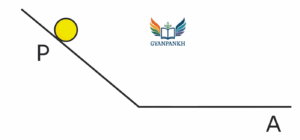
(i) before the point A
(iI) after crossing the point A
Answer: A ball released from point P rolls down an inclined plane and then moves along a horizontal surface, stopping at point A.
- (i) To stop before point A: Make the horizontal surface rougher. A rougher surface increases friction, which will oppose the ball’s motion more strongly and bring it to a stop sooner.
- (iI) To stop after crossing point A: Make the horizontal surface smoother. A smoother surface reduces friction, so the ball will travel a longer distance before friction stops it.
(Explanation:
This is a beautiful example of how energy conversion (from potential to kinetic) and frictional forces determine motion.)
Question 7
- Why do we sometimes slip on smooth surfaces like ice or polished floors? Explain.
Answer: We slip because the force of friction between our feet and the surface is very low.
(Explanation:
- Friction is the force that resists motion between two surfaces in contact.
- On rough surfaces, friction is high, so your feet grip the ground well.
- On smooth surfaces like ice or polished tiles, friction is very low—your feet can’t grip properly, so they slide instead of staying in place.)
Question 8
- Is any force being applied to an object in a non-uniform motion?
Answer: Yes, a force is definitely being applied to an object in non-uniform motion.
Explanation: An object in non-uniform motion is either changing its speed or its direction (or both). A force is required to change the speed or direction of an object. Therefore, an unbalanced force must be acting on it.
What Is Non-Uniform Motion?
Non-uniform motion means the object’s speed or direction is changing over time. This could be:
- Acceleration (speeding up)
- Deceleration (slowing down)
- Changing direction (like turning)
Why Is Force Involved?
According to Newton’s First and Second Laws of Motion:
- An object will stay in uniform motion unless acted upon by a net external force.
- A change in velocity (which includes speed or direction) means acceleration, and acceleration is caused by a net force.
So, if motion is non-uniform, some force must be acting—whether it’s:
- Friction
- Gravity
- Applied force
- Air resistance
- Or a combination of these
Question 9
- The weight of an object on the Moon becomes one-sixth of its weight on Earth. What causes this change? Does the mass of the object also become one-sixth of its mass on the Earth?
Answer: The weight of an object on the Moon becomes one-sixth of its weight on Earth because the Moon’s gravitational force is weaker. However, the mass of the object remains unchanged.
(Explantion:
- What causes the change?: The change is caused by the Moon’s gravitational force being weaker than the Earth’s. Weight is the force of gravity on an object, and since the Moon’s gravity is one-sixth of Earth’s, the weight becomes one-sixth.
- Does the mass change?: No, the mass of the object remains the same. Mass is the amount of matter in an object and does not depend on gravity
Why Does Weight Change on the Moon?
The weight of an object is the force with which a planet pulls it toward its center. This force depends on:
- The mass of the object
- The gravitational field strength of the planet
On Earth, gravity is stronger than on the Moon. In fact, the Moon’s gravitational pull is about one-sixth that of Earth’s. So:
Weight on Moon = (1/6) × Weight on Earth
This is why astronauts can jump higher and carry heavy equipment more easily on the Moon—they weigh less!
Does Mass Change Too?
No, the mass of an object remains constant regardless of location.
- Mass is the amount of matter in an object.
- It does not depend on gravity.
- Whether you’re on Earth, the Moon, or floating in space, your mass stays the same.
Summary Table
| Property | Definition | Changes on Moon? |
| Mass | Amount of matter in an object | No change |
| Weight | Force due to gravity (mass × gravity) | Becomes 1/6th |
Question 10
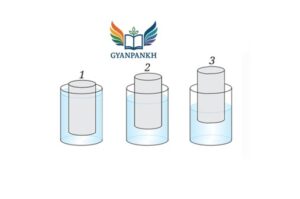
- Three objects 1, 2, and 3, of the same size and shape but made of different materials, are placed in the water. They dip to different depths as shown in the Figure. If the weights of the three objects 1, 2, and 3 are w1, w2, and w3, respectively, then
(i) w1 = w2 = w3
(iI) w1 > w2 > w3
(iII) w2 > w3 > w1
(iV) w3 > w1 > w2
Answer: (iI) w1 > w2 > w3
- Object 1 floats highest → heaviest
- Object 2 sinks deepest → medium weight
- Object 3 floats midway → lightest
(Explanation: From the figure, Object 1 has sunk the most, meaning the gravitational force (its weight) pulling it down is the greatest compared to the buoyant force pushing it up. Object 3 is floating the highest, meaning its weight is the smallest and is almost entirely balanced by the buoyant force. Therefore, Object 1 is the heaviest and Object 3 is the lightest.)
Click here for any Help, Click here for any Suggestions.