
Table of Contents
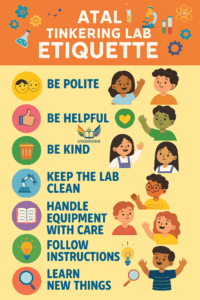
Atal Tinkering Lab Etiquette: Innovation is not born in silence—it thrives in spaces where ideas collide, tools hum, and young minds dare to experiment. The Atal Tinkering Lab (ATL) is one such space. It is more than a room filled with gadgets; it is a launchpad for creativity, a workshop for problem-solving, and a playground for future inventors. But with this freedom to explore comes an equally important responsibility: the responsibility to maintain discipline, respect, and safety. That responsibility is captured in one phrase—Atal Tinkering Lab Etiquette.
Etiquette here does not mean stiff rules that stifle creativity. Instead, it is a framework that ensures every student, mentor, and visitor can innovate boldly while tinkering responsibly. It is about balancing curiosity with caution, collaboration with independence, and experimentation with accountability. Without etiquette, the lab risks becoming chaotic; with it, the lab becomes a thriving ecosystem of ideas.
Why Atal Tinkering Lab Etiquette Matters
Every Atal Tinkering Lab Etiquette is designed to empower students with tools like robotics kits, 3D printers, coding platforms, and electronics. These resources are powerful, but they are also delicate and potentially hazardous if misused. A soldering iron can create brilliant circuits, but it can also burn fingers. A 3D printer can bring imagination to life, but it can be damaged by careless handling.
Atal Tinkering Lab Etiquette ensures that:
- Students respect the lab as a shared creative sanctuary.
- Tools are used safely and effectively.
- Projects are documented for learning and continuity.
- Collaboration flourishes without conflict.
- Safety protocols protect both people and equipment.
In short, etiquette is the invisible scaffolding that holds innovation together.
Atal Tinkering Lab Etiquette Do’s: Habits That Fuel Innovation
1. Enter With Curiosity and Respect
Walking into the lab should feel like stepping into a temple of ideas. Curiosity is welcome, but respect is mandatory. Respect for peers, mentors, tools, and time creates an atmosphere where everyone feels safe to share and experiment.
2. Handle Tools and Tech with Care
Every piece of equipment in ATL—from Arduino boards to 3D printers—represents an investment in learning. Atal Tinkering Lab Etiquette demands that students learn how to use tools before touching them. Blind experimentation may seem adventurous, but it risks damage and injury.
3. Document Your Process
Innovation is not just about the final product; it is about the journey. Keeping a logbook or digital journal ensures that ideas, failures, and breakthroughs are recorded. This habit builds resilience and helps future innovators learn from past experiments.
4. Collaborate Generously
No great invention was ever built in isolation. Collaboration is the heartbeat of ATL. Sharing knowledge, asking questions, and offering help are not optional—they are essential. When students collaborate generously, the lab transforms into a hive of collective intelligence.
5. Clean Up After You Create
A cluttered lab is a stalled lab. Wires tangled on tables, tools left scattered, or waste left behind can discourage the next innovator. Cleaning up is not just about hygiene; it is about respect for the community.
6. Report Issues Promptly
If something breaks or malfunctions, etiquette requires honesty. Reporting issues immediately prevents accidents and ensures quick repairs. Trying to fix broken tools alone is risky and often counterproductive.
Atal Tinkering Lab Etiquette Don’ts: Mistakes That Stall Creativity
1. Don’t Hoard Resources
Innovation is a shared journey. Hoarding tools or monopolizing materials limits others’ opportunities to learn. Atal Tinkering Lab Etiquette insists on fairness—rotate usage and share resources.
2. Avoid Guesswork with Equipment
Guesswork may sound like tinkering, but in reality, it is recklessness. Experimenting blindly with electronics or machinery can cause damage or injury. Responsible tinkering means informed tinkering.
3. No Food or Drinks Near Workstations
Spills near circuits or printers can ruin projects and pose hazards. Eating or drinking in the lab is not just untidy—it is unsafe.
4. Don’t Disrespect Others’ Projects
Every prototype, however small, represents effort and imagination. Tampering with someone else’s work is disrespectful and demoralizing. Etiquette demands that every idea be given space to grow.
5. Don’t Ignore Safety Gear
Skipping gloves, goggles, or masks during fabrication or soldering is not bravery—it is negligence. Safety gear is non-negotiable.
6. Don’t Leave Without Logging Out or Powering Down
Digital discipline is part of Atal Tinkering Lab Etiquette. Leaving systems running or accounts open risks data loss and hardware damage. Always shut down devices and log out properly.
Comparison Chart: ATL Do’s vs Don’ts
| Category | Do’s | Don’ts |
| Mindset & Behaviour | Be curious, respectful, and collaborative | Don’t disrupt others or dismiss their ideas |
| Tool Usage | Use tools safely and as instructed | Don’t guess or misuse equipment |
| Workspace Etiquette | Keep area clean, return tools, organize materials | Don’t leave clutter or spill food/drinks |
| Project Integrity | Document your process, respect others’ work | Don’t tamper with or copy others’ projects |
| Safety Protocols | Wear protective gear, report issues immediately | Don’t ignore safety rules or fix broken tools |
| Digital Discipline | Log out, shut down devices, save work properly | Don’t leave systems running or accounts open |
The Spirit Behind the Rules
Rules alone do not create innovation; the spirit behind them does. Atal Tinkering Lab Etiquette is not about restricting creativity—it is about channelling it. When students follow these do’s and avoid this don’ts, they create a culture of responsibility. That culture ensures that ATL remains a safe, inspiring, and collaborative environment for years to come.
Think of etiquette as the invisible code of conduct that protects the lab’s soul. It is what allows a student to solder a circuit without fear, to code without interruption, and to brainstorm without judgment. It is what transforms ATL from a room of machines into a community of innovators.
Building a Culture of Innovation
Etiquette is not taught once; it is practiced daily. Teachers, mentors, and senior students play a crucial role in modelling these habits. Posters on the wall, reminders during sessions, and peer accountability all reinforce the message.
A lab where etiquette is ignored quickly becomes dysfunctional—tools break, projects stall, and conflicts arise. But a lab where etiquette is embraced becomes unstoppable. Students not only build prototypes; they build confidence, resilience, and teamwork.
Conclusion: Innovate Boldly, Tinker Responsibly
The Atal Tinkering Lab is a gift—a space where imagination meets engineering, where ideas meet execution. But this gift comes with responsibility. Atal Tinkering Lab Etiquette is the compass that guides students through this responsibility. It ensures that every innovator can explore freely while keeping the lab safe, respectful, and collaborative.
So the next time you step into ATL, remember: innovation is bold, but tinkering must be responsible. Respect the lab, respect your peers, respect the process. Because when etiquette and innovation walk hand in hand, the future is not just imagined—it is engineered.
Click here for any Help, Click here for any Suggestions.