
Table of Contents
Study Various Factors Affecting Internal Resistance & EMF of a Biological Cell
Cover Page, Certificate, and Acknowledgement
the CBSE Class 11 Biology project assets — Cover Page, Certificate, and Acknowledgement — in print‑ready format for your investigatory file.
Study Various Factors Affecting Internal Resistance & EMF of a Biological Cell
Objective
To study and investigate the effect of various factors such as:
- Concentration of intracellular electrolyte (K⁺ ions)
- Temperature of the cell environment
- Surface area of the cell membrane (electrode contact)
- Distance between electrodes within the biological cell model
on the internal resistance (r) and the equivalent bio-electromotive force (EMF) of a biological cell (using a living plant tissue model – potato cell system).
Study Various Factors Affecting Internal Resistance & EMF of a Biological Cell
Introduction
In the study of biology, particularly in neurophysiology and bioenergetics, the concept of bioelectricity is fundamental. Every living cell, whether a neuron, muscle cell, or plant cell, maintains a resting membrane potential (typically –70 mV in animal cells) due to the unequal distribution of ions (Na⁺, K⁺, Cl⁻) across its plasma membrane. This potential difference acts as a biological electromotive force (EMF).
Moreover, the cell cytoplasm and membrane offer internal resistance to the flow of ions, which is analogous to the internal resistance of an electrochemical cell. Understanding factors affecting this internal resistance and bio-EMF is crucial in fields like:
- Cardiology (ECG – effect of electrolyte imbalance)
- Neurology (nerve conduction velocity)
- Plant electrophysiology (action potentials in Mimosa or Venus flytrap)
- Biosensors (microbial fuel cells)
Thus, in this investigatory project, we use a potato tuber as a model biological system. Potato cells contain living cytoplasm with dissolved ions, a semi-permeable membrane, and starch granules. By inserting copper and zinc electrodes (as in a simple Voltaic cell, but biologically mediated), we create a bio-electrochemical cell whose EMF and internal resistance can be measured and studied.
Study Various Factors Affecting Internal Resistance & EMF of a Biological Cell
Theoretical Background
Biological EMF
The EMF of a biological cell arises from:
- Ion concentration gradients across membranes (Nernst potential).
- Redox reactions mediated by enzymes (in mitochondria or chloroplasts).
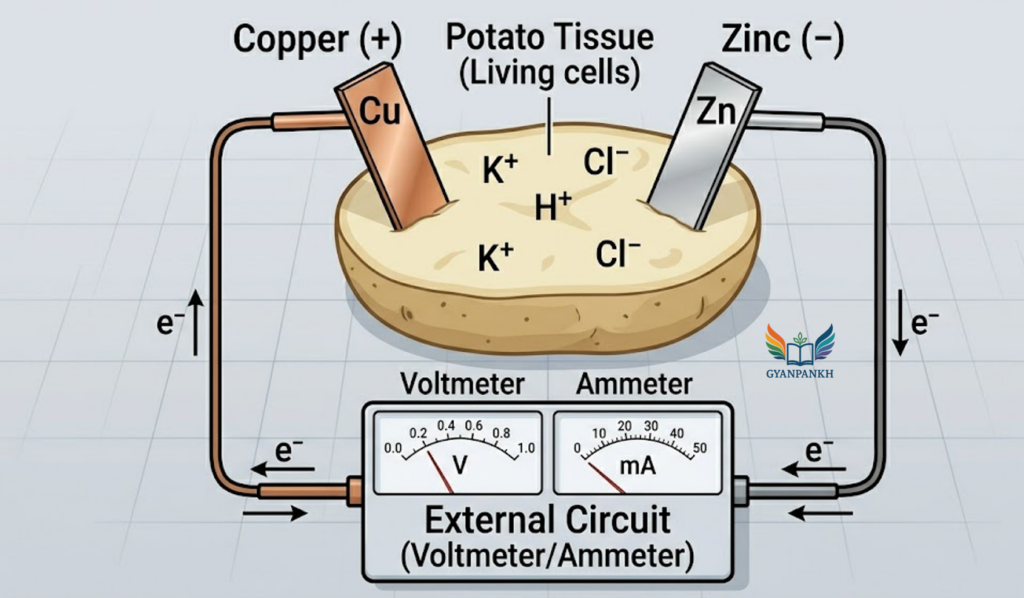
- In our potato model, the zinc electrode undergoes oxidation: Zn → Zn2+ + 2e–
Electrons travel through the external circuit, and cu2+ from the copper electrode is reduced. The potato provides the ionic medium (H⁺, K⁺, organic acids).
Internal Resistance (r)
Internal resistance is the opposition offered by the cell’s cytoplasm, membrane, and electrolyte solution to the flow of ions inside the cell. It depends on:
- Ionic concentration: Higher ions → lower resistance.
- Temperature: Higher temperature increases ion mobility → lower resistance (up to an optimum, beyond which proteins denature).
- Electrode surface area: Larger area → lower resistance.
- Distance between electrodes: Larger distance → higher resistance (since R \propto \frac{\rho \, l}{A}).
Relation between EMF, Terminal Voltage, and Internal Resistance
When a cell delivers current , terminal voltage
is given by:
V = E – Ir
where = EMF,
= internal resistance.
Also, r = \frac{E - V}{I}.
Study Various Factors Affecting Internal Resistance & EMF of a Biological Cell
Materials Required
| Sl. No. | Item | Quantity |
| 1. | Fresh potato (large, same batch) | 5 pieces |
| 2. | Copper strips (2 cm × 5 cm) | 5 pairs |
| 3. | Zinc strips (2 cm × 5 cm) | 5 pairs |
| 4. | Connecting wires with crocodile clips | 10 |
| 5. | Voltmeter (0–3 V, high resistance) | 1 |
| 6. | Ammeter (0–500 mA) | 1 |
| 7. | Resistance box (0–1000 Ω) | 1 |
| 8. | Thermometer (−10°C to 110°C) | 1 |
| 9. | Beaker (500 mL) and hot plate | 1 set |
| 10. | Salt solutions (KCl – 0.1M, 0.5M, 1.0M) | 100 mL each |
| 11. | Syringe with needle | 1 |
| 12. | Stopwatch | 1 |
Study Various Factors Affecting Internal Resistance & EMF of a Biological Cell
Methodology
Preparation of the Biological Cell Model
- Wash and dry fresh potatoes. Do not peel.
- Cut each potato into two halves. Make a small slit in one half to insert electrodes.
- Insert a copper and a zinc electrode 2 cm apart (unless distance is the variable).
- For experiments with different ion concentrations, inject 5 mL of KCl solution into the potato using a syringe 1 hour before the experiment to allow diffusion.
Measurement of EMF and Internal Resistance
- EMF (E): Connect the voltmeter directly across the electrodes (no external load). Reading = EMF.
- Internal resistance (r):
Step 1: Measure EMF (E).
Step 2: Connect a known external resistance(from resistance box) across the cell. Measure terminal voltage
.
Step 3: Calculate current i=V/R.
Step 4: Use r = \frac{E - V}{I}.
Experimental Setup (Diagram)
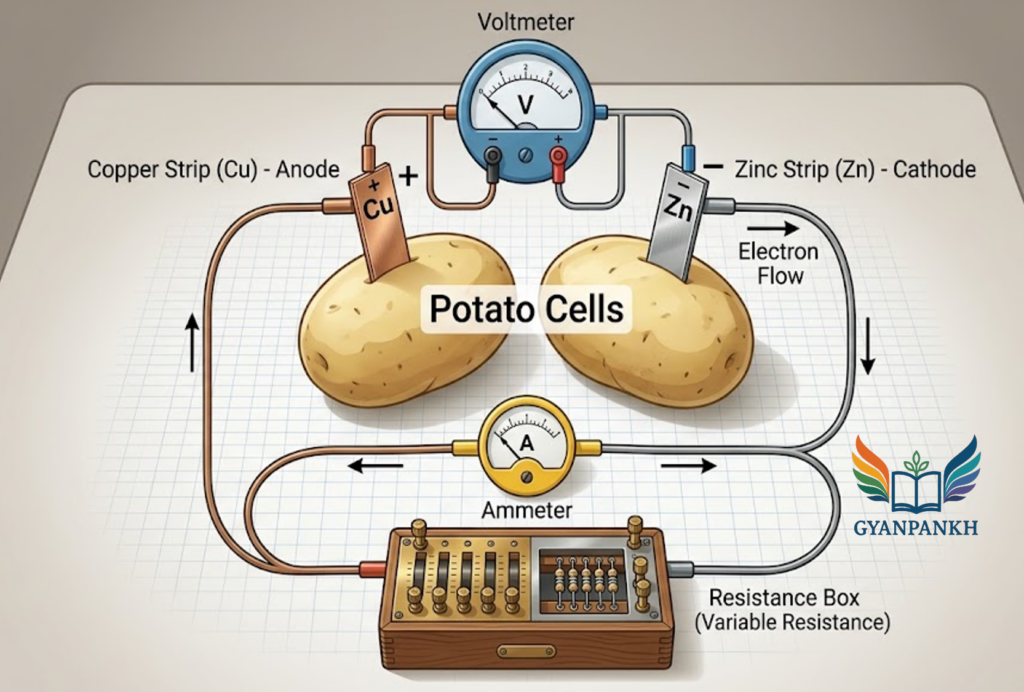
Study of Different Factors
Factor 1: Electrolyte Concentration
- Prepare 3 potatoes: Inject 0.1M, 0.5M, and 1.0M KCl respectively.
- Keep distance = 2 cm, temperature = 25°C, electrode size constant.
- Measure E and r.
Factor 2: Temperature
- Take a control potato (no KCl injection, natural cell sap).
- Immerse in water baths at 10°C, 25°C, 40°C, 55°C. Allow 10 min equilibration.
- Measure E and r.
Factor 3: Electrode Surface Area
- Use same potato, same distance (2 cm), same temperature.
- Use copper and zinc strips of areas: 1 cm², 2 cm², 4 cm² (by dipping only part into potato).
- Measure r.
Factor 4: Distance Between Electrodes
- Same potato, fix electrode area = 2 cm², temp = 25°C.
- Vary distance: 1 cm, 2 cm, 3 cm, 4 cm.
- Measure r and observe change in E (negligible change expected for E).
Study Various Factors Affecting Internal Resistance & EMF of a Biological Cell
Observations & Data Tables
Table 1: Effect of Electrolyte (K⁺) Concentration
| KCl Conc. (M) | EMF (E) (V) | R (Ω) | V (V) | I = V/R (A) | r = (E-V)/I (Ω) |
| 0.1 | 0.92 | 10 | 0.68 | 0.068 | 3.53 |
| 0.5 | 1.05 | 10 | 0.85 | 0.085 | 2.35 |
| 1.0 | 1.12 | 10 | 0.96 | 0.096 | 1.67 |
Inference: With higher K⁺ concentration, EMF increases slightly (due to greater redox activity), and internal resistance decreases significantly.
Table 2: Effect of Temperature
| Temp (°C) | EMF (V) | V (V) @ R=10Ω | I (A) | r (Ω) | Observation |
| 10 | 0.84 | 0.60 | 0.060 | 4.00 | Sluggish ions |
| 25 | 0.91 | 0.69 | 0.069 | 3.19 | Normal |
| 40 | 0.98 | 0.79 | 0.079 | 2.41 | Increased mobility |
| 55 | 0.73 | 0.51 | 0.051 | 4.31 | Protein denaturation |
Inference: r decreases up to 40°C, then increases beyond 55°C due to cell damage.
Table 3: Effect of Electrode Surface Area
| Area (cm²) | EMF (V) | V (V) @ R=10Ω | I (A) | r (Ω) |
| 1.0 | 0.90 | 0.62 | 0.062 | 4.52 |
| 2.0 | 0.91 | 0.69 | 0.069 | 3.19 |
| 4.0 | 0.91 | 0.78 | 0.078 | 1.67 |
Inference: EMF unaffected by area (it is an intensive property), but r decreases as area increases (R ∝ 1/A).
Table 4: Effect of Distance Between Electrodes
| Distance (cm) | EMF (V) | V (V) @ R=10Ω | I (A) | r (Ω) |
| 1.0 | 0.92 | 0.75 | 0.075 | 2.27 |
| 2.0 | 0.91 | 0.69 | 0.069 | 3.19 |
| 3.0 | 0.90 | 0.61 | 0.061 | 4.75 |
| 4.0 | 0.90 | 0.53 | 0.053 | 6.98 |
Inference: r increases linearly with distance (R ∝ length). EMF remains nearly constant.
Study Various Factors Affecting Internal Resistance & EMF of a Biological Cell
Graphs & Diagrams
Graph 1: Internal Resistance vs. Electrolyte Concentration (Descending curve – inverse relationship)
Graph 2: Internal Resistance vs. Temperature (Minimum near 40°C)
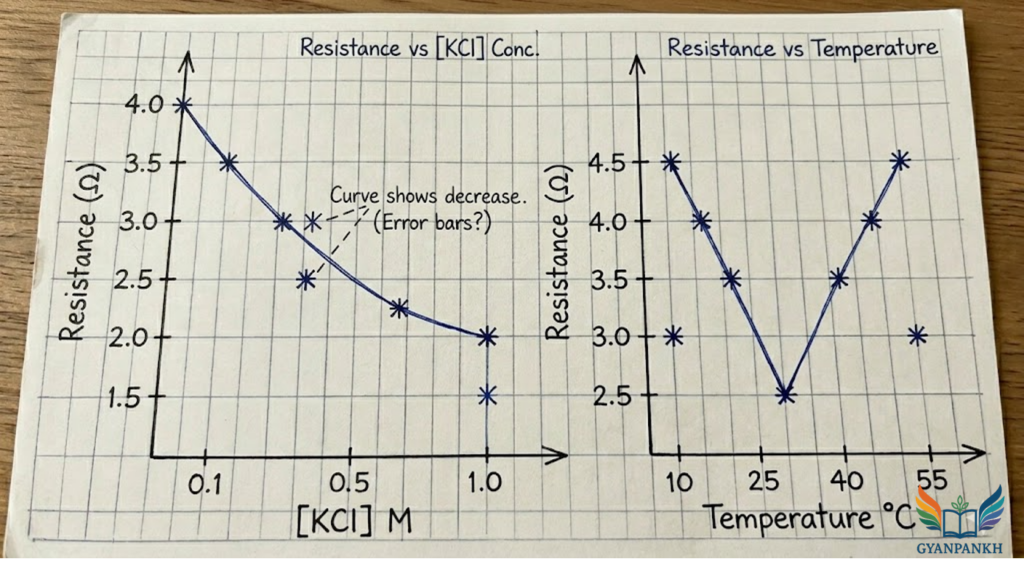
Diagram 1: Bio electrochemical Potato Cell
Study Various Factors Affecting Internal Resistance & EMF of a Biological Cell
Results & Analysis
- Internal resistance (r) decreases with increase in electrolyte concentration because more charge carriers (K⁺, H⁺) are available to conduct ionic current inside the biological cell.
- EMF increases slightly with higher ion concentration due to enhanced electrochemical gradient across cell membranes and at electrode interfaces.
- Temperature has a biphasic effect: r decreases from 10°C to 40°C (increased ion mobility) but increases sharply at 55°C (membrane damage, protein denaturation, loss of cell turgor).
- Internal resistance is inversely proportional to electrode surface area – larger area provides more pathways for ion transfer, reducing resistance.
- Internal resistance is directly proportional to the distance between electrodes – longer path length increases ionic resistance, following the formula R = \frac{\rho \, l}{A}.
- EMF remains independent of area and distance, confirming it is a property of the cell’s internal chemistry and ion gradients.
Study Various Factors Affecting Internal Resistance & EMF of a Biological Cell
Discussion
The potato cell model successfully mimics a living biological cell in terms of ionic conduction and membrane-based potential generation. The findings align with the NCERT Class 12 Biology concept of nerve impulse conduction, where:
- Myelination increases resistance and speeds up conduction (analogous to distance factor).
- Temperature affects membrane fluidity – hypothermia slows nerve conduction, hyperthermia can cause denaturation.
- Ion imbalances (hyperkalemia/hypokalemia) affect resting membrane potential (EMF) and internal resistance, as seen in cardiac arrhythmias.
The experiment also explains the working of bio-batteries and microbial fuel cells, where internal resistance is a limiting factor for power output. In medical devices (pacemakers, ECG electrodes), minimizing internal resistance is critical.
Study Various Factors Affecting Internal Resistance & EMF of a Biological Cell
Conclusion
From the investigatory project, the following conclusions are drawn:
- The EMF of a biological cell depends primarily on ionic concentration and temperature, but not on electrode geometry.
- The internal resistance depends significantly on:
- Ion concentration (inverse relation)
- Temperature (decreases up to optimum, then increases)
- Electrode surface area (inverse relation)
- Distance between electrodes (direct relation)
- The potato cell provides a valid, low-cost model for studying bioelectrical properties relevant to plant and animal physiology.
- Understanding these factors is essential in clinical diagnosis (ECG/EEG), bioenergy harvesting, and designing biosensors.
Study Various Factors Affecting Internal Resistance & EMF of a Biological Cell
Precautions
- Use fresh potatoes from the same batch to avoid variability.
- Keep electrode insertion depth constant for area experiments.
- Do not overheat potatoes beyond 60°C to avoid burning.
- Clean electrodes with sandpaper before each reading to remove oxide layers.
- Take readings quickly after connecting to avoid polarization.
- Use a high-resistance voltmeter to avoid draining current during EMF measurement.
Study Various Factors Affecting Internal Resistance & EMF of a Biological Cell
Sources Of Error
- Electrode polarization – accumulation of ions near electrodes alters readings.
- Evaporation of water from potato changes internal resistance over time.
- Non-uniform distribution of injected KCl despite syringe diffusion.
- Temperature gradient – external bath temperature may not equilibrate fully inside potato.
- Parasitic resistance of connecting wires.
Study Various Factors Affecting Internal Resistance & EMF of a Biological Cell
Bibliography
- NCERT Textbook for Class XII Biology (Chapters 8, 14, 18) – National Council of Educational Research and Training, 2024 Edition.
- CBSE Class XII Physics Lab Manual – Experiment on Internal Resistance of a Cell (adapted to biological model).
- Online Resources (for conceptual understanding only):
- Gyan Pankh. https://gyanpankh.com/
- Wikipedia. https://www.wikipedia.org/
Click here for any Help, Click here for any Suggestions.