
Chemistry Lab Safety: Do’s, Don’ts, and Why They Matter
Walking into a chemistry lab is like stepping into a world of possibilities—where reactions spark curiosity, colours shift with a single drop of reagent, and experiments unlock the secrets of matter. Yet behind every bubbling beaker and glowing flame lies a simple truth: Chemistry Lab Safety is science’s silent partner. Without it, discovery collapses into disaster.
Whether you’re a student mixing your first solution or a seasoned educator guiding young minds, Chemistry Lab Safety isn’t just a checklist—it’s a mindset. It’s the invisible discipline that ensures the lab remains a place of wonder rather than worry. Let’s explore the essential dos and don’ts, and more importantly, why they matter.
The Do’s: Habits That Protect and Empower
1. Dress for the Lab, Not the Lounge
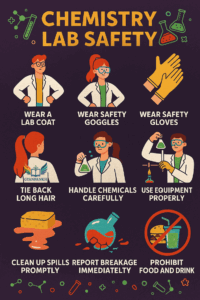
Clothing in the lab is not about style—it’s about shielding yourself from hazards. A lab coat, safety goggles, and closed shoes form the holy trinity of protection. They guard against chemical splashes, broken glass, and accidental spills. Loose sleeves, dangling scarves, or open sandals may look casual, but they invite trouble. Imagine a sleeve brushing against a flame or a sandal exposed to a spill of concentrated acid—the consequences are immediate and severe. Dressing correctly is the simplest yet most powerful act of Chemistry Lab Safety.
2. Know Before You Flow
Preparation is the antidote to panic. Reading the experiment thoroughly before starting ensures you understand the chemicals, the procedure, and the risks. A prepared mind is a safe mind. For example, knowing that hydrochloric acid reacts violently with bases prevents careless mixing. Understanding that ethanol is flammable keeps you cautious around open flames. Safety begins not at the bench, but in the mind. This principle is at the heart of Chemistry Lab Safety.
3. Label Everything
Unmarked containers are accidents waiting to happen. A clear label with the chemical’s name, concentration, and hazard symbols transforms confusion into clarity. Imagine mistaking concentrated sulfuric acid for distilled water—one careless assumption could lead to burns or ruined experiments. Labels are not bureaucracy; they are lifesavers. In fact, proper labelling is one of the most overlooked aspects of Chemistry Lab Safety, yet it prevents countless accidents.
4. Clean as You Go
A cluttered bench is a breeding ground for chaos. Wiping spills immediately, returning unused reagents, and keeping tools organized prevents accidents and saves time. A tidy workspace is not just about aesthetics—it’s about efficiency and safety. Many accidents occur not during experiments but during cleanup, when forgotten spills or misplaced glassware catch someone off guard. Cleanliness is a cornerstone of Chemistry Lab Safety.
5. Ask, Report, Repeat
Silence is never safe in a lab. If something feels off—ask. If something spills—report. If something breaks—repeat the protocol. Communication is the backbone of safety. A student who hides a broken thermometer risks mercury exposure for the entire class. A researcher who ignores a spill risks contamination. Speaking up is not weakness—it’s responsibility. This culture of openness is what makes Chemistry Lab Safety effective.
The Don’ts: Mistakes That Can Cost More Than Grades
1. No Food, No Fun
Eating or drinking in the lab is a strict no. Chemicals don’t care if it’s lunchtime—they can contaminate anything. A sandwich placed near a beaker of copper sulphate could absorb toxic residues. A water bottle left open could be mistaken for a reagent. The lab is a place for science, not snacks. This rule is one of the most basic pillars of Chemistry Lab Safety.
2. Don’t Wing It
Improvisation belongs in art class, not in a lab with volatile substances. Mixing chemicals without instructions is reckless. For instance, combining bleach with ammonia produces toxic chloramine gas—a mistake that can send students to the hospital. Following procedures is not about limiting creativity; it’s about channelling curiosity safely. Improvisation without knowledge undermines Chemistry Lab Safety.
3. Avoid Distractions
Horseplay, loud music, or mobile phones can turn a simple task into a serious hazard. A distracted student might knock over a beaker of acid or forget to turn off a burner. The lab demands focus. Fun has its place, but in the lab, discipline is the difference between discovery and disaster. Staying focused is a non‑negotiable part of Chemistry Lab Safety.
4. Don’t Leave Flames Unattended
Fire spreads faster than curiosity. Bunsen burners and alcohol lamps should never be left burning without supervision. A moment’s neglect can ignite papers, clothing, or chemicals nearby. Flames demand respect—never assume they will behave politely in your absence. Fire prevention is central to Chemistry Lab Safety.
5. Never Assume
Just because a liquid looks like water doesn’t mean it’s harmless. Clear solutions can be acids, bases, or toxic solvents. Treat every substance with respect and caution. Assumptions in the lab are shortcuts to accidents. Respecting every chemical is a golden rule of Chemistry Lab Safety.
Comparison Chart: Chemistry Lab Do’s vs Don’ts
| Category | Do’s | Don’ts |
| Attire | Wear lab coat, goggles, closed shoes | Avoid loose clothing, open footwear |
| Preparation | Read instructions, understand risks | Don’t start without knowing the procedure |
| Chemical Handling | Label containers, use pipettes properly | Don’t mix chemicals randomly or use mouth pipetting |
| Workspace Hygiene | Clean spills, organize tools | Don’t leave clutter or dirty glassware |
| Behaviour | Stay focused, report issues immediately | No horseplay, distractions, or ignoring accidents |
| Equipment Use | Turn off burners when done, handle glassware carefully | Don’t leave flames unattended or use damaged equipment |
| Personal Safety | Wash hands after experiments, avoid touching face | Don’t eat, drink, or apply cosmetics in the lab |
This chart is more than a quick reference—it’s a snapshot of Chemistry Lab Safety in action.
Why These Rules Matter
Rules in the lab are not arbitrary—they are written in the ink of past accidents. Every “do” and “don’t” reflect lessons learned from mistakes.
- Attire saves skin and eyes. A splash of sodium hydroxide on bear arms can cause burns. Goggles prevent blindness from flying shards of glass.
- Preparation prevents panic. Knowing the hazards of chemicals avoids dangerous improvisation.
- Labels prevent confusion. A mislabelled bottle can lead to catastrophic reactions.
- Cleanliness prevents chaos. A tidy bench reduces accidents and improves efficiency.
- Communication prevents silence from becoming danger. Reporting issues ensures collective safety.
On the flip side:
- Food invites contamination.
- Improvisation invites explosions.
- Distractions invite accidents.
- Unattended flames invite fires.
- Assumptions invite misjudgements.
Each of these lessons reinforces the importance of Chemistry Lab Safety.
The Bigger Picture: Safety as a Mindset
Chemistry Lab Safety extends beyond the walls of classrooms. It teaches responsibility, discipline, and respect for processes—skills that apply to life itself. A student who learns to label chemicals will later learn to organize tasks. A researcher who cleans as they go will later manage projects efficiently. Safety habits in the lab are seeds of professionalism in the workplace.
Moreover, safety fosters community. When everyone follows protocols, trust grows. Students feel secure, teachers feel confident, and the lab becomes a space of collaboration. Chemistry Lab Safety is not just about protecting individuals—it’s about protecting the collective spirit of discovery.
Conclusion: Discovery Without Disaster
Chemistry is the science of transformation—turning elements into compounds, ideas into innovations. But transformation requires caution. The lab is a place of wonder, but only when Chemistry Lab Safety stands guard.
Dos empower us: dress correctly, prepare thoroughly, label diligently, clean consistently, and communicate openly. Don’ts protects us: avoid food, improvisation, distractions, unattended flames, and careless assumptions.
Together, these habits ensure that the lab remains what it was meant to be—a sanctuary of curiosity, not a stage for accidents. Chemistry Lab Safety is not the enemy of discovery; it is its silent partner. When respected, it allows science to flourish freely, responsibly, and joyfully.
Click here for any Help, Click here for any Suggestions.