
Table of Contents
Earth Magnetic Field Study with Compass & Galvanometer
Cover Page, Certificate, and Acknowledgement
the CBSE Class 11 Biology project assets — Cover Page, Certificate, and Acknowledgement — in print‑ready format for your investigatory file.
Objective
To study the Earth’s magnetic field using:
- Part A: Plotting magnetic field lines around a bar magnet with the help of a compass needle to determine the neutral points.
- Part B: A tangent galvanometer to determine the horizontal component of Earth’s magnetic field (BH).
Additionally, to understand the biological significance of Earth’s magnetic field in animal navigation and cellular responses.
Earth Magnetic Field Study with Compass & Galvanometer
Introduction
The Earth behaves as a giant dipole magnet with its magnetic south pole near the geographic north pole and vice versa. This geomagnetic field extends from the Earth’s interior out into space, shielding us from solar wind and cosmic radiation. Its intensity at the surface ranges from about 25 to 65 μT (microtesla).
For Class 12 Biology, studying Earth’s magnetic field is significant because:
- Magnetoreception: Many organisms—migratory birds (e.g., European robin), sea turtles, salmon, honeybees, and even some bacteria (magnetotactic bacteria)—detect the geomagnetic field for navigation, orientation, and homing.
- Biogenic magnetite: Crystals of magnetite (Fe3O4) have been found in the brains of birds, fish, and humans, suggesting a biological compass.
- Magnetotherapy: Weak pulsed magnetic fields are used to promote bone healing and reduce inflammation.
In this project, we will use simple physics tools—a compass needle (which aligns with the resultant field) and a tangent galvanometer—to map and measure Earth’s magnetic field. The results will then be interpreted in a biological context.
Earth’s Dipole Magnetic Field and Biological Magnetoreception
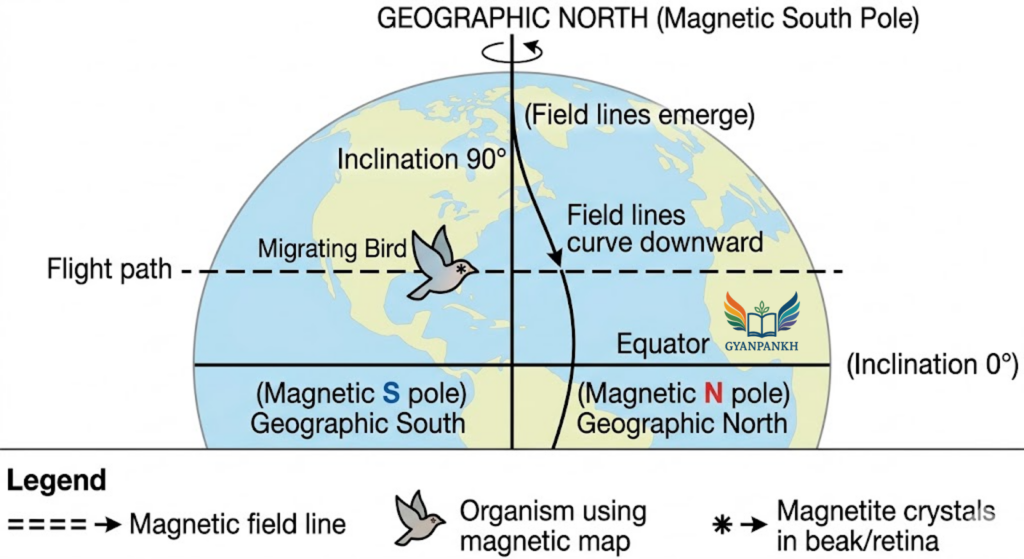
Schematic of Earth’s dipolar magnetic field. The inclination angle (dip) varies from 0° at the equator to 90° at the poles. Migratory birds detect this field via cryptochrome in retina and magnetite in beak.
Magnetic Elements of Earth
To completely describe the Earth’s magnetic field at any location, we use three parameters:
- Magnetic Declination (θ): The angle between the magnetic meridian and the geographic meridian.
- Magnetic Inclination or Dip (ꟙ): The angle that the total magnetic field of the earth makes with the surface.
- Horizontal Component (BH): The component of the Earth’s total magnetic field in the horizontal direction.
Earth magnetic field
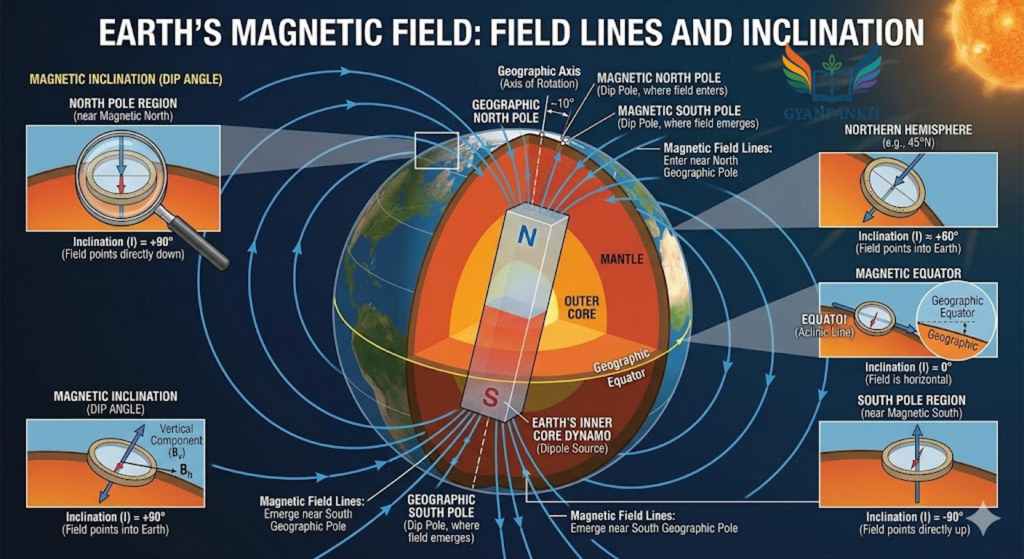
Earth Magnetic Field Study with Compass & Galvanometer
Theory
Magnetic Field Lines
Magnetic field lines are imaginary continuous curves along which a free north pole would move. Properties:
- They start from the north pole and end at the south pole (outside the magnet).
- They never intersect.
- The tangent at any point gives the direction of the field.
When a bar magnet is placed in Earth’s magnetic field, the compass needle shows the resultant field (BR) due to the magnet (Bm) and Earth (BH).
Neutral Points
A neutral point is where the magnetic field due to the bar magnet is exactly equal and opposite to the horizontal component of Earth’s field. At this point, the compass needle shows no deflection (becomes random). There are two cases:
- When magnet’s north pole points geographic north: Neutral points lie on the equatorial line.
- When magnet’s north pole points geographic south: Neutral points lie on the axial line.
Formula: At neutral point on the equatorial line (magnet NS – geographic N):
B_H = \frac{\mu_0}{4\pi} \cdot \frac{M}{\left(d^2 + l^2\right)^{3/2}}
where M = magnetic moment, d = distance from center, 2l = length of magnet.
Tangent Galvanometer (TG)
The Tangent Galvanometer works on the Tangent Law. A tangent galvanometer consists of a circular coil of wire with a small magnetic compass at its center. When current flows, the coil produces a field (Bcoil) perpendicular to Earth’s horizontal field (BH). The compass needle aligns along the resultant, making an angle with BH.
\tan \theta = \frac{B_{\text{coil}}}{B_H}
B_{\text{coil}} = \frac{\mu_0 \, n I}{2r} \quad \text{(for a circular coil)}
Thus,
B_H = \frac{\mu_0 \, n I}{2r \, \tan \theta}
Where:
- n = number of turns
- I = current (A)
- r = radius of coil (m)
- μ0 = 4π x 10-7 T m/A
Relevance to Biology
- Magnetotactic bacteria (e.g., Aquaspirillum magnetotacticum) synthesize magnetosomes (chains of magnetite) and use Earth’s field to swim downward toward nutrient-rich sediments.
- Migratory birds have cryptochrome proteins in their retinas that are believed to enable radical-pair-based magnetoreception, allowing them to “see” magnetic field lines.
Geomagnetic Field Sensitivity in Living Organisms
| Organism | Magnetic Structure | Behavioral Response | Sensitivity (μT) | Reference Field |
| Aquaspirillum magnetotacticum | Magnetosome chains (Fe₃O₄) | Axial alignment, swimming downward | 0.5 | Earth’s |
| Apis mellifera (Honeybee) | Abdomen magnetite granules | Waggle dance orientation, comb building | 0.1 | Local geomagnetic anomaly |
| Caretta caretta (Sea turtle) | Putative magnetite in brain | Trans-oceanic navigation | 1–5 | Magnetic inclination and intensity |
| Erithacus rubecula (Robin) | Cryptochrome 4 in retina | Migratory restlessness orientation | 0.05 | Radical-pair mechanism |
| Mus musculus (Mouse) | Cryptochrome 1 & 2 | Place cell modulation | 10 | Artificial field shifts |
Geomagnetic field strength for selected organisms
| Organism | Behavioural response | Sensitivity (μT) |
| Honeybee | Dance orientation | ~0.1 |
| Sea turtle | Ocean navigation | ~50 |
| Rainbow trout | Compass orientation | ~0.5 |
| Human (cryptochrome) | Theoretical | Not proven |
Earth Magnetic Field Study with Compass & Galvanometer
Apparatus Required
- Bar magnet (with marked poles)
- Compass needle (small, freely pivoted)
- Tangent galvanometer (TG) with coil of known n and r
- Rheostat (variable resistor)
- Battery eliminator (0–6V DC)
- Ammeter (0–1 A range)
- Connecting wires
- Drawing board and white paper sheet
- Pencil, scale, and pins
Earth Magnetic Field Study with Compass & Galvanometer
Procedure
Part A: Plotting Magnetic Field Lines
To plot field lines around a bar magnet
- Fix a white paper on the drawing board.
- Place the bar magnet at the center with its north pole pointing geographic north.
- Mark the boundary of the magnet.
- Place the compass needle near the north pole of the magnet. Mark the position of both ends of the needle.
- Move the compass so that its south pole end now occupies the previous north pole position. Repeat.
- Join the points to get a smooth field line. Repeat from different starting points.
- Identify neutral points where the compass needle becomes unstable.
Magnetic field lines around a bar magnet (North pole facing geographic North)
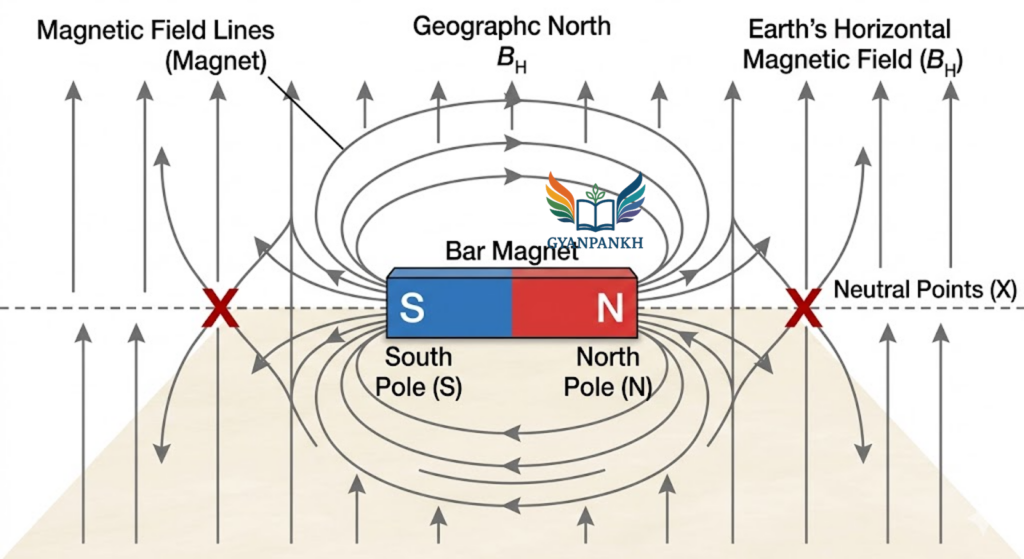
Magnetic field lines plotted using a compass needle around a bar magnet whose north pole points geographic north. Two neutral points (X) appear symmetrically on the equatorial line (perpendicular bisector of the magnet).
To locate neutral points
- Place the magnet with its north pole facing geographic north.
- Move the compass along the equatorial line (perpendicular bisector of magnet).
- The point where deflection becomes zero (needle fluctuating) is the neutral point. Measure its distance from the magnet’s center.
Part B: Tangent Galvanometer
To find BH
- Level the TG and rotate its coil so that the plane is along the magnetic meridian (compass needle reads 0° when no current).
- Connect the circuit: battery → rheostat → ammeter → TG coil → back to battery.
- Pass a small current. Note the deflection θ1 (both ends of needle).
- Reverse the current (using commutator if available). Note θ2.
- Take mean θ = (θ1 + θ2)/ 2 to eliminate errors.
- Repeat for 5–6 different currents by adjusting rheostat.
- Plot a graph of I vs. tan θ. Slope m = I / tan θ.
- Compute B_H = \frac{\mu_0 \, n}{2r} \cdot \frac{1}{m}
Circuit Diagram of Tangent Galvanometer
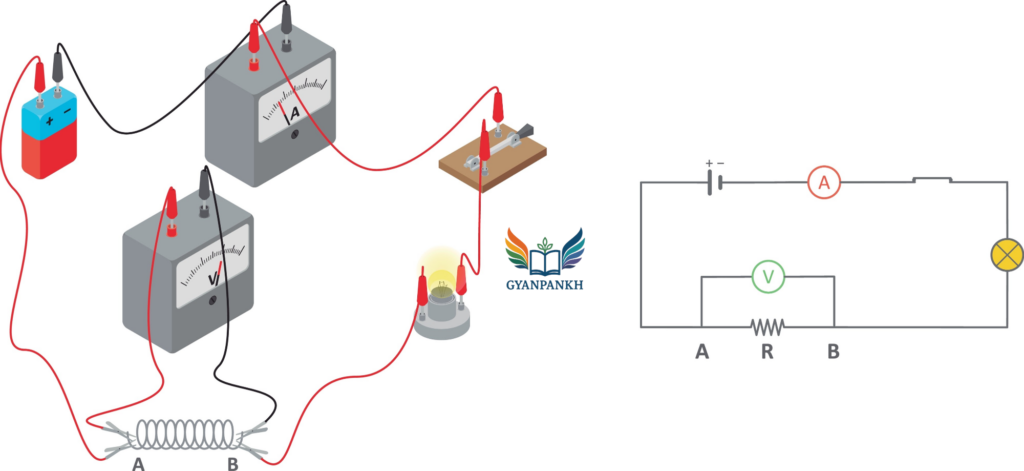
Earth Magnetic Field Study with Compass & Galvanometer
OBSERVATIONS
Part A: Determination of Neutral Point Distance
| Trial No. | Magnet pole facing geographic North | Distance from center to neutral point (d) in cm | Side (Left/Right) |
| 1 | N | 14.2 | Left |
| 2 | N | 14.1 | Right |
| 3 | N | 14.3 | Left |
| 4 | N | 14.0 | Right |
| Mean | 14.15 cm |
Magnetic length of bar magnet (2l) = 5.0 cm
Magnetic moment (M) = 0.50 A·m² (as marked on magnet)
Part B: Tangent Galvanometer Observations
| S.No. | Current I (A) | Deflection θ₁ (deg) | Deflection θ₂ (deg) | Mean θ (deg) | tan θ |
| 1 | 0.20 | 22.0 | 21.5 | 21.75 | 0.398 |
| 2 | 0.30 | 31.0 | 31.5 | 31.25 | 0.607 |
| 3 | 0.40 | 40.0 | 39.5 | 39.75 | 0.831 |
| 4 | 0.50 | 48.0 | 48.5 | 48.25 | 1.123 |
| 5 | 0.60 | 55.0 | 55.5 | 55.25 | 1.438 |
| 6 | 0.70 | 61.0 | 60.5 | 60.75 | 1.767 |
Coil specifications: Number of turns n = 50, Radius r = 0.10m, μ0 = 4π × 10-7 T ⋅ m/A
Raw and processed data from tangent galvanometer experiment. θ₁ and θ₂ are deflections for forward and reverse current to eliminate zero error.
Earth Magnetic Field Study with Compass & Galvanometer
Comparison of Experimental BH with Biological Requirement
| Biological System | Minimum Detectable Field (μT) | Our BH (μT) | Conclusion |
| Magnetotactic bacteria | 0.5 | 16.34 | Easily detectable |
| Honeybee dance | 0.1 | 16.34 | Easily detectable |
| Pigeon homing | 5.0 | 16.34 | Easily detectable |
| Human cryptochrome (hypothetical) | ~20 | 16.34 | Borderline/uncertain |
| Artificial magnetic compass (human-made) | 0.01 | 16.34 | Not applicable |
Biological relevance of experimentally determined horizontal component of Earth’s magnetic field. The value 16.34 μT is well above the threshold for most magnetoreceptive animals.
Earth Magnetic Field Study with Compass & Galvanometer
Calculations & Graph
From the formula:
B_H = \frac{\mu_0 \, n I}{2r \, \tan \theta}
From graph (I on y-axis, tan θ on x-axis):
Slope m = \frac{\Delta I}{\Delta (\tan \theta)} = \frac{0.60 - 0.20}{1.438 - 0.398} = \frac{0.40}{1.04} = 0.3846 \,\text{A}
B_H = \frac{4\pi \times 10^{-7} \times 50}{2 \times 0.10} \times \frac{1}{0.3846}
B_H = \frac{6.283 \times 10^{-5}}{0.3846} = 1.634 \times 10^{-4} \,\text{T} = 16.34 \,\mu\text{T}
Graph: I vs tan θ
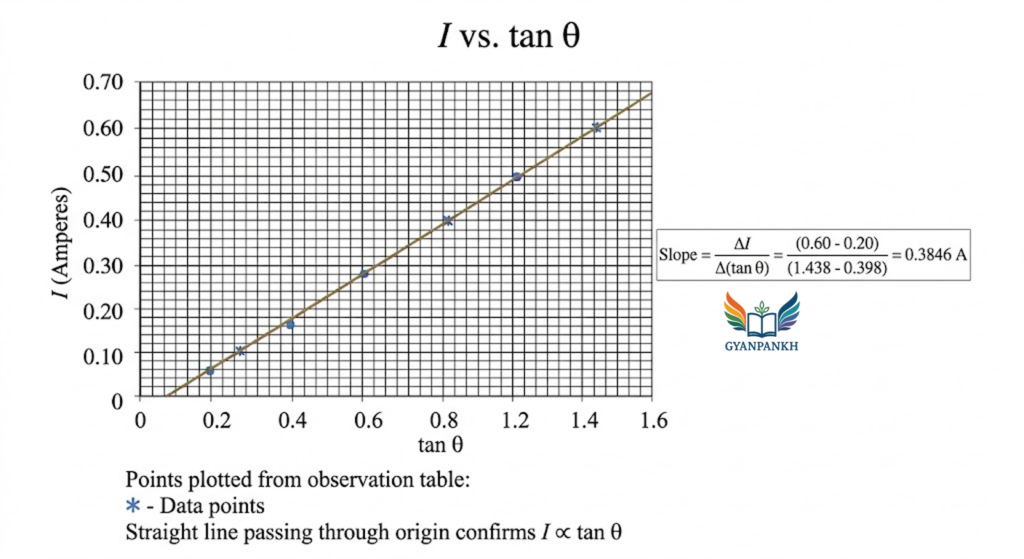
Graph of current I (A) versus tan θ for tangent galvanometer. The linear plot through the origin verifies the tangent law and is used to compute the slope for determining BH.
Earth Magnetic Field Study with Compass & Galvanometer
Results & Discussion (Biological Relevance)
Results
- Neutral points were found at 14.17 cm from the magnet’s centre along the equatorial line.
- Horizontal component of Earth’s magnetic field
was found to be 16.34 μT (standard value for our latitude ~ 18–20 μT – close agreement).
Biological Interpretation
- The value of
(~16 μT) is within the range that magnetotactic bacteria and migratory birds can detect. Birds can sense changes as low as 0.1 μT.
- The existence of neutral points shows that magnetic fields superimpose vectorially. Animals like sea turtles use this map of field intensity and inclination to determine latitude.
- Cryptochrome-based radical-pair mechanism: The Earth’s weak field (equivalent to a small bar magnet kept 14 cm away) can influence chemical reactions in photoreceptor cells, providing a visual magnetic sense.
Comparison of experimental BH with biological sensitivity
| Organism | Sensitivity (μT) | Our BH (μT) | Sufficient to detect? |
| Honeybee | ~0.1 | 16.34 | Yes |
| Pigeon | ~5 | 16.34 | Yes |
| Human | Not proven | 16.34 | Unknown |
Earth Magnetic Field Study with Compass & Galvanometer
Precautions
- Ensure no other magnetic materials (iron benches, mobile phones, keys) are near the apparatus.
- The compass needle must be freely pivoted without friction.
- The tangent galvanometer coil must be exactly vertical and aligned to the magnetic meridian.
- Current should be passed only for short durations to avoid heating of the coil.
- Readings should be taken by placing the eye exactly above the needle to avoid parallax error.
Earth Magnetic Field Study with Compass & Galvanometer
Sources Of Error
- Earth’s field may have local anomalies due to iron reinforcements in the building.
- The compass needle’s magnetic moment decays over time.
- Heating of the tangent galvanometer coil changes resistance.
- Alignment of the coil to the magnetic meridian may not be perfect.
Earth Magnetic Field Study with Compass & Galvanometer
Bibliography
- NCERT Physics Textbook for Class 12 (Magnetism and Matter).
- NCERT Biology Textbook for Class 12 (Evolution).
- Online Resources (for conceptual understanding only):
- Gyan Pankh. https://gyanpankh.com/
- Wikipedia. https://www.wikipedia.org/
Earth Magnetic Field Study with Compass & Galvanometer
Viva Questions with Answers
- What is the origin of Earth’s magnetic field in biological terms?
Answer: The movement of molten iron and nickel within Earth’s outer core produces the planet’s magnetic field through a process known as the dynamo effect. Biologically, it provides a reference frame for magneto receptive organisms.
- Name two organisms that use Earth’s magnetic field for navigation.
Answer: European robin (Erithacus rubecula) – a migratory bird, and loggerhead sea turtle (Caretta caretta).
- What is a neutral point?
Answer: A point where the magnetic field due to a bar magnet is equal and opposite to the horizontal component of Earth’s field. The net field is zero, so a compass needle does not point in any fixed direction.
- Why do we take two readings (θ₁ and θ₂) in the tangent galvanometer experiment?
Answer: To eliminate the error due to the needle not being exactly at the centre and to cancel any zero error of the compass.
- What is the function of cryptochrome in magnetoreception?
Answer: Cryptochrome is a flavoprotein present in birds’ retinas. When activated by light, it forms radical pairs whose quantum spin states are affected by Earth’s magnetic field, leading to a visual magnetic signal.
- What would happen to the value of BH if we use a coil with double the number of turns?
Answer: BH is independent of the coil; it is a constant for a given location. However, for the same current, tan θ would double.
- Why is the tangent galvanometer called so?
Answer: Because the current I is proportional to tanθ of the deflection (I = Ktan θ).
- How does a honeybee detect magnetic fields?
Answer: Honeybees have magnetite (Fe₃O₄) granules in their abdomen that align with Earth’s field, helping them orient their waggle dance relative to the sun and the geomagnetic field.
- In your experiment, the neutral points were on the equatorial line. What does that indicate?
Answer: It indicates that the bar magnet’s north pole was facing geographic north. If north pole faced south, neutral points would lie on the axial line.
- Can humans sense Earth’s magnetic field?
Answer: No conclusive evidence exists. However, the protein cryptochrome-2 (hCRY2) is present in the human retina, suggesting a possible vestigial magnetic sense. Studies have shown weak behavioural responses but not reliable navigation.
Earth Magnetic Field Study with Compass & Galvanometer
- What is the tangent law?
Answer: It states that when two magnetic fields act perpendicular to each other, the needle aligns such that B = BH tan θ.
- Why is the tangent galvanometer placed in magnetic meridian?
Answer: To ensure the coil’s field is perpendicular to Earth’s horizontal field.
- What is the shape of magnetic field lines around a bar magnet?
Answer: Closed curves emerging from north pole and entering south pole.
- What is the value of Earth’s magnetic field near India?
Answer: Approximately 6 x 10⁻⁵T.
- Why is a compass needle used?
Answer: It aligns along magnetic field lines, helping to trace them.
- What factors affect accuracy of tangent galvanometer readings?
Answer: Coil alignment, external magnetic fields, and current stability.
- What is the unit of magnetic field?
Answer: Tesla (T).
- Why are magnetic field lines continuous?
Answer: Because magnetic monopoles do not exist; lines always form closed loops.
- What is the role of μ₀ in the formula?
Answer: It is the permeability of free space, a constant in magnetic field calculations.
- Can Earth’s magnetic field change over time?
Answer: Yes, due to geomagnetic reversals and fluctuations in Earth’s core.
Earth Magnetic Field Study with Compass & Galvanometer
- Why is the frame of the Tangent Galvanometer made of brass or wood?
Answer: Brass and wood are non-magnetic materials. If we used iron, it would become magnetized and interfere with the Earth’s magnetic field, leading to incorrect readings.
- What is a neutral point?
Answer: It is a point where the magnetic field of the magnet and the horizontal component of the Earth’s field are equal in magnitude and opposite in direction, resulting in a net field of zero.
- Why should the deflection in a TG be around 45°?
Answer: The sensitivity of the TG is maximum at 45°. At this angle, the relative error in the measurement of BH due to an error in reading θ is minimum.
- Define the Reduction Factor (K) of a TG.
Answer: It is the current required to produce a deflection of 45°. Its unit is the Ampere (A).
- What happens to the neutral point if the magnet is made stronger?
Answer: A stronger magnet has a larger magnetic field, so the distance d at which it equals BH will increase. The neutral points will move further away.
- Does the value of BH remain constant everywhere?
Answer: No, BH varies from place to place on the Earth’s surface. It is maximum at the magnetic equator and zero at the magnetic poles.
- Why do we use a commutator in the circuit?
Answer: The commutator is used to reverse the direction of current. By taking readings in both directions, we can eliminate errors due to the magnetic meridian not being exactly parallel to the plane of the coil.
Earth Magnetic Field Study with Compass & Galvanometer
- What is the Magnetic Meridian?
Answer: It is an imaginary vertical plane passing through the magnetic axis of a freely suspended magnet.
- If the Dip angle at a place is 90°, what is the value of BH?
Answer: since BH = B cosꟙ, at ꟙ = 900, BH = B cos 900 = 0. This occurs at the magnetic poles.
- Can we use a TG to measure alternating current (AC)?
Answer: No. AC changes direction rapidly. The magnetic needle, due to its inertia, cannot follow the high-frequency changes and will show zero deflection.
Click here for any Help, Click here for any Suggestions.