
Chapterwise Solution for Pressure, Winds, Storms, and Cyclones
Question 1
- Choose the correct statement.
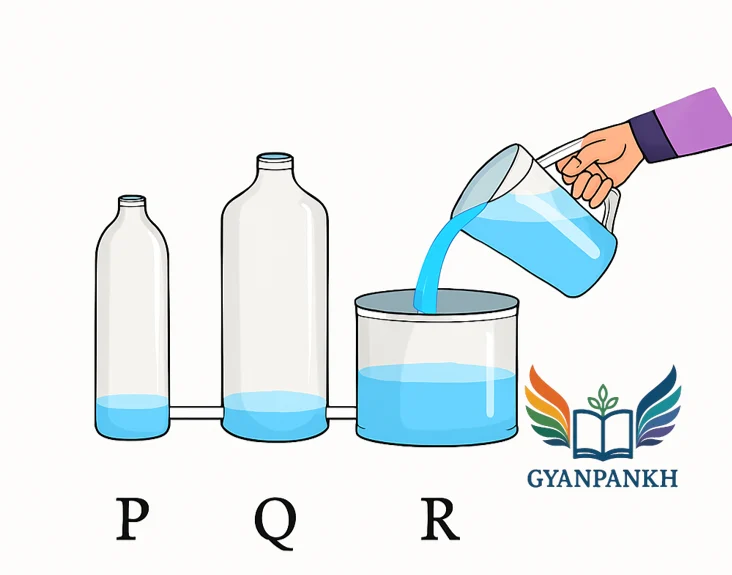
- Look at the Figure carefully. Vessel R is filled with water. When pouring of water is stopped, the level of water will be ________.
(a) the highest in vessel P
(b) the highest in vessel Q
(c) the highest in vessel R
(d) equal in all three vessels
Answer: Correct Option: (d) equal in all three vessels
Explanation:
This setup demonstrates the principle of communicating vessels. When vessels are connected at the bottom and filled with the same liquid:
- The water level becomes equal in all the vessels, regardless of their shape or size. Chapterwise Solution for Pressure
- This happens because liquid pressure depends only on height, not on the volume or shape of the container. Chapterwise Solution for Pressure
- A rubber sucker (M) is pressed on a flat, smooth surface, and an identical sucker (N) is pressed on a rough surface:
(a) Both M and N will stick to their surfaces.
(b) Both M and N will not stick to their surfaces.
(c) M will stick but N will not stick.
(d) M will not stick but N will stick.
Answer: (c) M will stick but N will not stick.
Explanation:
- A rubber sucker sticks to a surface by creating a partial vacuum underneath when pressed. Chapterwise Solution for Pressure
- This works best on a flat, smooth surface because it allows airtight contact, preventing air from entering. Chapterwise Solution for Pressure
- On a rough surface, air can leak in through gaps, so the vacuum cannot hold — and the sucker won’t stick. Chapterwise Solution for Pressure
- A water tank is placed on the roof of a building at a height ‘H’. To get water with more pressure on the ground floor, one has to
(a) Increase the height ‘H’ at which the tank is placed.
(b) Decrease the height ‘H’ at which the tank is placed.
(c) Replace the tank with another tank of the same height that can hold more water.
(d) Replace the tank with another tank of the same height that can hold less water.
Answer: (a) increase the height ‘H’ at which the tank is placed.
Explanation:
Pressure due to a liquid column is given by the formula:
Pressure = h × ρ × g
Where:
- h = height of the liquid column
- ρ = density of the liquid
- g = acceleration due to gravity
So, greater height (h) means greater pressure at the bottom (i.e., on the ground floor).
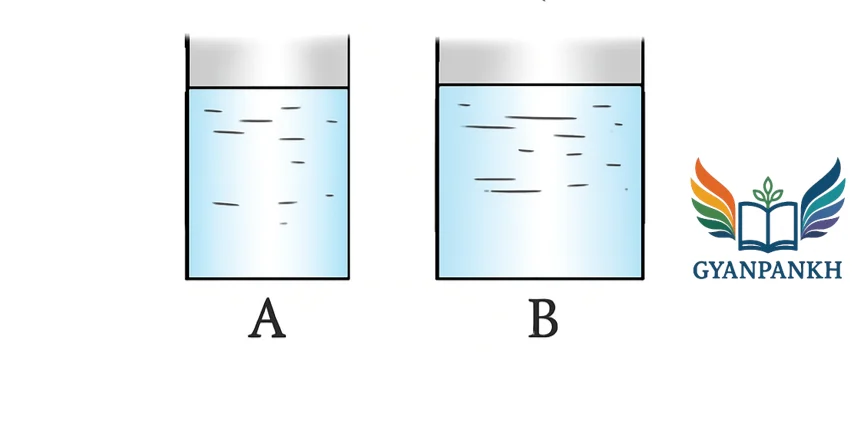
- Two vessels, A and B, contain water up to the same level as shown in the figure. PA and PB are the pressures at the bottom of the vessels. FA and FB are the forces exerted by the water at the bottom of the vessels A and B.
(a) PA = PB, FA = FB
(b) PA = PB, FA <FB
(c) PA < PB, FA = FB
(d) PA > PB, FA > FB
Answer: (b) PA = PB, FA <FB
Explanation:
- Both vessels A and B contain water up to the same level. Chapterwise Solution for Pressure
- Pressure at the bottom of a liquid depends only on the height (depth) of the liquid column, not the shape of the container. Chapterwise Solution for Pressure
So:
- Pressure PA = Pressure PB
Because both vessels have the same water level, the pressure at the bottom is equal. Chapterwise Solution for Pressure - Force = Pressure × Area
Since vessel B has a wider base, the area is greater, so the force FB > FA.
Question 2
- State whether the following statements are True [T] or False [F].
- Air flows from a region of higher pressure to a region of lower pressure. Chapterwise Solution for Pressure
- Liquids exert pressure only at the bottom of a container. Chapterwise Solution for Pressure
- The weather is stormy at the eye of a cyclone. Chapterwise Solution for Pressure
- During a thunderstorm, it is safer to be in a car.
Answer:
- Air flows from a region of higher pressure to a region of lower pressure. [True]
Explanation: This is a fundamental principle of how winds and storms form. Chapterwise Solution for Pressure - Liquids exert pressure only at the bottom of a container. [False]
Explanation: Liquids exert pressure in all directions — not just at the bottom. Chapterwise Solution for Pressure - The weather is stormy at the eye of a cyclone. [False]
Explanation: The eye of a cyclone is calm; the stormy weather occurs around the eye. - During a thunderstorm, it is safer to be in a car. [True]
Explanation: A car acts like a Faraday cage, protecting you from lightning.
Question 3
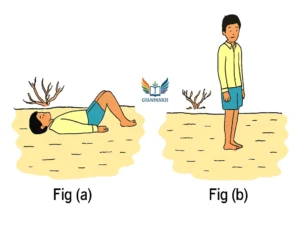
- Figure a shows a boy lying horizontally, and Figure b shows the boy standing vertically on a loose sand bed. In which case does the boy sink more in the sand? Give reasons
Answer:
In Which Case Does the Boy Sink More in Sand?
The boy sinks more when standing vertically (Figure b).
Explanation:
This is due to the concept of pressure, which is defined as:
Pressure = Force / Area
- In Figure (a), the boy is lying horizontally. His weight is spread over a larger area, so the pressure on the sand is less. Chapterwise Solution for Pressure
- In Figure (b), the boy is standing vertically. His weight is concentrated on a smaller area (his feet), so the pressure is greater. Chapterwise Solution for Pressure
Greater pressure causes the sand to give way more, making the boy sink deeper when standing. Chapterwise Solution for Pressure
Question 4
- An elephant stands on four feet. If the area covered by one foot is 0.25 m2, calculate the pressure exerted by the elephant on the ground if its weight is 20000 N. Chapterwise Solution for Pressure
Answer: The pressure exerted by the elephant on the ground is 20,000 N/m².
Explanation:
Pressure = Force / Area
Given:
- Weight of the elephant (Force) = 20,000 N
- Area of one foot = 0.25 m²
- Total area (4 feet) = 4 × 0.25 = 1 m²
Calculation:
Pressure = 20,000 N ÷ 1 m² = 20,000 N/m²
Pressure depends on both force and area. Even a large force like an elephant’s weight spreads out over a larger area, reducing pressure compared to a sharp object with small area.
Question 5
- There are two boats, A and B. Boat A has a base area of 7 m2, and 5 persons are seated in it. Boat B has a base area of 3.5 m2, and 3 persons are seated in it. If each person weighs 700 N, find out which boat will experience more pressure on its base and by how much? Chapterwise Solution for Pressure
Answer:
- Boat B experiences more pressure on its base.
- Difference in pressure = 600 − 500 = 100 N/m²
Explanation:
Pressure = Force / Area
Step-by-Step Calculation
Boat A:
- Number of persons = 5
- Total force (weight) = 5 × 700 N = 3500 N
- Area of base = 7 m²
- Pressure on base = 3500 ÷ 7 = 500 N/m²
Boat B:
- Number of persons = 3
- Total force (weight) = 3 × 700 N = 2100 N
- Area of base = 3.5 m²
- Pressure on base = 2100 ÷ 3.5 = 600 N/m²
Pressure increases when force increases or area decreases. Boat B has a smaller base area, so even with fewer people, it experiences more pressure.
Question 6
- Would lightning occur if air and clouds were good conductors of electricity? Give reasons for your answer. Chapterwise Solution for Pressure
Answer: No, lightning would not occur in the same way if air and clouds were good conductors of electr
Explanation:
- Lightning is caused by the build-up of electric charges in clouds due to friction between water droplets and ice particles.
- Normally, air is a poor conductor of electricity. This allows charges to accumulate in the clouds and on the ground.
- When the difference in charges becomes very large, the insulating air breaks down, and a sudden discharge occurs — this is lightning.
If Air Were a Good Conductor:
- The charges would leak away gradually through the air.
- There would be no sudden build-up of electric potential.
- Hence, no dramatic discharge — and no lightning flash.
Question 7
- What will happen to the two identical balloons A and B as shown in Figure when water is filled into the bottle up to a certain height? Will both the balloons bulge? If yes, will they bulge equally? Explain your answer.
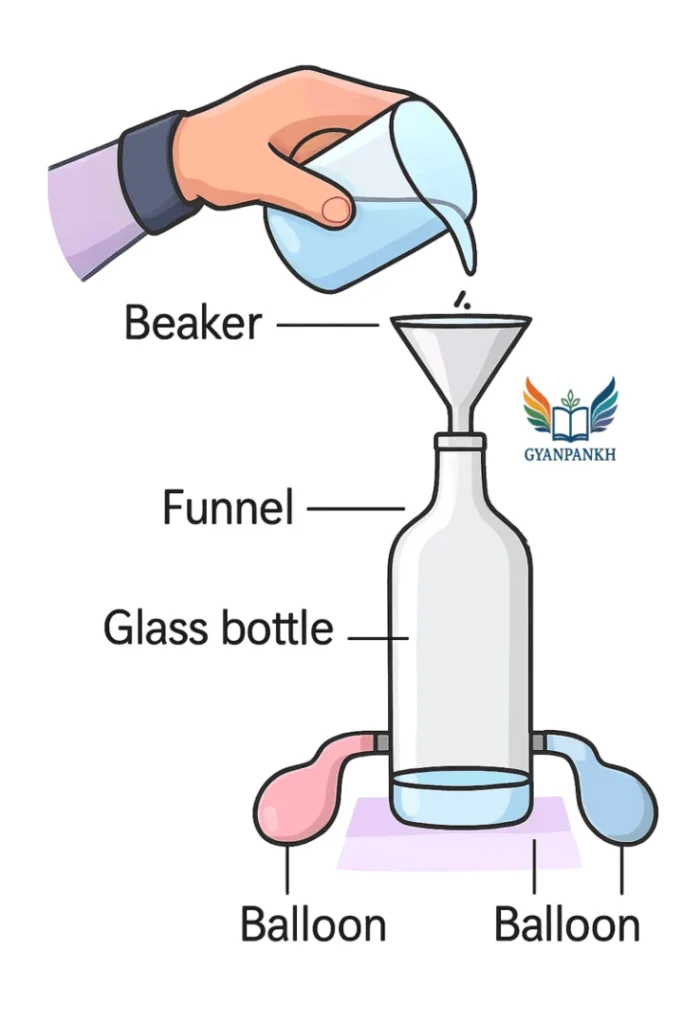
Answer: Yes, both balloons will bulge — because the air pressure inside the bottle pushes air equally into both balloons.
Will They Bulge Equally?
If:
- The balloons are identical,
- The bottle is symmetrical, and
- The water is poured evenly,
Then yes, they will bulge equally. However, if there’s any slight difference in balloon elasticity or placement, one may bulge slightly more than the other.
Explanation:
What Happens When Water Is Poured into the Bottle?
As water is poured into the bottle:
- The water displaces the air inside the bottle.
- This creates increased air pressure inside the bottle.
- The trapped air has nowhere to go except into the balloons A and B.
This activity shows that air exerts pressure, and when compressed, it moves into available spaces — like the balloons. It also reinforces that fluids (like water) can transfer pressure to gases (like air).
Question 8
- Explain how a storm becomes a cyclone.
Answer:
A cyclone is a large, swirling storm system with very strong winds and low pressure at its center. It forms over warm ocean waters and grows from a simple storm through the following process:
Step-by-Step Formation:
- Warm Ocean Water Heats the Air
The sun heats the surface of the sea. This warms the air above it, making it light and moist. - Rising Warm Air Creates Low Pressure
The warm air rises, leaving behind a region of low pressure near the surface. - Air Rushes In from Surroundings
Cooler air from nearby areas (higher pressure) rushes in to fill the gap. This movement creates strong winds. - Continuous Cycle Intensifies the Storm
The incoming air also gets heated and rises. This cycle continues, pulling in more air and moisture. - Spinning Begins Due to Earth’s Rotation
The Earth’s rotation causes the rising air to spin. In the Northern Hemisphere, it spins anticlockwise; in the Southern Hemisphere, clockwise. - Formation of a Cyclone
As the system grows, it becomes a cyclone — a massive, rotating storm with a calm center called the eye and violent winds around it.
Key Idea:
A cyclone is formed when a low-pressure system over warm seas pulls in moist air, which rises, spins due to Earth’s rotation, and intensifies into a powerful storm.
Question 9
- The figure below shows trees along the sea coast on a summer afternoon. Identify which side is land — A or B. Explain your answer.
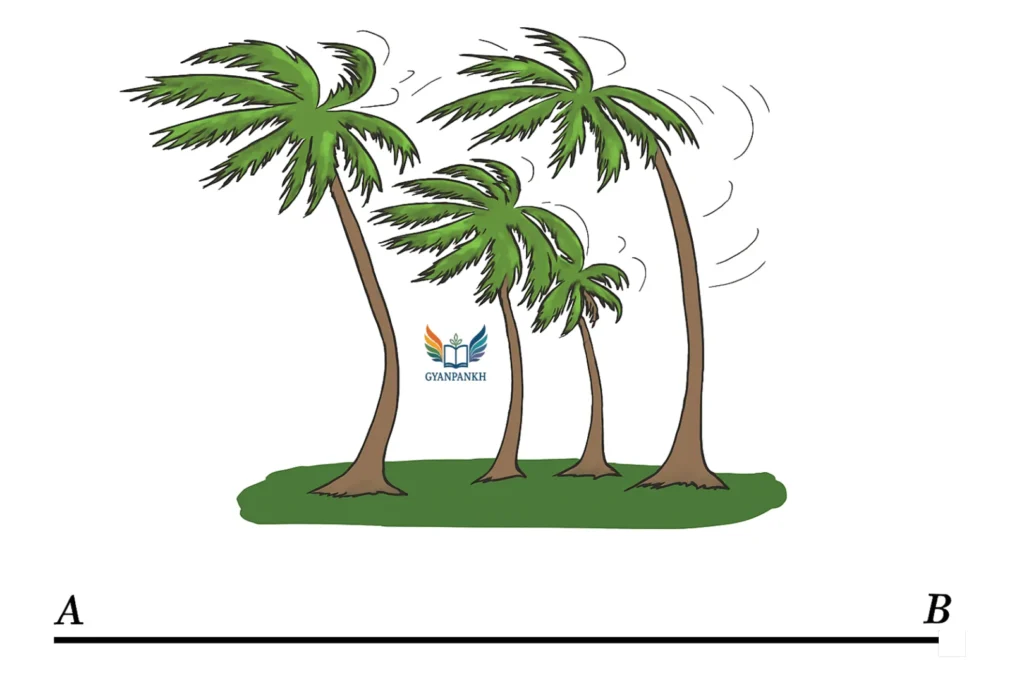
Answer: Side A is the land, and Side B is the sea.
Explanation:
On a summer afternoon, the land heats up faster than the sea. This causes:
- Warm air over the land rises (low pressure).
- Cool air from the sea (high pressure) rushes in to replace it.
This movement of air from sea to land is called a sea breeze.
As the wind blows from B (sea) to A (land), it pushes the trees toward the land, making them lean toward B.
Air moves from a region of high pressure to low pressure. During the day, the sea is cooler (high pressure) and the land is warmer (low pressure), causing wind to blow from sea to land.
Question 10
- Describe an activity to show that air flows from a region of high pressure to a region of low pressure.
Answer: Activity: Air Moves from High Pressure to Low Pressure
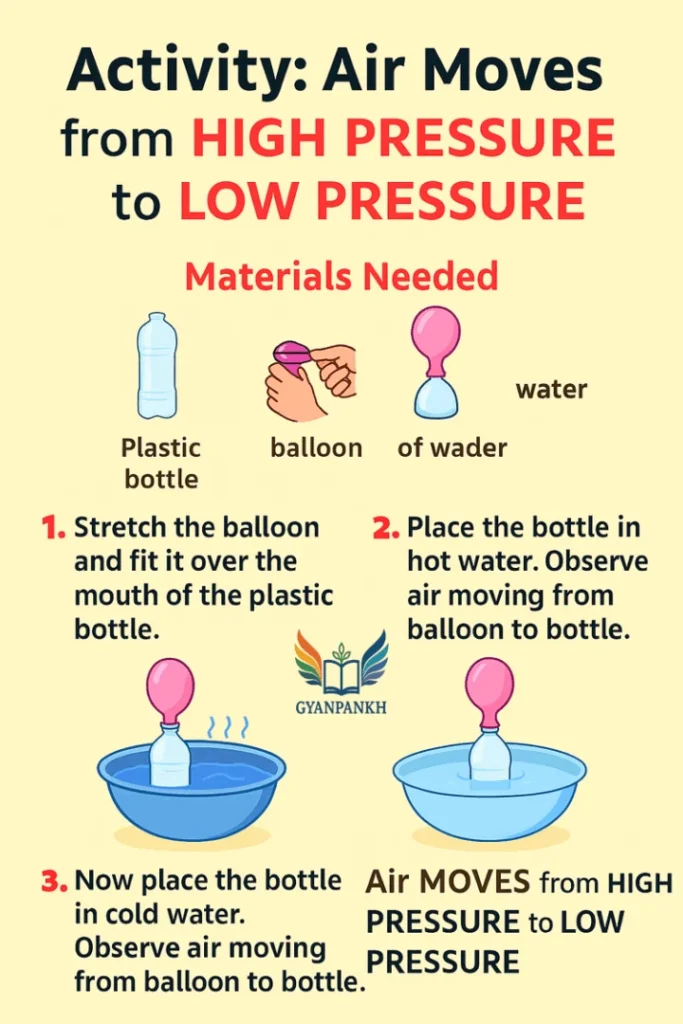
Materials Needed:
A plastic bottle
- A balloon
- A bowl of hot water
- A bowl of cold water
Steps:
- Stretch the balloon a few times to soften it.
- Insert the balloon into the mouth of the empty plastic bottle and stretch its open end over the rim to seal it tightly.
- Place the bottle in a bowl of hot water for a few minutes. Observation: The balloon inflates slightly.
- Now, place the same bottle in a bowl of cold water. Observation: The balloon deflates.
Explantion:
- Hot water heats the air inside the bottle, causing it to expand and create high pressure.
- This high-pressure air moves into the balloon, inflating it.
- When placed in cold water, the air contracts, creating low pressure inside the bottle.
- Air from the balloon flows back into the bottle, and the balloon deflates.
Air always flows from a region of high pressure to low pressure. This principle explains many natural phenomena, including winds and storms.
Question 11
- What is a thunderstorm? Explain the process of its formation.
Answer:
A thunderstorm is a storm with lightning, thunder, and often heavy rain or hail.
- Formation Process:
- The process involves several steps:
- Heating of the Earth’s Surface
On a hot day, the sun heats the land surface, which in turn heats the air above it. - Rising Warm Air
This warm air becomes lighter and rises upward. As it rises, it cools down. - Condensation and Cloud Formation
The cooling air contains water vapor. As it cools, the vapor condenses to form clouds. This process releases heat energy, which makes the air rise even faster. - Development of Strong Winds
The rising air creates strong upward currents. These currents can lead to turbulence and gusty winds. - Lightning and Thunder
The cloud particles rub against each other, generating static electricity. This leads to lightning, followed by thunder due to the sudden expansion of heated air.
NCERT Key Idea:
Thunderstorms develop due to the rapid upward movement of warm, moist air, leading to cloud formation, lightning, and thunder.
Question 12
- Explain the process that causes lightning.
Answer:
Lightning is a sudden electric discharge that occurs in the sky during thunderstorms.
step by step:
- Cloud Formation and Friction
During a thunderstorm, strong air currents move upward and downward in the clouds. These movements cause water droplets and ice particles to rub against each other. - Charge Separation
This rubbing creates static electricity. As a result:- The top of the cloud becomes positively charged.
- The bottom of the cloud becomes negatively charged.
- Induced Charge on the Ground
The negative charge at the bottom of the cloud pushes electrons away from the ground below, making the ground positively charged. - Electric Discharge
When the difference between the charges becomes very large, the air (normally an insulator) breaks down and allows a huge spark to jump between the cloud and the ground, or between clouds.
This spark is what we see as lightning. - Thunder
The sudden heating of air due to lightning causes it to expand rapidly, producing the sound of thunder.
Lightning is caused by the build-up of static charges in clouds and their sudden discharge.
Question 13
- Explain why holes are made in banners and hoardings.
Answer:
Holes are made in banners and hoardings to reduce the pressure exerted by high-speed winds. When the wind blows, it creates high pressure on the front side of the hoarding. If the hoarding is solid, this pressure can be great enough to tear it down or break its support. The holes allow wind to pass through, reducing the pressure difference between the front and back of the hoarding and preventing damage.
- When the wind blows against a large surface like a banner, it pushes hard on it.
- If the air cannot pass through, the banner acts like a sail and may tear or get uprooted.
- Holes allow air to pass through, reducing the pressure on the surface.
In short:
Holes help the air escape, so the banner stays in place and doesn’t get damaged.
Click here for any Help, Click here for any Suggestions.
There are some fascinating points in time in this article however I don’t know if I see all of them middle to heart. There may be some validity however I’ll take maintain opinion till I look into it further. Good article , thanks and we want extra! Added to FeedBurner as well
I’m still learning from you, while I’m trying to reach my goals. I definitely liked reading everything that is written on your blog.Keep the tips coming. I loved it!