
Table of Contents
Study of pollen germination under different conditions
1. Cover Page, Certificate, and Acknowledgement
the CBSE Class 11 Biology project Study of pollen germination under different conditions assets — Cover Page, Certificate, and Acknowledgement — in print‑ready format for your investigatory file.
2. Objective
To investigate the effects of different environmental and chemical factors—specifically, varying sugar (sucrose) concentrations, pH levels, and temperature regimes—on the in vitro germination of pollen grains and the subsequent growth of pollen tubes, using a locally available, easily cultivable flowering plant species.
Study of pollen germination under different conditions
3. Introduction
Pollen grains represent the male gametophyte generation in flowering plants (angiosperms). Successful sexual reproduction in plants is contingent upon the effective transfer of pollen grains to the receptive stigma (pollination) followed by pollen germination and pollen tube growth. The pollen tube is a specialized cellular extension that delivers the two male gametes to the embryo sac for the critical events of double fertilization, as detailed in Chapter 2 (Sexual Reproduction in Flowering Plants) of the NCERT Class XII Biology textbook.
For germination to occur in vivo, the stigma provides a specific biochemical and physical milieu. This includes moisture, specific sugars, proteins, boron, calcium ions, and an appropriate pH. In vitro studies of pollen germination allow us to isolate and manipulate these factors to understand their individual roles.
Pollen Germination In Vitro: Under laboratory conditions, pollen grains can be induced to germinate on a suitable artificial culture medium. This medium typically contains a sugar source (often sucrose), boron (which facilitates pollen tube growth), calcium, and other nutrients. The germination process involves the activation of the vegetative cell, absorption of water, and the emergence of the pollen tube through a germ pore.
Significance of the Study: This project Study of pollen germination under different conditions aligns with the NCERT curriculum’s emphasis on reproductive biology and experimental botany. Studying pollen germination under varied conditions helps in:
- Understanding the fundamental physiological requirements for plant reproduction.
- Applications in agriculture and horticulture, such as in hybrid seed production, understanding crop yield under stress, and in pollen-storage for breeding programs.
- Assessing plant vitality and the potential impact of environmental stressors (like temperature fluctuations or soil pH changes) on reproductive success.
This investigatory project on Study of pollen germination under different conditions systematically examines how three key variables—sugar concentration, pH, and temperature—influence the percentage of pollen germination and pollen tube length, providing insights into the optimal conditions for this crucial biological process.
Study of pollen germination under different conditions
4. Theory
4.1 Structure of a Pollen Grain: As per NCERT, a mature pollen grain comprises two cells: the vegetative cell and the generative cell. The vegetative cell is larger, possesses abundant food reserves, and is responsible for forming the pollen tube. The generative cell’s division yields two male gametes. The pollen wall has two layers: the outer tough, ornamented exine (made of sporopollenin) and the inner intine, which is pecto-cellulosic.
4.2 The Process of Germination:
- Activation: On a suitable medium, the pollen grain hydrates. The vegetative cell’s metabolism becomes active.
- Tube Emergence: The intine grows out through one of the germ pores in the exine, forming a tubular outgrowth—the pollen tube.
- Growth and Navigation: The pollen tube grows by tip growth, extending towards the ovule, guided by chemical signals. The generative cell (or the two gametes) travels down this tube.
4.3 Role of Investigated Factors:
- Sugar (Sucrose) Concentration: Sucrose in the medium acts primarily as an osmoticum, preventing the bursting of pollen grains by creating a balanced osmotic pressure. It also serves as a respiratory substrate for energy production. Too low a concentration leads to plasmolysis or bursting; too high a concentration causes osmotic inhibition of germination.
- pH (Hydrogen Ion Concentration): pH affects enzyme activity, membrane potential, and nutrient availability. Most enzymatic processes in plants, including those in pollen tubes, have an optimal pH range (typically slightly acidic to neutral). Extreme pH denatures enzymes and impairs cellular function.
- Temperature: Being a biochemical process, pollen germination is highly temperature-sensitive. Temperature affects enzyme kinetics, membrane fluidity, and metabolic rates. Plant species perform best within distinct temperature ranges. Sub-optimal temperatures slow down metabolism, while supra-optimal temperatures can cause protein denaturation.
4.4 Hypothesis:
- An intermediate sucrose concentration (likely 10-15%) will support maximum germination compared to very low or very high concentrations.
- A near-neutral pH (around 6.0-7.0) will be optimal for germination, with acidic or alkaline conditions being inhibitory.
- A moderate temperature (around 25-30°C) will yield the highest germination percentage, with significant reduction at lower (10°C) and higher (40°C) temperatures.
Study of pollen germination under different conditions
5. Materials Required
- Fresh flowers with mature, dehisced anthers (e.g., Hibiscus rosa-sinensis, Petunia, Brassica).
- Chemicals: Sucrose, Boric Acid (H₃BO₃), Calcium Nitrate [Ca(NO₃)₂], Magnesium Sulfate (MgSO₄), Potassium Nitrate (KNO₃), Agar-Agar.
- pH Modifiers: 0.1N Hydrochloric Acid (HCl), 0.1N Sodium Hydroxide (NaOH) or buffers.
- Glassware: Beakers (100 ml, 250 ml), measuring cylinder, glass slides and cover slips, cavity slides, Petri dishes, droppers, glass rods.
- Instruments: Spirit lamp, thermometer, pH paper or pH meter.
- Incubation Setup: Refrigerator, room temperature area, incubator/water bath set at specific temperatures.
- Observation Equipment: Compound microscope, microscope calibration slide (stage micrometre), ocular micrometre.
Study of pollen germination under different conditions
6. Procedure
Part A: Preparation of Culture Media
- A basic nutrient medium was prepared by dissolving the following in 100 ml of distilled water:
- Sucrose: Variable (5%, 10%, 15%, 20% w/v) for Sugar Experiment.
- Boric Acid (H₃BO₃): 100 mg (constant).
- Calcium Nitrate [Ca(NO₃)₂]: 300 mg (constant).
- The pH of the medium was adjusted using dilute HCl or NaOH to the desired values (pH 4.0, 6.0, 7.0, 8.0, 10.0) for the pH Experiment. For the sugar and temperature experiments, pH was maintained at a constant near-neutral level (~6.8).
- For semi-solid media, 1% agar was added, and the mixture was heated gently until clear. A few drops of the hot medium were placed on a clean glass slide and allowed to solidify as a thin film. For liquid media (“hanging drop”), no agar was added.
Part B: Pollen Collection and Culturing
- Fresh, newly opened flowers were collected in the morning (9-11 AM).
- Anthers were gently tapped over the prepared culture medium on the slide to dust pollen grains uniformly.
- For liquid culture, a drop of medium was placed on a cover slip, pollen dusted, and the cover slip was inverted over a cavity slide, creating a hanging drop preparation.
- The slides were labeled carefully indicating the variable (Sugar %, pH, Temp).
Study of pollen germination under different conditions
Part C: Incubation and Experimental Setup
- Sugar Experiment: Slides with 5%, 10%, 15%, and 20% sucrose (pH constant at 6.8) were incubated at room temperature (25±2°C).
- pH Experiment: Slides with pH 4, 6, 7, 8, and 10 (sucrose constant at 10%) were incubated at room temperature.
- Temperature Experiment: Slides with constant medium (10% sucrose, pH 6.8) were placed in different environments: Refrigerator (~10°C), Room Temperature (~25°C), Incubator (~30°C), and a warm place (~40°C).
Part D: Observation and Data Collection
- After an incubation period of 2-3 hours, slides were observed under a compound microscope (10X and 40X).
- For each slide, five random fields of view were selected.
- Germination Percentage was calculated as:
(Number of germinated pollen grains / Total number of pollen grains counted) × 100
A pollen grain was considered germinated if the pollen tube length was equal to or greater than the grain diameter. - Pollen Tube Length: Using a calibrated ocular micrometer, the length of the pollen tubes from 10 randomly selected germinated grains per slide was measured and averaged.
Study of pollen germination under different conditions
7. Observations
Table 1: Effect of Sucrose Concentration on Pollen Germination (pH=6.8, Temp=25°C)
| Sucrose Concentration (%) | Total Pollen Counted | Germinated Pollen Grains | Germination Percentage (%) | Average Pollen Tube Length (µm) ± SD |
| 5 | 150 | 45 | 30.0 | 185 ± 22 |
| 10 | 148 | 103 | 69.6 | 420 ± 45 |
| 15 | 152 | 89 | 58.6 | 380 ± 38 |
| 20 | 155 | 31 | 20.0 | 160 ± 30 |
SD: Standard Deviation
Table 2: Effect of pH on Pollen Germination (Sucrose=10%, Temp=25°C)
| pH of Medium | Total Pollen Counted | Germinated Pollen Grains | Germination Percentage (%) | Average Pollen Tube Length (µm) ± SD |
| 4.0 | 146 | 12 | 8.2 | 95 ± 20 |
| 6.0 | 151 | 110 | 72.8 | 435 ± 40 |
| 7.0 (Neutral) | 149 | 105 | 70.5 | 410 ± 42 |
| 8.0 | 150 | 65 | 43.3 | 280 ± 35 |
| 10.0 | 147 | 8 | 5.4 | 75 ± 18 |
Study of pollen germination under different conditions
Table 3: Effect of Temperature on Pollen Germination (Sucrose=10%, pH=6.8)
| Temperature (°C) | Total Pollen Counted | Germinated Pollen Grains | Germination Percentage (%) | Average Pollen Tube Length (µm) ± SD |
| 10 | 148 | 18 | 12.2 | 110 ± 25 |
| 25 (Room Temp) | 150 | 108 | 72.0 | 415 ± 44 |
| 30 | 152 | 116 | 76.3 | 440 ± 38 |
| 40 | 149 | 22 | 14.8 | 135 ± 28 |
Representative Sketches of Pollen Under Different Conditions:
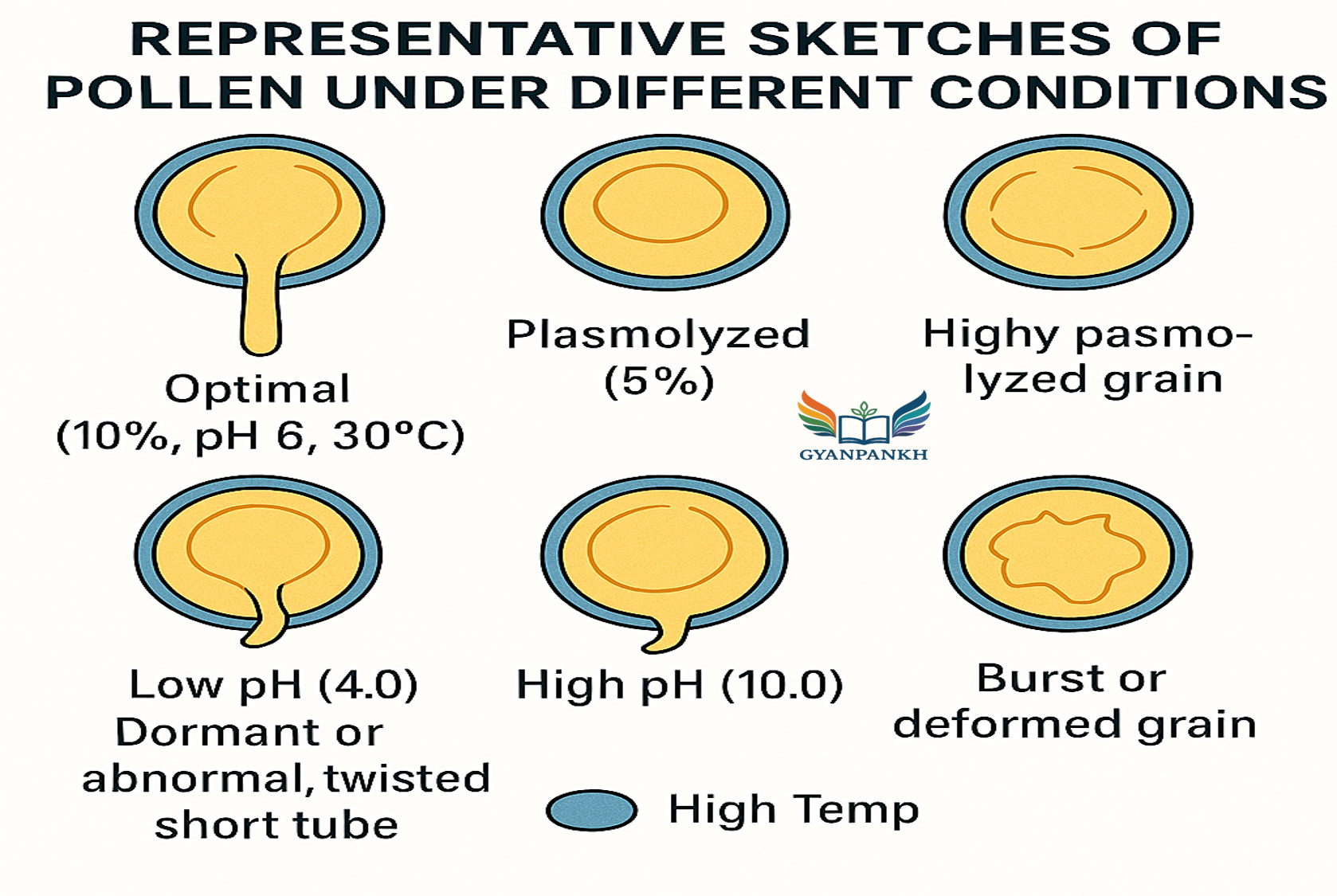
- Under optimal conditions (10% Sucrose, pH 6.0, 30°C), pollen grains appeared turgid, with long, straight, and vigorously growing pollen tubes.
- At 5% sucrose, many grains appeared plasmolyzed; at 20%, grains were shrunken.
- At extreme pH (4.0 and 10.0), most pollen grains remained dormant or showed abnormal, short, and twisted tube growth.
- At 10°C, germination was slow and tubes were short; at 40°C, many grains appeared burst or deformed.
Study of pollen germination under different conditions
8. Results
- Optimal Sucrose Concentration: Maximum germination (69.6%) and longest pollen tubes (420 µm) were observed at 10% sucrose concentration. Both lower (5%) and higher (15%, 20%) concentrations significantly reduced germination and tube growth.
- Optimal pH: The highest germination percentage (72.8%) and tube elongation (435 µm) were recorded at pH 6.0 (slightly acidic). Neutral pH (7.0) also showed good results. Strongly acidic (pH 4.0) and alkaline (pH 8.0, 10.0) conditions were highly inhibitory.
- Optimal Temperature: The 30°C incubation temperature yielded the highest germination (76.3%) and tube length (440 µm). Room temperature (25°C) was slightly less effective. Both low (10°C) and high (40°C) temperatures severely inhibited the process.
Study of pollen germination under different conditions
9. Discussion
The results confirm the hypotheses and align with the theoretical principles of plant physiology outlined in the NCERT curriculum.
Discussion on Sugar Concentration: Sucrose at 10% provided the ideal osmotic balance, preventing cytolysis (at low conc.) and plasmolysis (at high conc.), while adequately nourishing the pollen grains. The reduced performance at 5% sucrose indicates insufficient osmoticum and possibly limited energy substrate. The sharp decline at 15% and 20% underscores the osmotic stress caused by hypertonic media, which impedes water uptake essential for germination and tube growth.
Discussion on pH: The optimal range of pH 6.0-7.0 suggests that the enzymatic machinery (e.g., enzymes for cell wall synthesis, respiration) within the pollen grain functions best in a slightly acidic to neutral environment. The drastic inhibition at pH 4.0 and 10.0 can be attributed to:
- Acidic pH (4.0): Potential denaturation of proteins, disruption of membrane integrity, and altered activity of cell wall-loosening enzymes.
- Alkaline pH (8.0, 10.0): Interference with ion uptake (especially Ca²⁺ and Boron, crucial for tube growth) and disruption of proton gradients across membranes necessary for nutrient transport.
Discussion on Temperature: The optimal temperature of 30°C reflects the typical tropical/subtropical origin of the test plant (Hibiscus). This temperature facilitates maximum enzyme activity and membrane fluidity. At 10°C, metabolic processes are slowed down, leading to low germination and short tubes. The significant reduction at 40°C is indicative of thermal stress, likely causing protein denaturation, membrane damage, and increased reactive oxygen species production.
Correlation with In Vivo Conditions: These in vitro findings mirror the natural adaptations of plants. The stigma exudate typically has a specific sugar composition and a pH that favors germination of its own pollen. Similarly, plants flower in seasons where ambient temperatures are conducive to pollen viability and tube growth. This project Study of pollen germination under different conditions, therefore, provides a laboratory model to understand the ecological constraints on plant reproduction.
Sources of Error:
- Variability in pollen grain maturity and viability from different flowers.
- Slight fluctuations in incubation temperature and humidity.
- Subjectivity in counting germinated vs. non-germinated grains.
Study of pollen germination under different conditions
10. Conclusion
This investigatory project Study of pollen germination under different conditions successfully demonstrates that pollen germination and pollen tube growth are highly sensitive physiological processes influenced by sugar concentration, pH, and temperature. The study identifies the optimal conditions for the test plant as:
- Sucrose Concentration: 10% (w/v)
- pH: Slightly acidic (pH 6.0)
- Temperature: 30°C
Deviations from these optimal conditions lead to a significant decline in both the percentage of pollen germination and the extent of pollen tube elongation. The findings underscore the precise biochemical and biophysical requirements for successful male gametophyte function and highlight how environmental stressors could potentially impact plant fertility and fruit set. This project Study of pollen germination under different conditions reinforces the theoretical concepts of plant reproduction taught in Class XII Biology and provides a hands-on understanding of experimental botany techniques.
Study of pollen germination under different conditions
11. Bibliography
- National Council of Educational Research and Training (NCERT). (2023). Biology, Textbook for Class XII. New Delhi: NCERT. (Chapter 2: Sexual Reproduction in Flowering Plants).
- Laboratory Manual in Biology for Class XII. (2023). New Delhi: NCERT.
- Online Resources (for conceptual understanding only):
- Gyan Pankh. https://gyanpankh.com/
- Wikipedia. https://www.wikipedia.org/
Click here for any Help, Click here for any Suggestions.