
CBQ of Pressure, Winds, Storms, and Cyclones
CBQ of Pressure, Winds, Storms, and Cyclones
Case 1: Megha and Pawan’s Picnic Bags
Megha and her brother Pawan are on their way to a picnic spot by foot. They are carrying identical items, meaning both bags have the same weight. However, Pawan feels uncomfortable because his bag has narrow straps that hurt his shoulders, while Megha’s bag has broad straps and does not cause pain. Megha explains that the difference is due to the area over which the weight of the bag acts on their shoulders.
1. Why does Pawan feel more pain than Megha despite carrying the same weight?
(a) His bag is affected more by the force of gravity.
(b) The narrow straps apply force over a smaller area, increasing pressure.
(c) The wide straps on Megha’s bag enhance the gravitational pull.
(d) The narrow straps decrease the pressure on his shoulders.
2. Pressure is scientifically defined as:
(a) Force multiplied by Area.
(b) Area divided by Force.
(c) Force per unit Area.
(d) Mass per unit Volume.
CBQ of Pressure, Winds, Storms, and Cyclones
3. What is the SI unit of pressure mentioned in the text?
(a) Newton (N).
(b) Newton (metre).
(c) Pascal (Pa).
(d) Millibar (mb).
4. If the area is doubled and the force stays the same, how will the pressure change?
(a) Double.
(b) Stay the same.
(c) Reduce to half.
(d) Become four times higher.
5. Which other daily life observation follows the same principle as the bag straps?
(a) Blowing air into a balloon.
(b) Using a blunt knife to cut an apple.
(c) Lifting a water bucket with a broad handle to feel more comfortable.
(d) A liquid applying force against the inner walls of its container.
CBQ of Pressure, Winds, Storms, and Cyclones
Case 2: Investigating Liquid Pressure
In a classroom activity, students attach rubber balloons to the bottom of two transparent pipes with different diameters. When both pipes are filled with water to the same height, the balloons bulge out to the same extent. Later, when more water is poured into one pipe to increase the height of the water column, the balloon on that pipe bulges out even more.
1. In the first part of the activity, why do the balloons bulge to the same extent despite the pipes having different diameters?
(a) The weight of the water is the same in both pipes.
(b) The pressure depends on the height of the water column, not the diameter.
(c) The pipes are made of different materials.
(d) The balloons are of different qualities.
2. What happens to the pressure at the bottom of a pipe as the height of the liquid column increases?
(a) It decreases.
(b) It remains constant.
(c) It increases.
(d) It becomes zero.
CBQ of Pressure, Winds, Storms, and Cyclones
3. Why are overhead water tanks in localities always placed at a significant height?
(a) To keep the water cooler.
(b) To increase the pressure in the taps for a better stream of water.
(c) To save space on the ground.
(d) To prevent the water from leaking.
4. A student makes four holes at the same height around a plastic bottle filled with water. The water spurts out with equal force from all holes. This shows that:
(a) Liquids only exert pressure downwards.
(b) Liquids apply pressure solely on the bottom surface.
(c) Liquids exert equal pressure in all directions at the same depth.
(d) Water moves from a region of low pressure to one of high pressure.
5. The base of a dam is made broader than the top primarily to:
(a) Make it look more stable.
(b) Support the structure and withstand high horizontal water pressure at the bottom.
(c) Decrease the area to increase the pressure.
(d) Help fish swim better at the bottom.
CBQ of Pressure, Winds, Storms, and Cyclones
Case 3: Atmospheric Pressure and the Rubber Sucker
The Earth is surrounded by an envelope of air called the atmosphere, which extends many kilometres high. This air exerts a force per unit area known as atmospheric pressure. To demonstrate its magnitude, a rubber sucker is pressed against a smooth flat surface. It sticks firmly because the air between the sucker and the surface is pushed out, creating a pressure difference.
1. Why does a rubber sucker stick to a smooth surface when pressed?
(a) Due to an adhesive glue on the sucker.
(b) The air pressure inside the sucker becomes higher than the outside.
(c) Most air is pushed out, and the higher external atmospheric pressure pushes it against the surface.
(d) The force of gravity pulls it toward the surface.
2. The atmospheric pressure on an area of is nearly equal to the weight of an object with a mass of:
(a) 15 kg.
(b) 225 kg.
(c) 1000 kg.
(d) 50 kg.
3. Why are humans not crushed under the enormous weight of the atmospheric air column?
(a) Our bones are made of metal.
(b) The air around us is actually weightless.
(c) The pressure within our bodies matches the atmospheric pressure outside.
(d) We are constantly moving, so the pressure cannot act on us.
4. What creates the pressure inside our bodies that balances the atmosphere?
(a) The food we eat.
(b) Movement of fluids and gases in tissues and organs.
(c) The clothes we wear.
(d) The heat from the sun.
5. In an experiment, more effort is needed to lift an inverted paper plate when it is covered by a large unfolded chart paper compared to a small folded one. This is because:
(a) The unfolded paper is heavier.
(b) The unfolded paper has a larger area for the air to exert force on.
(c) The folded paper is affected by more gravity.
(d) There is no air pressure on the folded paper.
CBQ of Pressure, Winds, Storms, and Cyclones
Case 4: The Formation of Wind and High-Speed Effects
Wind, or the movement of air, mainly results from variations in air pressure. In an experiment with two balloons connected by a straw, air moves from the inflated balloon (high pressure) to the uninflated one (low pressure) until the pressures are equal. Furthermore, when air is blown at high speed between two hanging balloons, they move towards each other, indicating that high-speed winds are accompanied by reduced air pressure.
1. According to the text, air always moves from:
(a) Areas of low pressure move toward areas of high pressure.
(b) Air flows from high-pressure zones to low-pressure zones.
(c) Cold regions to hot regions only.
(d) The land to the sea during the day.
2. A “sea breeze” forms during the day due to:
(a) The sea gets heated faster than the land.
(b) Land heats up faster, creating a low-pressure area that pulls in air from the sea.
(c) The moon’s gravity pulls the wind.
(d) High pressure develops on the land.
CBQ of Pressure, Winds, Storms, and Cyclones
3. When you blow air into the gap between two hanging balloons, they move closer. Why?
(a) You are pulling them with your breath.
(b) The air speed creates a low-pressure zone between them, and higher outside pressure pushes them in.
(c) The balloons are statically charged.
(d) The balloons want to occupy the same space.
4. High-speed winds during a storm can blow off the roofs of houses because:
(a) The wind is physically lifting the roof like a hand.
(b) A low-pressure area is created over the roof, making the higher pressure inside the house push the roof up.
(c) The rain makes the roof too slippery to stay on.
(d) The trees falling on the house knock the roof off.
5. To prevent a roof from being blown off during a high-speed wind storm, it is safer to:
(a) Seal all doors and windows tightly.
(b) Keep doors and windows open to reduce the pressure difference.
(c) Hide in the attic.
(d) Pour water on the roof to make it heavier.
CBQ of Pressure, Winds, Storms, and Cyclones
Case 5: Thunderstorms and Cyclones
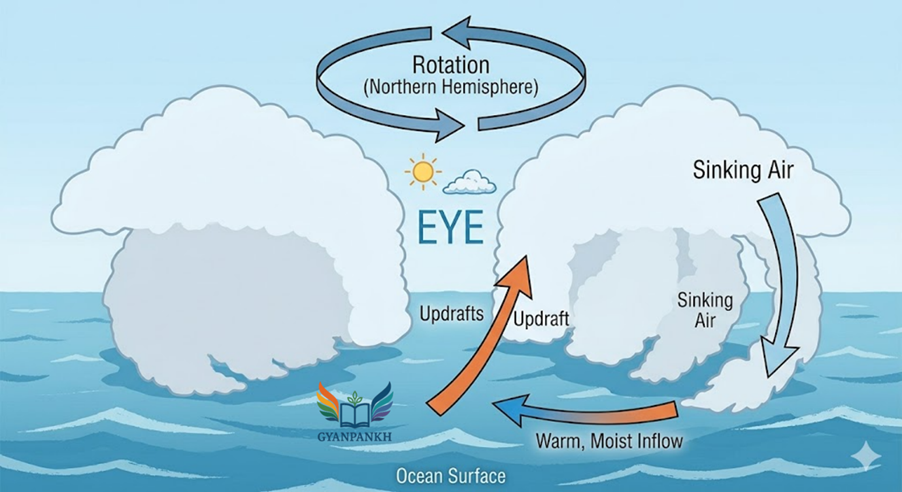
Thunderstorms develop in hot, humid, tropical regions like India. They involve strong upward and downward winds that cause ice particles and water droplets to rub together, creating static electric charges. Cyclones are even larger storms that form over warm ocean waters. They feature a still, low-pressure center referred to as the “eye.”
1. Lightning is produced during a thunderstorm when:
(a) Clouds collide with each other physically.
(b) The build-up of opposite charges becomes so large that the insulating property of air breaks down.
(c) The sun’s rays reflect off the ice particles in the clouds.
(d) The wind speed exceeds 300 km/h.
2. Which of the following is a safe precaution during lightning?
(a) Standing under a tall tree.
(b) Using an umbrella with a metallic rod.
(c) Staying low in an open, depression-like area.
(d) Lying down flat on the ground.
3. What is the primary source of energy that sustains a cyclone?
(a) The rotation of the Earth.
(b) Energy is released into the air as water vapor turns into raindrops.
(c) The friction between the wind and the ocean waves.
(d) Static electricity from lightning.
4. The “eye” of a cyclone is characterized by:
(a) The strongest winds and most intense rainfall.
(b) Extremely high pressure and calm winds.
(c) The lowest pressure and calm winds.
(d) Constant lightning strikes.
5. How has modern technology helped in reducing the impact of cyclones?
(a) We can now stop cyclones using satellites.
(b) Satellites help track and predict the path of cyclones to issue early warnings.
(c) We can use giant fans to push cyclones back to the sea.
(d) Technology has made the soil immune to seawater salt.
CBQ of Pressure, Winds, Storms, and Cyclones
Answer Key
Case 1: Megha and Pawan’s Picnic Bags
1. (b) The narrow straps apply force over a smaller area, increasing pressure.
2. (c) Force per unit area.
3. (c) Pascal (Pa).
4. (c) Reduce to half (Since pressure is inversely proportional to area).
5. (c) Lifting a water bucket with a broad handle to feel more comfortable.
Case 2: Investigating Liquid Pressure
1. (b) The pressure depends on the height of the water column, not the diameter.
2. (c) It increases.
3. (b) To increase the pressure in the taps for a better stream of water.
4. (c) Liquids exert equal pressure in all directions at the same depth.
5. (b) Support the structure and withstand high horizontal water pressure at the bottom.
Case 3: Atmospheric Pressure and the Rubber Sucker
1. (c) Most air is pushed out, and the higher external atmospheric pressure pushes it against the surface.
2. (b) 225 kg.
3. (c) The pressure within our bodies matches the atmospheric pressure outside.
4. (b) Movement of fluids and gases in tissues and organs.
5. (b) The unfolded paper has a larger area for the air to exert force on.
CBQ of Pressure, Winds, Storms, and Cyclones
Case 4: The Formation of Wind and High-Speed Effects
1. (b) Air flows from high-pressure zones to low-pressure zones.
2. (b) Land heats up faster, creating a low-pressure area that pulls in air from the sea.
3. (b) The air speed creates a low-pressure zone between them, and higher outside pressure pushes them in.
4. (b) A low-pressure area is created over the roof, making the higher pressure inside the house push the roof up.
5. (b) Keep doors and windows open to reduce the pressure difference.
Case 5: Thunderstorms and Cyclones
1. (b) The build-up of opposite charges becomes so large that the insulating property of air breaks down.
2. (c) Staying low in an open, depression-like area.
3. (b) Energy is released into the air as water vapor turns into raindrops.
4. (c) The lowest pressure and calm winds.
5. (b) Satellites help track and predict the path of cyclones to issue early warnings.
Click here for any Help, Click here for any Suggestions.