
Table of Contents
Awareness of pollution and its health effects
1. Cover Page, Certificate, and Acknowledgement
the CBSE Class 11 Biology project Awareness of pollution and its health effects assets — Cover Page, Certificate, and Acknowledgement — in print‑ready format for your investigatory file.
2. Objective
- To study the types, sources, and characteristics of major environmental pollutants.
- To investigate the direct and indirect effects of key pollutants (air and water) on human physiological systems.
- To assess the level of awareness regarding pollution and its health impacts among a sample population (students and local residents).
- To correlate awareness levels with demographic factors like age and education.
- To suggest remedial measures based on the findings to enhance public awareness and mitigate health risks.
Awareness of pollution and its health effects
3. Introduction
Pollution, defined as the introduction of harmful substances or contaminants into the natural environment causing adverse change, has emerged as one of the most critical global challenges of the 21st century. It directly contravenes the principles of environmental biology and sustainable development. According to the World Health Organization (WHO), environmental pollution is responsible for an estimated 9 million premature deaths annually, making it the single largest environmental cause of disease and death.
This project Awareness of pollution and its health effects aligns with the NCERT Class XII Biology curriculum (Environmental Issues), which details various forms of pollution, their causes, and consequences. The chapter emphasizes the interconnectedness of environmental health and human well-being, a concept central to this investigation.
While the physical and chemical aspects of pollution are widely studied, the “awareness” component acts as a critical bridge between scientific knowledge and actionable change. A deficit in awareness can lead to unchecked exposure, poor lifestyle choices, and insufficient public demand for policy interventions. This project (Awareness of pollution and its health effects), therefore, adopts a dual approach: first, reviewing the established scientific link between pollutants and health, and second, empirically gauging the level of understanding within a community. Such an integrated study is essential for formulating effective educational and policy strategies to combat the health burden imposed by pollution.
Awareness of pollution and its health effects
4. Theory
4.1. Classification of Major Pollutants and Their Sources
- Air Pollutants:
- Particulate Matter (PM2.5 & PM10): Emitted from vehicle exhaust, industrial processes, construction, and biomass burning. Can penetrate deep into the respiratory system.
- Nitrogen Oxides (NOx) & Sulfur Dioxide (SO2): Primarily from fossil fuel combustion in vehicles and industries. Contribute to acid rain and respiratory ailments.
- Carbon Monoxide (CO): A poisonous gas from incomplete combustion (vehicles, stoves). Binds irreversibly to haemoglobin, reducing oxygen transport.
- Ozone (O3): A ground-level pollutant formed by photochemical reactions of NOx and VOCs. A potent respiratory irritant.
- Lead & Heavy Metals: From industrial emissions, leaded petrol (historic), and battery recycling. Cause neurological and developmental disorders.
- Water Pollutants:
- Pathogens: Bacteria, viruses, protozoa from sewage and animal waste, causing water-borne diseases (cholera, typhoid).
- Organic Wastes: Domestic sewage and agricultural runoff lead to eutrophication, reducing Dissolved Oxygen (DO) and causing aquatic life death.
- Chemical Pollutants: Fertilizers (nitrates, phosphates), pesticides (DDT, organophosphates), heavy metals (mercury, arsenic), and industrial chemicals. They cause bioaccumulation and biomagnification in food chains.
- Thermal Pollutants: Heated water from industries elevates water temperature, reducing DO and affecting aquatic metabolism.
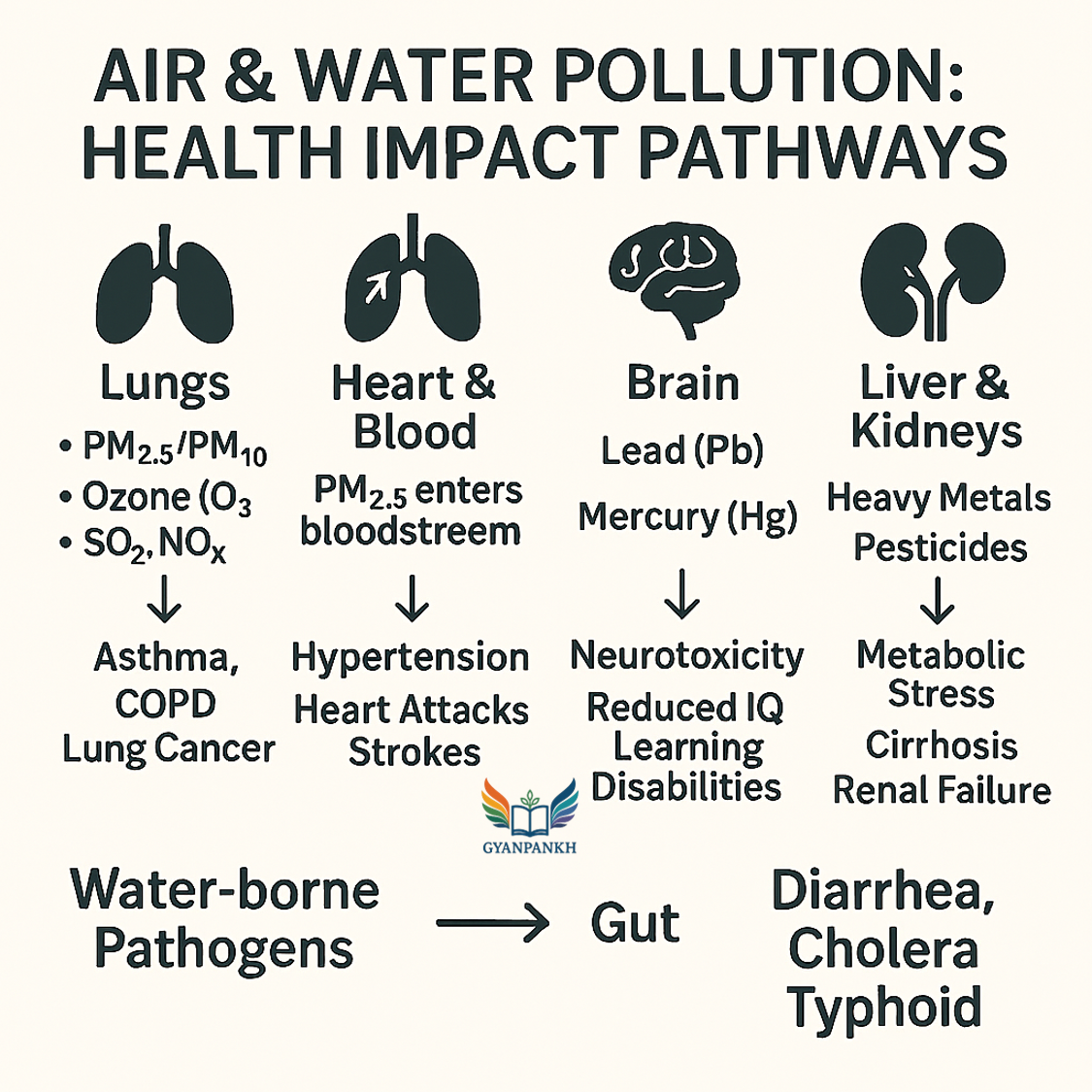
Awareness of pollution and its health effects
4.2. Health Effects: A Physiological Perspective
- Respiratory System: PM2.5 can deposit in alveoli, causing inflammation, exacerbating asthma, bronchitis, and leading to Chronic Obstructive Pulmonary Disease (COPD) and lung cancer. Ozone damages lung tissue, reducing function.
- Cardiovascular System: Fine particles can enter the bloodstream, promoting atherosclerosis (plaque buildup), increasing the risk of hypertension, heart attacks, and strokes.
- Nervous System: Neurotoxicants like lead and mercury cross the blood-brain barrier. Lead exposure in children causes reduced IQ, learning disabilities, and behavioral issues. Mercury affects motor skills and cognitive function.
- Hepatorenal System: Heavy metals and pesticides are metabolized by the liver and excreted by kidneys. Chronic exposure can lead to liver cirrhosis, fatty liver disease, and renal failure.
- Carcinogenicity: Several pollutants (benzene, asbestos, arsenic, certain PM) are classified as Group 1 carcinogens by IARC, directly linked to cancers of the lung, skin, and bladder.
- Water-Borne Diseases: Contaminated water is a vector for diarrheal diseases, hepatitis A, and polio, causing high morbidity and mortality, especially in children.
Awareness of these pathways is crucial for individuals to adopt protective behaviors (e.g., using masks, water purifiers) and support community-level actions (waste segregation, advocating for cleaner fuels).
Awareness of pollution and its health effects
5. Materials and Methods
This study employed a mixed-method approach, combining secondary data analysis with primary survey research.
5.1. Secondary Research (Literature Review)
- Sources: NCERT Biology Textbook (Class XII), peer-reviewed scientific journals accessed via online repositories, reports from WHO, CPCB (Central Pollution Control Board), and MoEFCC (Ministry of Environment, Forest and Climate Change).
- Purpose: To establish the scientific foundation on pollutant types, sources, and documented health effects.
Awareness of pollution and its health effects
5.2. Primary Research (Awareness Survey)
- Tool: A structured, anonymous questionnaire with a mix of multiple-choice and Likert-scale questions.
- Questionnaire Design: Divided into three sections:
- Demographics: Age, gender, education, locality.
- Knowledge Assessment: Identification of pollutants, sources, and associated health disorders.
- Attitude and Practice: Perceived personal risk, sources of information, and preventive measures adopted.
- Data Collection: Questionnaires were administered in person and via digital forms over two weeks.
- Data Analysis:
- Quantitative data from the survey was compiled in Microsoft Excel.
- Descriptive statistics (percentages, means) were calculated.
- Comparative analysis between Group A and Group B was performed based on aggregate scores from the knowledge section.
- Scoring: 1 point for each correct answer in the knowledge section (Max: 15 points). Scores were categorized as: High Awareness (12-15), Moderate Awareness (8-11), Low Awareness (<8).
- Ethical Consideration: Participation was voluntary, and informed consent was implied upon questionnaire completion. No personal identifiers were collected.
Awareness of pollution and its health effects
6. Observations and Results
6.1. Secondary Research Findings (Summary)
A consolidated overview of key pollutants and their health impacts is presented in Table 1.
Table 1: Major Pollutants and Associated Health Effects
| Pollutant | Primary Source | Major Health Effects |
| PM2.5 | Vehicles, Industry, Burning | Asthma, COPD, Lung Cancer, Heart Attacks |
| Ground-level Ozone | Photochemical Smog | Chest pain, Coughing, Throat irritation, Worsened Bronchitis |
| Lead | Old Paints, Contaminated Soil/Water | Neurodevelopmental defects in children, Anemia, Hypertension |
| Nitrogen Dioxide | Fossil Fuel Combustion | Increased bronchial reactivity, Inflammation of Airways |
| Sewage Pathogens | Untreated Human/Animal Waste | Cholera, Typhoid, Dysentery, Hepatitis A |
| Nitrates (in water) | Fertilizer Runoff | Methemoglobinemia (“Blue Baby Syndrome”) in infants |
6.2. Primary Survey Results
A. Demographic Profile of Respondents:
- Group A (Students): 50 respondents, 56% female, 44% male. All aged 16-18.
- Group B (Adults): 50 respondents, 52% female, 48% male. Age range: 25-60 years. 70% held a graduate degree or above.
Awareness of pollution and its health effects
B. Aggregate Awareness Levels:
The overall awareness score across 100 respondents showed a mean score of 9.2/15, indicating a moderate level of awareness.
- High Awareness: 22%
- Moderate Awareness: 54%
- Low Awareness: 24%
C. Comparative Analysis: Group A vs. Group B:
Table 2: Comparative Awareness Analysis
| Awareness Parameter | Group A (Students) | Group B (Adults) |
| Mean Knowledge Score (/15) | 10.1 | 8.3 |
| Could identify PM2.5 as most harmful air pollutant | 82% | 58% |
| Aware of the term ‘Biomagnification’ | 90% | 42% |
| Knew lead affects the nervous system | 78% | 64% |
| Could list 3+ water-borne diseases | 88% | 72% |
| Primary Source of Information | School (74%), Internet (20%) | News (TV/Newspaper) (66%), Internet (24%) |
Awareness of pollution and its health effects
D. Attitude and Practice:
- 68% of all respondents considered air pollution a “serious” or “very serious” threat to their personal health.
- However, only 34% reported regularly using protective masks on poor air quality days.
- 85% were aware of the need for water purification, but methods varied (RO: 45%, Boiling: 30%, Chlorination: 10%).
- 62% expressed that they did not have access to clear information on local pollution levels.
Awareness of pollution and its health effects
7. Analysis and Discussion
The results reveal a significant disparity between knowledge and practice, and highlight key demographic differences in awareness levels.
- Students Exhibit Higher Theoretical Knowledge: The higher mean score (10.1 vs. 8.3) for Group A can be directly attributed to the inclusion of Environmental Issues in the NCERT Biology curriculum. Specific concepts like ‘Biomagnification’ (90% awareness in students vs. 42% in adults) are a direct testament to academic learning. This underscores the pivotal role of formal education in building scientific literacy on environmental health.
- Adults Lag on Specific Scientific Concepts: While adults showed pragmatic awareness of common issues like water-borne diseases, their lower scores on specific air pollutants (PM2.5) and ecological processes suggest that their knowledge is often derived from general media reports, which may lack scientific depth. This gap is concerning as PM2.5 is a leading cause of mortality.
- The Knowledge-Action Gap: A critical finding is that despite 68% perceiving pollution as a serious threat, only 34% adopted a simple protective measure like mask-wearing. This gap can be attributed to factors such as perceived inconvenience, lack of access to real-time air quality data, and a sense of individual helplessness against a large-scale problem. Behavioral change requires more than just awareness; it needs enabling environments and social reinforcement.
- Source of Information Matters: The data indicates that structured learning (school) leads to more comprehensive understanding compared to passive consumption of news. This argues for the need to design targeted awareness campaigns for adults, possibly through workplace or community programs, that explain the “science” behind the “headlines.”
- Health Education is Multidisciplinary: The project Awareness of pollution and its health effects reinforces that pollution is not just an environmental concern but a public health emergency. Understanding its effects requires integrating biology (physiology), chemistry (pollutant nature), and social sciences (awareness and behavior). This interdisciplinary approach is essential for holistic solutions.
Limitations of the Study:
- The sample size was limited to 100 and may not represent wider demographics.
- The survey relied on self-reported data, which may have biases.
- Health effects were not clinically measured but were based on reported knowledge.
Awareness of pollution and its health effects
8. Conclusion
This investigatory project Awareness of pollution and its health effects successfully established a direct link between the academic curriculum and real-world application by studying pollution awareness. It concludes that:
- Formal education is a powerful tool for creating scientifically informed awareness, as evidenced by the higher scores of student respondents.
- General awareness among the public is moderate but lacks depth on specific hazardous pollutants and their mechanisms of action.
- A significant “knowledge-action gap” exists, where awareness does not reliably translate into preventive behavior.
- Tailored communication strategies are needed for different age groups—reinforcing curriculum-based learning for youth and developing science-embedded messaging for adults.
To mitigate the health effects of pollution, a two-pronged strategy is recommended: strengthening environmental biology education at all levels, and launching sustained public health campaigns that move beyond information dissemination to promoting actionable steps, supported by accessible infrastructure like air quality monitors and clean water facilities.
Awareness of pollution and its health effects
9. Bibliography
- NCERT. (2023-24). Biology, Textbook for Class XII. Chapter: Environmental Issues. National Council of Educational Research and Training.
- World Health Organization (WHO). (2022). Ambient (outdoor) air pollution. [Fact Sheet]. Retrieved from [WHO Website].
- Central Pollution Control Board (CPCB). (2021). National Ambient Air Quality Status & Trends.
- MoEFCC. (2019). India State of Forest Report. (For indirect context on pollution sinks).
- Online Resources (for conceptual understanding only):
- Gyan Pankh. https://gyanpankh.com/
- Wikipedia. https://www.wikipedia.org/
Awareness of pollution and its health effects
10. Annexure
Section 1: Demographics
- Age: ______ years
- Gender:
- Male
- Female
- Prefer not to say
- Education Level:
- Schooling (up to Class 12)
- Graduate
- Postgraduate or higher
- Other: ________
- Locality/Area of Residence:
- Urban
- Suburban
- Rural
Awareness of pollution and its health effects
Section 2: Knowledge Assessment
Multiple Choice Questions (Tick one correct option unless stated otherwise)
- Which of the following is the most harmful size of airborne particulate matter for human lungs?
- PM100
- PM10
- PM2.5
- Don’t know
- Ground-level ozone is primarily formed due to:
- Industrial emissions directly
- Photochemical reactions of NOx and VOCs
- Burning of coal
- Don’t know
- Lead pollution primarily affects which system in the human body?
- Digestive system
- Nervous system
- Circulatory system
- Don’t know
- Which of the following is a common water pollutant causing ‘Blue Baby Syndrome’?
- Arsenic
- Nitrates
- Fluoride
- Don’t know
- The process where pollutants increase in concentration along a food chain is called:
- Bioaccumulation
- Biomagnification
- Eutrophication
- Don’t know
- Which of these diseases is not primarily caused by water pollution?
- Cholera
- Asthma
- Typhoid
- Hepatitis A
- Main source of Sulfur Dioxide (SO₂) pollution is:
- Vehicular exhaust
- Fossil fuel combustion in industries
- Agricultural waste burning
- Don’t know
- List any THREE health effects of air pollution:
a) ______________________
b) ______________________
c) ______________________
Awareness of pollution and its health effects
Section 3: Attitude and Practice
Likert Scale Questions (Please circle your level of agreement)
| Statement | Strongly Disagree | Disagree | Neutral | Agree | Strongly Agree |
| 13. I believe pollution is a serious threat to my health. | 1 | 2 | 3 | 4 | 5 |
| 14. I am satisfied with the air quality in my locality. | 1 | 2 | 3 | 4 | 5 |
| 15. I feel well-informed about pollution-related health risks. | 1 | 2 | 3 | 4 | 5 |
| 16. Government is doing enough to control pollution. | 1 | 2 | 3 | 4 | 5 |
| 17. Individual actions can significantly reduce pollution exposure. | 1 | 2 | 3 | 4 | 5 |
Awareness of pollution and its health effects
Multiple Choice / Short Answer
- What is your primary source of information about pollution and health?
- School/College
- Internet/Social Media
- TV/Newspaper
- Family/Friends
- Health campaigns
- Which protective measures do you adopt during poor air quality days? (Tick all that apply)
- Wear a mask (N95/Cloth)
- Use air purifier at home
- Avoid outdoor activities
- None
- Other: ________________
- How do you ensure your drinking water is safe?
- Boiling
- Water purifier (RO/UV)
- Buy packaged water
- Chlorination
- Don’t take any special measures
- Do you have access to real-time air/water quality information for your area?
- Yes
- No
- Don’t know
- What, in your opinion, is the most effective way to increase public awareness about pollution?
Click here for any Help, Click here for any Suggestions.