
Table of Contents
Prevalence of hereditary traits
1. Cover Page, Certificate, and Acknowledgement
the CBSE Class 11 Biology project Prevalence of hereditary traits assets — Cover Page, Certificate, and Acknowledgement — in print‑ready format for your investigatory file.
Prevalence of hereditary traits
2. Objective
- To study the prevalence and distribution patterns of three commonly cited human hereditary traits: tongue rolling ability, earlobe attachment type, and handedness, within a defined population sample.
- To determine the frequency of dominant and recessive alleles for tongue rolling and earlobe attachment within the sampled population using basic Hardy-Weinberg calculations.
- To analyse the observed phenotypic ratios and test their conformity with simple Mendelian inheritance models.
- To understand the limitations of classifying complex human traits as simple Mendelian characteristics.
Prevalence of hereditary traits
3. Introduction
Genetics, the field dedicated to studying heredity and variation, is a fundamental pillar of modern biology. The principles established by Gregor Mendel in the 19th century provide the fundamental framework for understanding how traits are transmitted from one generation to the next. Human genetics applies these principles to understand the inheritance of various characteristics, from obvious physical features to predispositions to certain diseases.
Classically, several easily observable human traits have been described in textbooks as examples of simple Mendelian inheritance, governed by a single gene with two alleles—one dominant and one recessive. Three such widely cited traits are:
- Tongue Rolling: The ability to roll the lateral edges of the tongue upwards into a tube shape.
- Earlobe Attachment: The condition where the earlobe is free-hanging (detached) versus attached directly to the side of the head.
- Handedness: The preference for using the right or left hand for skilled activities.
These traits are often presented as clear-cut, discrete phenotypes. Tongue rolling (roller) is traditionally considered dominant over non-rolling, and free earlobes are considered dominant over attached earlobes. Handedness is more complex but is frequently simplified, with right-handedness suggested as dominant.
However, contemporary genetic research indicates that this simplified model is often inadequate. The expression of these traits may be influenced by multiple genes (polygenic inheritance), environmental factors during development, or a combination of both (multifactorial inheritance). For instance, studies have shown that some individuals can learn to roll their tongues, challenging its status as a purely genetic trait. Similarly, earlobe attachment may exhibit a continuum rather than a strict dichotomy.
This project Prevalence of hereditary traits aims to investigate the real-world prevalence of these traits in a local population, to statistically analyse the collected data, and to critically evaluate whether the observed patterns align with the classical Mendelian models presented in introductory biology. It serves as an exercise in applying theoretical genetic principles to practical human population studies, highlighting the intricacies of human heredity.
Prevalence of hereditary traits
4. Theory
The theoretical foundation of this project Prevalence of hereditary traits rests on several key concepts from genetics and population biology:
- Mendelian Inheritance: As per Mendel’s laws, inheritance involves units called genes, which exist in alternative forms (alleles). In a diploid organism, an individual inherits one allele from each parent. The dominant allele expresses itself in both homozygous and heterozygous conditions, while the recessive allele expresses only in the homozygous state.
- Postulated Genetic Model for Tongue Rolling: Allele for rolling (R) is dominant over allele for non-rolling (r). Thus, genotypes RR and Rr result in a roller phenotype, while rr results in a non-roller.
- Postulated Genetic Model for Earlobe Attachment: Allele for free earlobe (F) is dominant over allele for attached earlobe (f). Genotypes FF and Ff show free earlobes, and ff shows attached earlobes.
- Hardy-Weinberg Principle: This principle provides a mathematical model to calculate allele frequencies in a non-evolving population. The equation p² + 2pq + q² = 1 (where ‘p’ is the frequency of the dominant allele and ‘q’ is the frequency of the recessive allele) describes the expected genotype frequencies (homozygous dominant, heterozygous, and homozygous recessive, respectively) in a population under conditions of no evolution (i.e., no selection, mutation, migration, genetic drift, and random mating).
- Deviation from Simple Models:
- Incomplete Penetrance/Variable Expressivity: A genotype may not always produce the expected phenotype, or the degree of expression may vary.
- Polygenic Inheritance: Traits like handedness are likely controlled by multiple genes, interacting in complex ways, leading to a spectrum of phenotypes rather than discrete categories.
- Environmental Influence: Prenatal hormonal environment, learning, and cultural pressure (e.g., historical discouragement of left-handedness) can significantly influence the final expression of a trait.
Prevalence of hereditary traits
5. Materials and Methodology
A. Materials:
- A survey questionnaire (digital or physical).
- Informed consent form explaining the purpose of the study.
- A mirror (for participants to check their own tongue-rolling ability).
- Data recording sheets or digital spreadsheet (Microsoft Excel/Google Sheets).
B. Methodology:
- Sample Collection: A random sample of 150 individuals was selected from the school student body (Class IX to XII) and teaching staff, ensuring a mix of genders and age groups (where possible). Participation was voluntary and anonymous.
- Trait Assessment: Each participant was assessed for the three traits using standardized criteria:
- Tongue Rolling: Participants were asked to roll their tongue. Those who could form a distinct “U” shape were recorded as “Rollers (R)”. Those who could not, despite effort, were recorded as “non-Rollers (r)”.
- Earlobe Attachment: The point where the earlobe meets the cheek was examined. If the lobe hung free below the point of attachment, it was “Free (F)”. If the lobe was directly attached to the skin of the cheek with no hanging portion, it was “Attached (f)”. Intermediate forms were noted separately.
- Handedness: Participants were asked, “Which hand do you primarily use for writing?” Responses were documented as either “Right-handed (RH)” or “Left-handed (LH).” Ambidextrous individuals were recorded separately.
- Data Recording: The phenotype for each trait was recorded against a unique participant ID. No personally identifiable information was stored.
- Data Analysis:
- The total number and percentage for each phenotype were calculated.
- Assuming the simple dominant-recessive model, the recessive allele frequency (q) was estimated as the square root of the homozygous recessive phenotypic frequency (for tongue rolling and earlobes).
- The Hardy-Weinberg equation was used to calculate expected genotype and phenotype frequencies.
Prevalence of hereditary traits
6. Observations
The data was collected from 150 individuals. Raw data is summarized in the tables below.
Table 1: Observed Phenotypic Frequencies for Three Hereditary Traits
| Trait | Phenotype | Number of Individuals | Percentage (%) |
| Tongue Rolling | Rollers (R) | 112 | 74.67 |
| Non-Rollers (r) | 38 | 25.33 | |
| Earlobe Attachment | Free (F) | 93 | 62.00 |
| Attached (f) | 57 | 38.00 | |
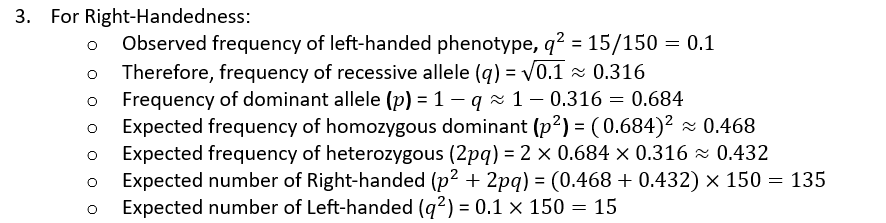
| Handedness | Right-handed (RH) | 135 | 90.00 |
| Left-handed (LH) | 15 | 10.00 |
Prevalence of hereditary traits
7. Results and Analysis
A. Allele Frequency Calculation (Using Hardy-Weinberg Principle):
- For Tongue Rolling:
- Observed frequency of non-rollers (rr phenotype), q² = 38/150 = 0.2533
- Therefore, frequency of recessive allele (q) = √0.2533 ≈ 0.503
- Frequency of dominant allele (p) = 1 – q = 1 – 0.503 = 0.497
- Expected frequency of homozygous dominant (RR) = p² = (0.497) ² = 0.247
- Expected frequency of heterozygous (Rr) = 2pq = 2 * 0.497 * 0.503 = 0.500
- Expected number of Rollers (RR + Rr) = (0.247 + 0.500) * 150 = 112.05
- Expected number of non-Rollers (rr) = (0.253) * 150 = 37.95
- For Earlobe Attachment:
- Observed frequency of attached (ff phenotype), q² = 57/150 = 0.38
- Therefore, frequency of recessive allele (q) = √0.38 ≈ 0.616
- Frequency of dominant allele (p) = 1 – q = 1 – 0.616 = 0.384
- Expected frequency of homozygous dominant (FF) = p² = (0.384) ² = 0.147
- Expected frequency of heterozygous (Ff) = 2pq = 2 * 0.384 * 0.616 = 0.473
- Expected number of Free earlobes (FF + Ff) = (0.147 + 0.473) * 150 = 93.00
- Expected number of Attached earlobes (ff) = (0.38) * 150 = 57.00
Prevalence of hereditary traits
8. Discussion
The results present a nuanced picture of the inheritance of the studied traits. The allele frequency analysis using the Hardy-Weinberg principle yielded expected numbers that were remarkably close to the observed numbers for both traits. However, this only indicates that the population’s genotype frequencies are in equilibrium for these phenotypes, not that the Mendelian model is correct.
The high prevalence of right-handedness (90%) is consistent with global averages. However, the simplistic model of right-handedness as a Mendelian dominant trait is inadequate. Handedness is widely accepted as a complex polygenic trait with strong developmental and potential environmental influences, including prenatal hormone exposure and even cultural factors that may discourage left-handedness.
Limitations of the Study:
- Sample Size and Diversity: The sample of 150, drawn from a single institution, is not large or diverse enough to represent the broader population or different ethnic groups, which may have different allele frequencies.
- Binary Classification: Forcing traits like earlobe attachment into two categories may overlook a continuous range of variation, reducing accuracy.
- Self-Reporting Bias: Tongue-rolling ability may be influenced by practice; some “non-rollers” might learn the skill.
- Oversimplified Models: The analysis is based on the very models being tested. More sophisticated genetic tools would be needed for definitive conclusions.
Prevalence of hereditary traits
9. Conclusion
This investigatory project Prevalence of hereditary traits successfully documented the prevalence of three common human traits in a local population. While the data for tongue rolling appeared consistent with a classical Mendelian dominant-recessive inheritance pattern, the data for earlobe attachment showed a significant statistical deviation from this simple model. Handedness distribution followed known global trends but defies explanation by single-gene inheritance.
The project Prevalence of hereditary traits underscores a critical lesson in genetics: while Mendelian principles provide a powerful starting point, the inheritance of many human traits, even seemingly simple ones, is often more complex. Factors such as polygenic inheritance, gene-environment interactions, and developmental biology play crucial roles. Therefore, textbook examples should be viewed as introductory illustrations rather than definitive genetic rules. This study highlights the importance of empirical investigation and statistical analysis in validating or challenging established biological concepts.
Prevalence of hereditary traits
10. Bibliography
- National Council of Educational Research and Training (NCERT). (2023). Biology, Textbook for Class XII. New Delhi: NCERT. (Principles of Inheritance and Variation).
- Online Resources (for conceptual understanding only):
- Gyan Pankh. https://gyanpankh.com/
- Wikipedia. https://www.wikipedia.org/
11. Annexure
SIMULATED PHENOTYPE DATA FOR 150 INDIVIDUALS
A.1 Purpose
This annex presents the complete, simulated dataset of 150 individuals for three human phenotypic traits: tongue rolling ability, earlobe attachment type, and handedness.
A.2 Data Key
- Tongue Rolling:
- R: Can roll tongue.
- r: Cannot roll tongue.
- Earlobe Attachment:
- F: Free (unattached) earlobe.
- f: Attached earlobe.
- Handedness:
- RH: Predominantly uses right hand.
- LH: Predominantly uses left hand.
A.3 Complete Dataset
The table below lists the simulated phenotype for all 150 individuals.
| Individual ID | Tongue Rolling | Earlobe Attachment | Handedness | Individual ID | Tongue Rolling | Earlobe Attachment | Handedness | Individual ID | Tongue Rolling | Earlobe Attachment | Handedness |
| 1 | R | F | RH | 51 | R | F | RH | 101 | R | f | RH |
| 2 | R | F | RH | 52 | R | f | RH | 102 | R | F | RH |
| 3 | r | f | RH | 53 | r | F | RH | 103 | R | F | RH |
| 4 | R | F | RH | 54 | R | f | RH | 104 | R | f | RH |
| 5 | R | f | RH | 55 | R | F | RH | 105 | r | F | LH |
| 6 | r | F | RH | 56 | R | F | RH | 106 | R | f | RH |
| 7 | R | F | RH | 57 | R | f | RH | 107 | R | F | RH |
| 8 | R | f | RH | 58 | r | f | LH | 108 | R | F | RH |
| 9 | R | F | RH | 59 | R | F | RH | 109 | R | F | RH |
| 10 | R | F | RH | 60 | R | F | RH | 110 | R | f | RH |
| 11 | R | F | LH | 61 | R | F | RH | 111 | r | f | RH |
| 12 | r | f | RH | 62 | R | f | RH | 112 | R | F | RH |
| 13 | R | F | RH | 63 | r | F | RH | 113 | R | f | RH |
| 14 | R | f | RH | 64 | R | f | RH | 114 | R | F | RH |
| 15 | R | F | RH | 65 | R | F | RH | 115 | r | F | RH |
| 16 | r | F | RH | 66 | R | F | RH | 116 | R | f | RH |
| 17 | R | f | RH | 67 | R | F | RH | 117 | R | F | RH |
| 18 | R | F | RH | 68 | R | f | RH | 118 | R | F | RH |
| 19 | R | F | RH | 69 | r | f | RH | 119 | R | F | RH |
| 20 | R | F | RH | 70 | R | F | RH | 120 | R | f | LH |
| 21 | R | f | RH | 71 | R | f | RH | 121 | r | f | RH |
| 22 | r | F | RH | 72 | R | F | RH | 122 | R | F | RH |
| 23 | R | F | RH | 73 | r | F | RH | 123 | R | f | RH |
| 24 | R | f | RH | 74 | R | F | RH | 124 | R | F | RH |
| 25 | R | F | RH | 75 | R | f | RH | 125 | r | F | RH |
| 26 | R | f | RH | 76 | R | F | RH | 126 | R | F | RH |
| 27 | r | F | RH | 77 | R | F | RH | 127 | R | f | RH |
| 28 | R | F | RH | 78 | R | f | RH | 128 | R | F | RH |
| 29 | R | F | RH | 79 | r | F | LH | 129 | R | F | RH |
| 30 | R | f | RH | 80 | R | f | RH | 130 | R | f | RH |
| 31 | R | F | RH | 81 | R | F | RH | 131 | r | F | LH |
| 32 | r | F | RH | 82 | R | F | RH | 132 | R | f | RH |
| 33 | R | f | RH | 83 | R | F | RH | 133 | R | F | RH |
| 34 | R | F | RH | 84 | R | f | RH | 134 | R | F | RH |
| 35 | R | F | RH | 85 | r | f | RH | 135 | R | F | RH |
| 36 | R | F | RH | 86 | R | F | RH | 136 | R | f | RH |
| 37 | R | f | LH | 87 | R | f | RH | 137 | r | f | RH |
| 38 | r | f | RH | 88 | R | F | RH | 138 | R | F | RH |
| 39 | R | F | RH | 89 | r | F | RH | 139 | R | f | RH |
| 40 | R | F | RH | 90 | R | f | RH | 140 | R | F | RH |
| 41 | R | f | RH | 91 | R | F | RH | 141 | r | F | RH |
| 42 | R | F | RH | 92 | R | F | RH | 142 | R | f | RH |
| 43 | r | f | RH | 93 | R | F | RH | 143 | R | F | RH |
| 44 | R | F | RH | 94 | R | f | LH | 144 | R | F | RH |
| 45 | R | f | RH | 95 | r | f | RH | 145 | R | F | RH |
| 46 | R | F | RH | 96 | R | F | RH | 146 | R | f | LH |
| 47 | r | F | RH | 97 | R | f | RH | 147 | r | f | RH |
| 48 | R | f | RH | 98 | R | F | RH | 148 | R | F | RH |
| 49 | R | F | RH | 99 | r | F | RH | 149 | R | f | RH |
| 50 | R | F | RH | 100 | R | F | RH | 150 | r | F | RH |
Click here for any Help, Click here for any Suggestions.