
Science Class 7 CBQ of Electricity Circuits and their Components
Science Class 7 CBQ of Electricity Circuits and their Components
Conceptual Understanding Based Questions
- MCQ: In an incandescent electric lamp, which specific part is responsible for producing light by getting hot and glowing?
- Metal case
- Glass bulb
- Filament
- Metal tip
Assertion (A): An LED (Light Emitting Diode) can glow even if the terminals are connected in any order to a battery.
Reason (R): Unlike incandescent lamps, LEDs allow electric current to pass through them in only one direction.
- Both A and R are factually correct, and R provides the precise logical explanation for A.
- A is true and R is also true, but R does not logically justify or clarify A.
- Assertion A holds true; however, the reason given in R is factually incorrect.
- Assertion A is not valid, but the statement in Reason R is accurate.
- Short Answer: What are the two terminals of an electric cell called, and which part of the cell represents each?
- Short Answer: Define a “battery” in the context of electrical circuits.
- Long Answer: Explain why an incandescent lamp might fail to glow even when the circuit is complete. What is this condition commonly called?
Science Class 7 CBQ of Electricity Circuits and their Components
Application Based Questions
- MCQ: Which of the following is the correct order for connecting two or more cells to form a battery that will make a lamp glow?
- Positive to Positive
- Negative to Negative
- Positive to Negative
- It does not matter
Assertion (A): Electric wires are typically covered with plastic or rubber.
Reason (R): Plastic and rubber are insulators that protect people from receiving electric shocks.
- Both A and R are factually correct, and R provides the precise logical explanation for A.
- A is true and R is also true, but R does not logically justify or clarify A.
- Assertion A holds true; however, the reason given in R is factually incorrect.
- Assertion A is not valid, but the statement in Reason R is accurate.
- Short Answer: Nihal noticed a danger sign on an electric pole. Why is it strictly advised never to experiment with the power supply from wall sockets?
- Short Answer: If you are building a circuit to light an LED, how can you identify the positive terminal of the LED?
- Long Answer: You are given a metal key and a plastic scale. Describe how you would use a “conduction tester” to determine which one is a conductor and which is an insulator.
Science Class 7 CBQ of Electricity Circuits and their Components
Problem Solving & Reasoning Based Questions
- MCQ: In a circuit diagram, what does a long line and a parallel short, thick line represent?
- A switch
- A lamp
- An electric cell
- A battery
- Short Answer: Look at a circuit where the switch is in the “OFF” position. Is this circuit “open” or “closed,” and will the current flow?
- Short Answer: If a battery has four cells connected in a row, and you accidentally reverse one cell so its positive terminal faces the positive terminal of the previous cell, will the circuit work? Justify your answer.
- Short Answer: A student uses a silver wire for a circuit. Will the lamp glow? Why is copper more commonly used for household wiring instead of silver?
- Long Answer:
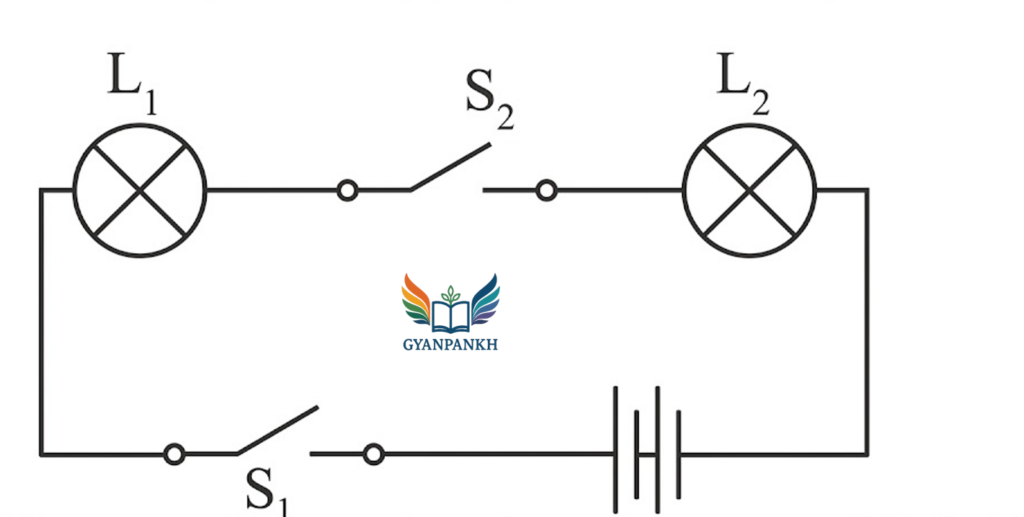
Look at Figure in the text. If S1 is ‘ON’ but S2 is ‘OFF’, explain which lamps (if any) will glow and why.
Science Class 7 CBQ of Electricity Circuits and their Components
Experimentation & Investigation Based Questions
- MCQ: While preparing a switch using drawing pins and a safety pin, the safety pin acts as the:
- Source of energy
- Moving component that completes or breaks the path
- Insulator
- Filament
- Short Answer: How can you prove that current flows from the positive to the negative terminal in a closed circuit?
- Short Answer: You are given an LED and a single cell. Why might the LED fail to glow even if connected correctly? (Hint: Consider the energy required).
- Short Answer: Describe a simple test to check if a discarded cell still has enough electrical energy to be used in a clock.
- Long Answer: Design an experiment to find out if “pencil lead” (graphite) is a conductor or an insulator. Write down the required materials and the procedure to follow.
Science Class 7 CBQ of Electricity Circuits and their Components
Values & Awareness Based Questions
- MCQ: The primary purpose of standardizing electrical symbols globally by organizations like the IEC is:
- To make textbooks look better
- To help people from different countries understand each other easily
- To sell more batteries
- To make science harder
- Short Answer: Why is it important to learn about both conductors and insulators when studying electrical safety?
- Short Answer: How do portable sources like cells and batteries change the way society uses technology compared to stationary wall sockets?
- Short Answer: What value does the “Bhakra Nangal Dam” trip add to Nihal’s understanding of electricity beyond just reading a textbook?
- Long Answer: Discuss the responsibility of a “Science Explorer” when handling electrical appliances at home. List three safety habits every student should follow.
Science Class 7 CBQ of Electricity Circuits and their Components
Case Based Questions
Case 1
Nihal and his classmates observed that electricity is generated in multiple ways—by windmills, solar panels, falling water, and burning fuels. During a trip to a dam, they discovered that the energy from falling water is harnessed to produce electricity. However, for classroom experiments, their teacher warned them not to use the main power supply but only portable cells or batteries.
Question: Why did the teacher advise using only cells or batteries for experiments?
A) Cells generate more electricity than power plants
B) Cells are safer and portable for basic experiments
C) Cells produce alternating current (AC)
D) Cells do not have positive or negative terminals
Case 2
While disassembling a torch, a student found two electric cells placed one after another. She noticed that the positive terminal of one cell touched the negative terminal of the next cell. When she reversed one cell, the torch did not glow. She then connected an LED to a battery using wires. The LED glowed only when its longer wire was connected to the battery’s positive terminal.
Question: What can be concluded from this observation?
A) LEDs glow regardless of terminal connections
B) Cells in a torch are always placed side by side
C) LEDs allow current to pass only in one direction
D) Torches do not require a complete circuit
Case 3
A student made a conduction tester using a cell, a lamp, and two wires with free ends. She tested materials like a metal key, a plastic scale, a wooden block, and a pencil lead. The lamp glowed only with the metal key and the pencil lead. She recorded that the lamp did not glow with plastic or wood. Later, she observed that electric wires are covered with plastic or rubber.
Question: What is the reason for coating electric wires with plastic or rubber?
A) To make wires look attractive
B) To increase the flow of current
C) To prevent electric shock as these are insulators
D) To help the battery last longer
Science Class 7 CBQ of Electricity Circuits and their Components
Case 4
In a circuit diagram, a student drew a battery, a switch in the OFF position, and a lamp. He connected the switch such that there was a gap in the circuit. When he closed the switch, the lamp glowed. He then replaced the incandescent lamp with an LED but forgot to check the terminal connections. The LED did not glow even when the switch was ON.
Question: What is the most likely reason the LED did not glow?
A) The LED’s filament was broken
B) The switch was still in OFF position
C) The battery had no charge left
D) The LED’s positive and negative terminals were reversed
Case 5
A group of students connected two cells in a holder, placing the negative terminal of each cell toward the spring side. They connected a wire from the holder’s positive terminal to the longer wire of an LED and another wire from the holder’s negative terminal to the shorter wire of the LED. The LED glowed. When they interchanged the wires, the LED stopped glowing.
Question: What does this activity demonstrate about electric circuits?
A) LEDs do not need a complete path to glow
B) Current flows from negative to positive terminal
C) The direction of current matters for LEDs but not for incandescent lamps
D) Cells cannot be connected in a holder
Answer Key
Science Class 7 CBQ of Electricity Circuits and their Components
- Conceptual:
- c
- d
- Positive: Metal cap; Negative: Metal disc
- Combination of two or more cells
- Fused; broken filament stops current
- Application:
- c
- a
- High voltage is dangerous/lethal
- Longer wire
- Tester lamp glows for key/conductor; stays dark for scale/insulator
- Reasoning:
- c
- Open; no current
- No; battery connection must be + to –
- Glows; silver is best conductor but copper is cheaper/abundant
- Neither glow; circuit is open at S1 near the battery
- Experiment:
- b
- Observe LED polarity or circuit diagrams
- LEDs often need 2+ cells
- Insert into a working circuit/tester
- Place lead between tester ends; lamp glows
- Values:
- b
- Conductors for use; insulators for safety
- Portability/Convenience
- Real-world generation
- Handle with care; no wet hands; check for damage
- Case Based
- B
- C
- C
- D
- C
Click here for any Help, Click here for any Suggestions.