
Table of Contents
Public perception of biotechnology in food
1. Cover Page, Certificate, and Acknowledgement
the CBSE Class 12 Biology project (Public perception of biotechnology in food) assets — Cover Page, Certificate, and Acknowledgement — in print‑ready format for your investigatory file. (Click to download)
Public perception of biotechnology in food
2. Introduction
2.1 What is Biotechnology?
Biotechnology, as defined by NCERT, is the “application of principles of biology and technology to create products or processes for human welfare.” It encompasses a vast array of techniques, from traditional fermentation used in producing curd and bread to modern genetic engineering. Class XII Biology details that modern biotechnology, especially recombinant DNA technology, allows for the deliberate alteration of an organism’s genetic makeup to produce novel organisms with specific, desirable traits. This project Public perception of biotechnology in food focuses on the application of this modern biotechnology in the agricultural sector, specifically concerning food production.
2.2 Biotechnology in Agriculture: An Overview
The global challenge of ensuring food and nutritional security for a growing population, amidst climate change and shrinking arable land, has propelled biotechnology to the forefront of agricultural innovation. It offers tools to develop crops with enhanced traits such as insect resistance (e.g., Bt cotton), herbicide tolerance, drought tolerance, and improved nutritional content. These advancements aim to increase yield, reduce pesticide use, and improve the nutritional quality of food, directly addressing issues of hunger and malnutrition.
2.3 Genetically Modified (GM) Foods and Biofortified Crops
This project Public perception of biotechnology in food investigates public perception of two key biotechnological applications:
- Genetically Modified (GM) Foods: These are derived from organisms whose genetic material (DNA) has been altered in a way that does not occur naturally by mating or natural recombination. A classic example is Bt brinjal, where a gene from the soil bacterium Bacillus thuringiensis is introduced to confer resistance against fruit and shoot borer. GM foods often face intense public scrutiny.
- Biofortified Crops: These are crops whose nutritional quality has been improved through biological means, which can include conventional breeding, agronomic practices, or modern biotechnology. When biotechnology is used (e.g., Golden Rice, rich in beta-carotene), it is a subset of GM crops. However, the term “biofortification” is also widely associated with non-GM, conventionally bred nutrient-rich crops like iron-rich pearl millet (ICTH 5791) or zinc-rich wheat (WB 02). Public perception often differentiates between the two.
2.4 The Crux of Public Perception
Despite scientific potential, the adoption of agricultural biotechnology is not merely a scientific issue but a socio-political one. Public perception acts as a critical determinant in the commercialization and acceptance of these technologies. Perception is shaped by a complex interplay of factors including awareness levels, trust in regulatory bodies, ethical and religious beliefs, media portrayal, understanding of risk versus benefit, and cultural attitudes towards food and “naturalness.” A gap often exists between the consensus within the scientific community regarding the safety of approved GM crops and public sentiment.
2.5 Need for the Study
In India, the debate around GM crops like Bt cotton (approved), Bt brinjal (moratorium), and GM mustard (under review) has been highly polarized. Simultaneously, government and international agencies are promoting conventionally biofortified crops to combat hidden hunger. Understanding the spectrum of public perception—from outright rejection to cautious acceptance—is essential for effective science communication, informed policymaking, and the responsible development of biotechnology. This project Public perception of biotechnology in food seeks to systematically explore these perceptions within a localized community sample.
Public perception of biotechnology in food
3. Review of literature
3.1 Scientific Consensus and Regulatory Stance
Leading global scientific authorities such as the WHO, the FAO, and the U.S. National Academy of Sciences confirm that commercially available GM foods have undergone rigorous safety assessments and pose no likely risk to human health. The Genetic Engineering Appraisal Committee (GEAC) is India’s primary regulatory authority. However, the regulatory process itself is often questioned by sections of the public and NGOs, affecting trust.
3.2 Global Variations in Perception and Acceptance
Studies reveal stark geographical differences. There is widespread acceptance in the Americas (USA, Canada, Brazil), while precautionary approaches dominate in the European Union. In many developing countries in Asia and Africa, perceptions are evolving, often weighing potential benefits for farmers and nutrition against concerns over corporate control and environmental impact.
3.3 Key Factors Influencing Perception in the Indian Context
Indian studies highlight that perception is influenced by:
- Low Baseline Awareness: General understanding of genetic concepts and biotechnology is limited.
- Media Framing: Sensationalist headlines often highlight risks and controversies over benefits.
- Trust Deficit: Mistrust in multinational seed companies and, to some extent, in domestic regulatory efficacy.
- Socio-cultural Factors: Concepts of food purity and the perception of “tampering with nature” play a role.
- Differentiation of Technologies: Preliminary evidence suggests biofortification (especially non-GM) is viewed more favourably than “GM” due to its association with nutritional benefit and perceived naturalness.
Public perception of biotechnology in food
4. Objectives
- To assess the level of awareness and understanding of GM foods and biofortified crops among a sample of the local adult population.
- To identify the primary sources of information on these technologies and evaluate their perceived trustworthiness.
- To analyse the perceived benefits, risks, and concerns associated with GM foods versus biofortified crops.
- To determine the factors influencing the willingness or reluctance to consume such foods.
Public perception of biotechnology in food
5. Materials and methods
5.1 Study Design and Duration
A descriptive, cross-sectional study was conducted using a survey method. The research was conducted over four weeks.
5.2 Study Population and Sample Size
The study targeted a heterogeneous adult population (aged 20-60 years) in a suburban residential locality. A sample size of 150 individuals was selected using a combination of purposive and convenience sampling to include representation from different educational backgrounds and professions (students, professionals, homemakers, retirees).
5.3 Tool for Data Collection
A structured, anonymous questionnaire was developed (see Appendix). It contained:
- Section A: Demographic details (Age, Gender, Educational Qualification).
- Section B: Questions assessing awareness (Yes/No/Don’t Know) and source of information.
- Section C: Likert-scale questions (Strongly Agree to Strongly Disagree) to gauge perceptions on benefits, risks, and trust.
- Section D: Direct questions on willingness to consume and preferred labels.
5.4 Methodology
- The questionnaire was pre-tested on a small group (n=10) and refined for clarity.
- Respondents were approached individually, and the purpose of the study was explained.
- Written/informed verbal consent was obtained.
- Questionnaires were administered through a mix of online forms and physical copies.
- Data from 150 completely filled questionnaires were compiled and analyzed manually and using basic spreadsheet software (MS Excel). Results were expressed in percentages and presented using tables and bar graphs.
5.5 Ethical Considerations and Limitations
- Participation was voluntary, and anonymity was guaranteed.
- No leading questions were asked to influence responses.
- Limitations: The sample size is limited and localized, not representative of the national population. The use of convenience sampling may introduce bias. Perceptions are dynamic and may change over time.
Public perception of biotechnology in food
6. Observations and results
6.1 Demographic Profile of Respondents
Out of 150 respondents, 52% were male, 48% female. Educational distribution: 20% Up to Senior Secondary, 45% Graduate, 35% Post-Graduate and above.
6.2 Awareness Levels Regarding GM Foods and Biofortified Crops
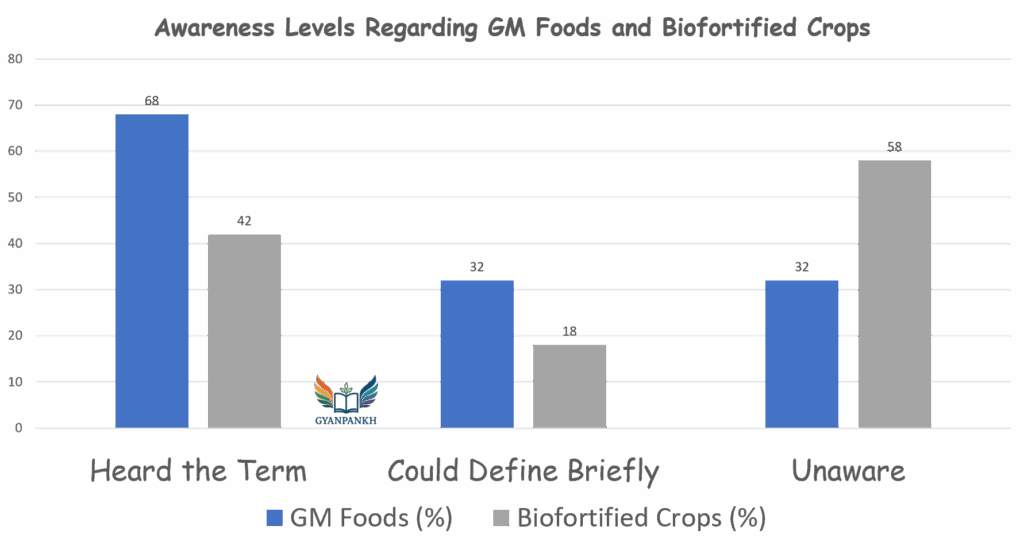
Interpretation: Awareness of GM foods was moderate, but accurate understanding was low. Awareness of biofortified crops was significantly lower.
6.3 Sources of Information and Their Perceived Trustworthiness
- Primary sources for GM information: Newspapers/Magazines (45%), Social Media (30%), Television (15%).
- Trustworthiness: Scientists/Agricultural Universities were rated “Most Trusted” (65%), followed by Government Bodies (35%). Media and Social Media were rated “Least Trusted” for accurate information (70%).
- For biofortification, 40% of those aware cited government health campaigns as their source.
6.4 Perceived Benefits and Risks
- Top Perceived Benefits of GM Crops: Increased crop yield (55%), reduced pesticide use (48%).
- Top Perceived Risks of GM Crops: Long-term health effects unknown (72%), harm to beneficial insects/environment (65%), corporate control over seeds (58%).
- Perception of Biofortified Crops: Over 80% of those aware viewed them positively, associating them with “improved health” and “solving malnutrition.” Concerns were minimal, primarily about taste and cost.
6.5 Willingness to Consume and Influencing Factors
| Statement | Agree/Strongly Agree (%) | Neutral (%) | Disagree/Strongly Disagree (%) |
| I would consume GM foods if approved by authorities. | 38 | 25 | 37 |
| I would prefer biofortified cereals (e.g., iron-rich) over regular ones. | 70 | 20 | 10 |
| Clear “GM” labeling would influence my purchase decision. | 85 | 10 | 5 |
6.6 Comparative Analysis of GM vs. Biofortified Crops
A clear dichotomy was observed. Biofortified crops (particularly non-GM) were perceived as a “beneficial,” “pro-nutrition,” and “farmer-friendly” technology. GM crops were often viewed through a lens of “risk,” “corporate interest,” and “ethical concern,” despite recognized benefits.
Public perception of biotechnology in food
7. Discussion
7.1 Interpreting the Knowledge Gap
The significant gap between having “heard of” a technology and understanding it underscores a major challenge. This knowledge vacuum is often filled by misinformation, making the public susceptible to polarized narratives. Educational qualification showed a positive correlation with awareness but not necessarily with acceptance.
7.2 The Media’s Dual Role and Trust Deficit
While media is the primary informant, its low trust rating reveals a crisis in science communication. Sensationalist reporting on controversies erodes public confidence. The high trust in scientists is a positive finding, suggesting that direct engagement by the scientific community could be more effective.
Public perception of biotechnology in food
7.3 Pragmatism vs. Precaution: A Societal Dilemma
The willingness to consume biofortified crops reflects a pragmatic approach to tangible health benefits. The reluctance towards GM foods embodies the “precautionary principle”—the desire to avoid potential unknown risks, even if scientifically unproven for approved events. The strong demand for labeling affirms the consumer’s right to choose.
7.4 The “Natural” Advantage of Biofortification
Biofortification, especially when framed within conventional breeding, aligns with the perception of “natural improvement.” GM technology, perceived as “gene transfer across species,” is often viewed as “unnatural,” triggering deeper ethical and philosophical concerns.
7.5 Implications for Science Communication and Policy
The study highlights the need for:
- Targeted Educational Campaigns: Integrating balanced perspectives on biotechnology into school curricula and public outreach.
- Transparent and Robust Regulation: Building public trust through transparent, stringent, and independent regulatory processes whose outcomes are communicated effectively.
- Nuanced Communication: Clearly distinguishing between different technologies (e.g., insect-resistant Bt vs. nutritionally enhanced GM), their purposes, and risk-assessment protocols.
- Leveraging Positive Perception: Using the favorable view of biofortification as an entry point to discuss the role of biotechnology in enhancing nutritional security.
Public perception of biotechnology in food
8. Conclusion
This investigatory project Public perception of biotechnology in food concludes that public perception of biotechnology in food within the studied sample is complex, nuanced, and technology-specific. While there is cautious acknowledgment of potential agricultural benefits, significant concerns regarding long-term health and environmental safety of GM foods persist, fueled by a lack of deep understanding and media narratives. In contrast, biofortified crops are perceived as a beneficial and acceptable application aimed directly at human welfare. The findings underscore that public acceptance is not solely a function of scientific evidence but is profoundly shaped by psychological, social, and informational factors.
For India to harness biotechnology responsibly to address food and nutritional security, a sustained, transparent, and dialogical approach to public engagement, moving beyond mere awareness to fostering informed understanding, is not just beneficial but essential.
Public perception of biotechnology in food
9. Bibliography
- National Council of Educational Research and Training (NCERT). (2023). Biology, Class XII Textbook. New Delhi: NCERT. (Biotechnology and Its Applications).
- Government of India, Ministry of Sci & Tech. (2021). Biotechnology: A National Imperative. Retrieved from [DST/DBT Website].
- Genetic Engineering Appraisal Committee (GEAC), Ministry of Envi, Forest and Climate Change. Official Website for regulatory information.
- Indian Council of Agricultural Research (ICAR). (2022). Biofortified Varieties for Nutritional Security. New Delhi: ICAR.
- Online Resources (for conceptual understanding only):
- Gyan Pankh. https://gyanpankh.com/
- Wikipedia. https://www.wikipedia.org/
Public perception of biotechnology in food
10. Appendix
Section A: Demographic Information
- Age: _ _ _ _ _ _
- Gender:
- Male
- Female
- Prefer not to say
- Highest Educational Qualification:
- Senior Secondary
- Graduate
- Post-Graduate
- Other (Specify)
Public perception of biotechnology in food
Section B: Awareness
- Have you heard of Genetically Modified (GM) Foods?
- Yes
- No
- Not Sure
- If Yes, your main source of information is:
- Newspaper
- Magazine
- TV
- Social Media
- School
- College
- Scientist
- Expert
- Other _ _ _ _ _ _ _
- Have you heard of Biofortified Crops (e.g., iron-rich bajra, zinc-rich wheat)?
- Yes
- No
- Not Sure
- If Yes, your main source of information is: ………………………………………
Public perception of biotechnology in food
Section C: Perception (Please tick one for each)
| Statement | Strongly Agree | Agree | Neutral | Disagree | Strongly Disagree |
| GM crops can help increase farmers’ yields. | |||||
| GM foods may have unknown long-term effects on health. | |||||
| Biofortified crops are a good way to fight malnutrition. | |||||
| I trust government approvals for the safety of GM foods. | |||||
| Media reports on GM crops are balanced and reliable. |
Section D: Consumption Preference
- Would you be willing to consume food labelled as “Genetically Modified” if it was approved as safe by Indian authorities?
- Yes, willingly
- Yes, but hesitantly
- No
- Not Sure
- Would you choose to buy biofortified cereals (e.g., high-iron millet) over regular ones if available at a similar price?
- Yes
- No
- Not Sure
- Do you believe mandatory labelling of Genetically Modified ingredients is important for consumers?
- Yes
- No
- Doesn’t matter
Click here for any Help, Click here for any Suggestions.