
Table of Contents
Waste segregation practices among households
1. Cover Page, Certificate, and Acknowledgement
the CBSE Class 11 Biology project assets — Cover Page, Certificate, and Acknowledgement — in print‑ready format for your investigatory file.
2. Objective
The primary objectives of this investigatory project are:
- To assess the current level of awareness and practices regarding waste segregation among households in a selected residential area.
- To identify the types of waste commonly generated and the predominant methods of disposal currently in use.
- To analyse the socio-economic and knowledge-based factors influencing household waste segregation behaviour.
- To correlate the findings with environmental biology concepts, highlighting the ecological impact of improper waste management.
- To suggest simple, actionable recommendations for improving segregation practices at the household level.
Waste segregation practices among households
3. Introduction
Waste management represents one of the most critical environmental challenges of the 21st century, particularly in urban and semi-urban landscapes. As populations grow and consumption patterns evolve, the volume of municipal solid waste (MSW) generated has increased exponentially. Households are the primary contributors to MSW, which comprises a complex mixture of biodegradable (kitchen waste, garden waste), non-biodegradable (plastics, metals, glass), and domestic hazardous waste (sanitary waste, e-waste, cleaning agents).
The unchecked accumulation of unsegregated waste in landfills leads to severe environmental consequences, a core concern in Environmental Biology (as outlined in NCERT Class XII Biology, Chapter 16: Environmental Issues). Decomposing organic matter in anaerobic conditions within landfills produces methane, a potent greenhouse gas contributing to global warming. Leachate from these sites contaminates soil and groundwater with heavy metals and pathogens. Non-biodegradable waste, especially plastics, persists for centuries, causing soil infertility, blocking drainage systems, and posing lethal threats to wildlife through ingestion and entanglement. Incineration of mixed waste releases toxic dioxins and furans into the atmosphere.
The pivotal first step in mitigating these impacts is source segregation—the separation of waste at the point of generation. Segregation facilitates efficient recycling, reduces landfill burden, enables safe processing of hazardous materials, and promotes composting of organic waste, thereby closing the nutrient cycle. This process aligns with the ecological principle of sustainable living, where waste is viewed not as an endpoint but as a resource.
Despite policy initiatives like the Swachh Bharat Mission and the Solid Waste Management Rules, 2016, which mandate source segregation, implementation at the household level remains inconsistent. This project delves into the ground realities of household waste segregation practices, examining the gap between policy and practice through a biological and sociological lens.
Waste segregation practices among households
4. Review of literature
- NCERT Class XII Biology, Chapter 16 (Environmental Issues): This chapter provides the foundational biological context, detailing the adverse effects of solid waste on ecosystems, including soil and water pollution, and the phenomenon of biomagnification of toxic substances. It emphasizes the key principle of Reduce, Reuse, Recycle.
- Solid Waste Management Rules, 2016 (MoEFCC, India): These rules legally mandate the segregation of waste into three streams—Biodegradable, Non-Biodegradable, and Domestic Hazardous Waste—at the source by waste generators, including households.
- Academic Studies: Various studies indicate that effective waste segregation is influenced by a multitude of factors:
- Awareness & Knowledge: Knowledge of proper segregation’s purpose and method drives compliance.
- Infrastructure: Availability of separate bins and consistent waste collection systems significantly affects compliance.
- Socio-demographics: Factors like education level, family income, and age can influence environmental attitudes and practices.
- Perceived Convenience: The extra time and effort required are often cited as barriers to consistent practice.
This project builds upon this understanding to investigate the specific dynamics within a defined community.
Waste segregation practices among households
5. Materials and methodology
A. Study Area and Duration:
- A residential colony (named “Greenwood Estates” for the study) comprising approximately 200 households in a suburban setting was selected.
- The study was conducted over a period of 8 weeks from [Date] to [Date].
B. Sample Selection:
- An unbiased sample was secured using random sampling.
- From the total 200 households, a sample size of 50 households was selected using a random number generator.
- The sample included a mix of independent houses and apartment units.
C. Materials Used:
- Structured Questionnaire: A pre-tested, closed-ended questionnaire (Annexure I) was the primary tool. It covered:
- Section A: Socio-demographic data (family size, education, occupation).
- Section B: Awareness about waste types and segregation rules.
- Section C: Current practices (methods of segregation, types of bins used, disposal frequency).
- Section D: Motivations and perceived challenges.
- Observation Checklist: For a subset of 15 voluntarily participating households, a non-intrusive observation of actual waste handling for one week was conducted to cross-verify self-reported data.
- Digital Tools: Camera (with permission), spreadsheet software (MS Excel) for data tabulation, and graphical tools for representation.
D. Methodology:
- Preliminary Survey & Consent: Verbal consent was obtained from each household head during a brief introductory visit.
- Data Collection:
- The questionnaire was administered through direct interview method to ensure clarity and 100% response rate.
- Interviews were conducted at a time convenient to the residents.
- Observations were recorded discreetly, focusing on the presence of separate bins and the visible mixing of waste types in the common disposal area.
- Data Analysis:
- Quantitative data from questionnaires was compiled in a master table.
- Percentages and proportions were calculated for categorical data.
- Simple correlation was attempted between awareness levels and practice levels.
- Graphical representations (bar graphs, pie charts) were created for key variables.
- Qualitative data on challenges and suggestions were analyzed thematically.
E. Ethical Considerations:
- Anonymity and confidentiality of respondents were maintained. No personal identifiers were recorded.
- Participation was purely voluntary.
Waste segregation practices among households
6. Observations and data analysis
6.1 Socio-Demographic Profile of Respondents:
- Family Size: 68% of households had 3-5 members.
- Education: 82% of the primary respondents were graduates or above.
- Occupation: A mix of salaried professionals (60%), businesspersons (25%), and retirees (15%).
6.2 Awareness Levels:
- Awareness of Segregation Concept: 88% of respondents were aware that waste should be segregated at home.
- Knowledge of Waste Categories: However, only 46% could correctly categorize common household items into Biodegradable (BD), Non-Biodegradable (NBD), and Domestic Hazardous (DHW) as per standard guidelines. Common confusions included:
- Sanitary napkins/diapers (often considered NBD instead of DHW).
- Milk packets (multi-layered packaging) (uncertainty between NBD and BD).
- Used batteries and medicines (low recognition as DHW).
- Source of Awareness: Primary sources were television campaigns (50%), social media (30%), and resident welfare association (RWA) notices (20%).
Table 1: Awareness vs. Correct Knowledge of Categories
| Awareness Parameter | Percentage of Households (%) |
| Heard about Segregation | 88 |
| Knows 2-bin system | 70 |
| Can correctly categorize common waste items | 46 |
Waste segregation practices among households
5.3 Current Waste Segregation Practices:
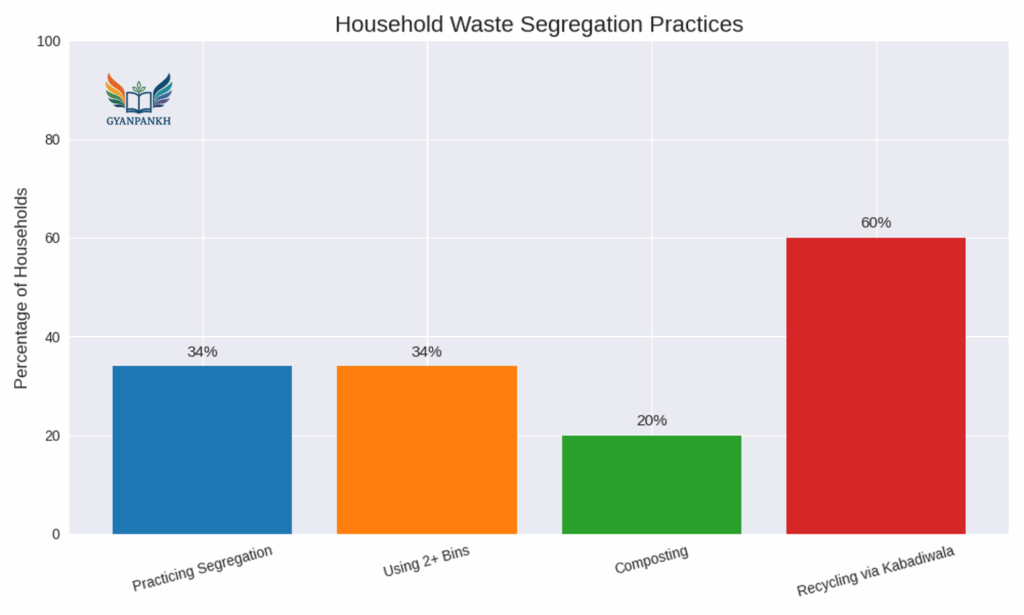
- Segregation at Source: Only 34% (17 out of 50) households reported practicing regular segregation into at least two categories (typically wet and dry).
- Number of Bins Used: 40% used a single bin for all waste, 26% used two bins, and only 8% used three or more bins.
- Disposal Methods:
- Biodegradable Waste: 20% practiced home composting (vermicompost/pot composting). 80% disposed of it with mixed waste.
- Non-Biodegradable Waste: 60% stored recyclables (newspapers, PET bottles) separately for selling to informal kabadiwalas. However, low-value plastics (wrappers, pouches) were almost always mixed.
- Domestic Hazardous Waste: 95% admitted to mixing it with general waste.
6.4 Factors Influencing Behaviour (Thematic Analysis from Open-ended Responses):
- Motivators for Segregating (Among the 34%):
- Environmental concern (cited by 70% of this group).
- Follow RWA rules/avoid fines (30%).
- Setting an example for children (40%).
- Barriers to Segregating (Among the 66% not segregating):
- Lack of Space/Infrastructure: “No space for multiple bins in kitchen.” (55%)
- Perceived Inefficacy: “The waste collector mixes everything back into the truck, so our effort is wasted.” (65%)
- Lack of Knowledge/Confusion: “Not sure which item goes where.” (40%)
- Inconvenience/Habit: “It’s time-consuming; we are used to throwing everything together.” (50%)
6.5 Observation Check Findings:
- In the 15 observed homes, self-reported practice was found to be slightly exaggerated. Only 4 of the 7 households claiming to segregate were found to do so consistently.
- Common contamination observed: food residue in plastic containers, liquid waste in mixed bins.
Waste segregation practices among households
7. Results and discussion
The study reveals a significant disconnect between awareness and actionable knowledge, and between intent and consistent practice.
- High Awareness, Low Precision Knowledge: While 88% awareness is encouraging, the drop to 46% in correct categorization is critical. This knowledge gap, particularly regarding domestic hazardous waste, has direct biological implications. Mixing sanitary waste or batteries with biodegradable waste can introduce pathogens and heavy metals like mercury and cadmium into the environment, disrupting soil microbiota and entering food chains through leachate. This validates the NCERT emphasis on the hazardous nature of certain waste streams.
- The Infrastructure and System Trust Deficit: The most cited barrier—the belief that waste collectors re-mix segregated waste—points to a systemic failure. This demotivates individuals, as the perceived ecological benefit of their effort is nullified. Biology teaches us that a system is only as strong as its weakest link; here, the household’s effort is compromised downstream.
- Selective Recycling vs. Comprehensive Segregation: The prevalent practice of segregating only high-value recyclables (for economic return) while ignoring low-value plastics and hazardous waste is a major concern. Non-biodegradable plastics fragment into microplastics, which are now known to accumulate in aquatic organisms, causing physiological stress and entering the human food web—a clear example of biomagnification potential discussed in NCERT.
- Positive Correlation between Education/Environmental Concern and Practice: Households with higher education levels and expressed environmental concern were more likely to be among the 34% practicing segregation and the 20% practicing composting. Composting is a direct application of the biological principle of decomposition, converting organic waste into humus, enriching soil biology, and reducing methane emissions from landfills.
- The Neglected Stream – Domestic Hazardous Waste: The near-total neglect of this category is alarming. From a biological standpoint, this is the most dangerous stream for ecosystem and human health if not managed separately and treated scientifically.
The findings underscore that improving household segregation requires a multi-pronged strategy targeting knowledge refinement, infrastructure support, and system reliability.
Waste segregation practices among households
8. Conclusion
This investigatory project on household waste segregation practices confirms that while policy-level awareness has permeated the community studied, its translation into effective, consistent, and scientifically sound practice is incomplete. The gap stems primarily from:
- Ambiguous knowledge about waste categorization.
- A lack of trust in the waste collection system.
- Inadequate convenience at the household level.
From a biological perspective, the continued mixing of waste streams perpetuates environmental degradation, soil and water pollution, and loss of recoverable resources. The project highlights that sustainable waste management is not merely a civic issue but a fundamental biological imperative for maintaining ecosystem health and balance.
Future Prospects:
- Biology Integration: School and community workshops can use biological demonstrations (e.g., showing compost formation, effects of plastics on plant growth) to make the impact tangible.
- Simplified Guidelines: Clear, pictorial charts distributed to each household can address knowledge gaps.
- Model Ward Initiative: Creating a zero-waste model lane within the colony with dedicated bins and transparent collection can build trust and serve as a learning example.
In conclusion, empowering households with precise knowledge and integrating their efforts into a reliable municipal chain is essential to transform waste management from a linear “take-make-dispose” model to a circular, biologically sustainable one.
Waste segregation practices among households
9. Bibliography
- National Council of Educational Research and Training (NCERT). (2023). Biology, Textbook for Class XII. Chapter 16: Environmental Issues.
- Ministry of Environment, Forest and Climate Change (MoEFCC), Government of India. (2016). Solid Waste Management Rules, 2016.
- Central Pollution Control Board (CPCB). (2021). Annual Report on Solid Waste Management. Parivesh Bhawan, Delhi.
- Online Resources (for conceptual understanding only):
- Gyan Pankh. https://gyanpankh.com/
- Wikipedia. https://www.wikipedia.org/
Waste segregation practices among households
10. Annexure
Section A: Socio-demographic profile
Please tick (✓) the appropriate option or write in the space provided.
- Type of Residence:
- Independent House
- Apartment (Flat)
- Number of family members residing in the household:
- 1-2
- 3-5
- More than 5
- Highest educational qualification of the primary respondent:
- Up to 10th Standard
- 10+2 (Senior Secondary)
- Graduate
- Post-Graduate and above
- Primary occupation of the head of the household:
- Government/Private Service
- Business/Self-Employed
- Professional (Doctor, Engineer, Lawyer, etc.)
- Retired
- Other: _______________
Waste segregation practices among households
Section B: Awareness about waste and segregation
- Are you aware that waste should be segregated at the source (i.e., at home) before disposal?
- Yes
- No
- If yes, what is your primary source of this information?(You may select more than one)
- Television/Radio
- Newspaper/Magazine
- Social Media/Internet
- Resident Welfare Association (RWA) Notices
- School/College
- Friends/Neighbours
- Municipal Corporation Campaigns
- As per your understanding, into how many main categories should household waste be segregated?
- One (All mixed)
- Two
- Three or more
- Please categorize the following common household waste items as per your knowledge. Tick (✓) in the appropriate column.
| Waste Item | Biodegradable | Non-Biodegradable (Recyclable/Other) | Domestic Hazardous/Sanitary |
| Vegetable/Fruit Peels | |||
| Leftover Cooked Food | |||
| Newspapers/Notebooks | |||
| Plastic Water Bottles | |||
| Glass Bottles/Jars | |||
| Milk Packets (Tetra Pak) | |||
| Used Tea Leaves/Coffee Grounds | |||
| Egg Shells | |||
| Old Batteries (AA, AAA, etc.) | |||
| Expired Medicines | |||
| Used Sanitary Napkins/Diapers | |||
| Plastic Carry Bags/Wrappers | |||
| Dust from Sweeping | |||
| Broken Glass/Ceramics | |||
| Metal Cans (Food/Beverage) |
Waste segregation practices among households
Section C: Current waste management practices
- Do you currently segregate your household waste at home?
- Yes, regularly
- Yes, but only sometimes/partially
- No
- If yes (for Q9), into which categories do you segregate?(You may select more than one)
- Wet/Kitchen Waste (Biodegradable)
- Dry Waste (Paper, Plastic, Metal, Glass)
- Domestic Hazardous (Sanitary, Medicines, Batteries)
- Garden/Yard Waste
- How many separate dustbins/containers do you use for waste collection inside your home?
- One (for all waste)
- Two
- Three
- More than three
- What do you do with your kitchen/food waste (Biodegradable)?
- Put it in a separate bin for municipal collection
- Compost it at home (e.g., vermicompost, pot composting)
- Dispose of it with all other mixed waste
- Other: _______________
- What do you do with recyclable materials like newspapers, plastic bottles, etc.?
- Store separately and sell to a kabadiwala (scrap dealer)
- Give to the municipal waste collector separately
- Dispose of them with all other mixed waste
- Other: _______________
- How do you dispose of domestic hazardous waste like used batteries, old medicines, or used syringes?
- Store separately and dispose of at a designated collection point
- Hand over separately to the waste collector
- Dispose of with general mixed waste
- Other: _______________
- How frequently is waste from your household collected by the municipal authority/private agency?
- Daily
- On alternate days
- Twice a week
- Once a week
- Irregularly
Waste segregation practices among households
Section D: Perceptions and suggestions
- What, in your opinion, is the MAIN BENEFIT of segregating waste at home?
- Helps in recycling and reduces landfill burden
- Good for the environment and reduces pollution
- It is a rule/law, so we must follow
- Keeps the home and locality cleaner
- No significant benefit
- Other: _______________
- What is the BIGGEST CHALLENGE or reason for NOT segregating waste at home?(Select the most significant one)
- Lack of space for multiple bins
- Lack of time/too inconvenient
- Lack of clear knowledge about how to segregate
- The waste collector mixes everything again, so effort is wasted
- No motivation, it’s not a habit
- Other: _______________
- Which of the following would encourage you/your family to segregate waste more consistently?(You may select more than one)
- Provision of two separate coloured bins by the municipality/RWA
- Assurance that segregated waste will not be mixed during collection
- Clear, simple charts/pamphlets on what goes where
- Workshops/demonstrations in the colony
- Rewards/recognition for participating households
- Penalties/fines for not segregating
- Other: _______________
- Any suggestions or comments you would like to give to improve waste management in our locality?
Click here for any Help, Click here for any Suggestions.