
Biology Class 11 CBQ of Photosynthesis in Higher Plants
Ever wonder how plants actually work—not just on paper, but in real life? CBQ of Photosynthesis in Higher Plants help you explore exactly that. Instead of just remembering steps, you get to step into the shoes of a scientist. For example, you might figure out why a plant struggles under red light, or how a farmer could save a stressed crop by understanding how plants make energy.
These aren’t just exam questions—they’re stories where you apply concepts to solve problems. You’ll connect dots between light, reactions, and real-world challenges in farming or environmental care. By doing this, you move from “What happens in photosynthesis?” to “How does this keep life going?”
CBQ of Photosynthesis in Higher Plants train you to think, not just memorize. They help you see the plant’s world—and maybe even discover how to make ours greener.
Section A: Basic MCQs
- Which scientist demonstrated that oxygen released during photosynthesis comes from water?
a) Joseph Priestley
b) Jan Ingenhousz
c) Cornelius van Niel
d) Melvin Calvin - In the Z-scheme of electron transport, where do electrons from PS II move before reaching PS I?
a) Directly to NADP⁺
b) Through an electron transport chain with cytochromes
c) To the Calvin cycle
d) To the stroma lamellae - Which pigment is primarily responsible for the absorption of light in the red and blue regions?
a) Chlorophyll b
b) Xanthophyll
c) Chlorophyll a
d) Carotenoids
CBQ of Photosynthesis in Higher Plants
Section B: Higher-Order Thinking (HOT) MCQs
- A plant is exposed to light of wavelength 700 nm only. Which process will be least affected?
a) Splitting of water
b) Cyclic photophosphorylation
c) Non-cyclic photophosphorylation
d) Photorespiration - If RuBisCO’s oxygenase activity increases in a C₃ plant, what will be the immediate outcome?
a) Higher glucose production
b) Increased photorespiration and reduced CO₂ fixation
c) Enhanced ATP synthesis
d) More NADPH formation - In C₄ plants, why does photorespiration not occur under normal conditions?
a) They lack RuBisCO
b) They have Kranz anatomy and high CO₂ concentration in bundle sheath cells
c) They do not perform the Calvin cycle
d) They lack mesophyll cells
CBQ of Photosynthesis in Higher Plants
Section C: Diagram-Based MCQs
Refer to the diagram below for questions 7–9.
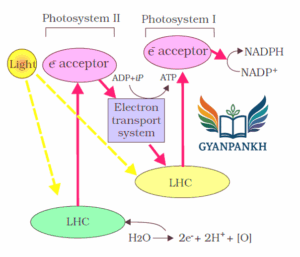
- In the Z-scheme, what is the role of the molecule labeled “P680”?
a) Final electron acceptor for NADPH synthesis
b) Reaction center of PS II that absorbs 680 nm light
c) Enzyme for CO₂ fixation
d) Proton pump in ATP synthase - Which part of the diagram directly illustrates the movement of electrons that leads to proton gradient formation?
a) Arrow from H₂O to PS II
b) Electron transport chain between PS II and PS I
c) NADP⁺ reduction to NADPH
d) Cyclic flow around PS I - If the electron flow between PS II and PS I is blocked, which product will not be formed?
a) ATP only
b) NADPH only
c) Both ATP and NADPH
d) O₂ only
CBQ of Photosynthesis in Higher Plants
Section D: Data Analysis MCQs
Use the table below for question 10:
| Light Intensity (% of full sun) | CO₂ Fixation Rate (μmol/m²/s) |
| 10 | 5 |
| 30 | 15 |
| 60 | 20 |
| 100 | 20 |
- At which light intensity does CO₂ fixation become limited by a factor other than light?
a) 10%
b) 30%
c) 60%
d) 100%
Use the table below for question 11:
| Plant Type | CO₂ Saturation Point (μL/L) | Temperature Optimum (°C) |
| C₃ | 450 | 20–25 |
| C₄ | 360 | 30–40 |
- At an atmospheric CO₂ level of 400 μL/L and a temperature of 35°C, which plant type will likely photosynthesize more efficiently?
a) C₃ plant
b) C₄ plant
c) Both equally
d) Cannot be determined
Use the table below for question 12:
| Photorespiration Level | ATP Used (per cycle) | CO₂ Released (per cycle) |
| High | 5 | 2 |
| Low | 0 | 0 |
- If photorespiration is high in a C₃ plant, what is the net effect on sugar production?
a) Increased due to more ATP
b) Decreased due to loss of CO₂ and ATP
c) Unchanged
d) Increased due to O₂ release
CBQ of Photosynthesis in Higher Plants
Section E: Assertion-Reason MCQs
- Both A and R are factually correct, and R provides the precise logical explanation for A.
- A is true and R is also true, but R does not logically justify or clarify A.
- Assertion A holds true; however, the reason given in R is factually incorrect.
- Assertion A is not valid, but the statement in Reason R is accurate.
- Assertion (A): C₄ plants are more productive in tropical climates than C₃ plants.
Reason (R): C₄ plants lack photorespiration and have higher temperature optima. - Assertion (A): Cyclic photophosphorylation does not produce NADPH.
Reason (R): Electrons in cyclic flow return to PS I and are not transferred to NADP⁺. - Assertion (A): The first product of CO₂ fixation in C₄ plants is a 4-carbon compound.
Reason (R): C₄ plants use PEP carboxylase in mesophyll cells for initial CO₂ fixation.
CBQ of Photosynthesis in Higher Plants
Section F: Case-Based MCQs
Case 1:
A researcher grows two sets of plants under identical light and temperature conditions but provides one set with 0.04% CO₂ and the other with 0.01% CO₂. After a week, the set with lower CO₂ shows stunted growth, yellowing leaves, and reduced starch in chloroplasts. The researcher concludes that CO₂ is a limiting factor for photosynthesis.
- Which experimental setup from the early photosynthesis studies does this most closely resemble?
a) Priestley’s candle and mint experiment
b) Ingenhousz’s aquatic plant experiment
c) Sachs’ starch production experiment
d) Engelmann’s Cladophora and bacteria experiment - Why did the low-CO₂ plants show yellowing leaves?
a) Increased chlorophyll production
b) Photo-oxidation due to excess light
c) Reduced sugar production leading to chlorophyll degradation
d) Enhanced photorespiration
Case 2:
A farmer in a hot, dry region notices that his maize (C₄) crops are thriving while his wheat (C₃) crops are wilting and producing lower yields, despite adequate irrigation. He learns that maize has Kranz anatomy and uses the Hatch–Slack pathway, which minimizes photorespiration.
- What structural advantage does maize have over wheat in these conditions?
a) More stomata per leaf
b) Bundle sheath cells with thick walls and abundant chloroplasts
c) Larger mesophyll cells
d) Higher RuBisCO concentration in mesophyll - Why is wheat more affected by high temperatures?
a) It lacks PEP carboxylase
b) It undergoes more photorespiration, wasting ATP and CO₂
c) It cannot absorb light efficiently
d) It has no Calvin cycle
CBQ of Photosynthesis in Higher Plants
Section G: Scenario-Based HOT MCQs with Tabular Data
Scenario 1:
A greenhouse manager wants to optimize CO₂ levels for tomato (C₃) and maize (C₄) plants. The table below shows net photosynthesis rates (μmol CO₂/m²/s) under different CO₂ concentrations.
| CO₂ (μL/L) | Tomato (C₃) | Maize (C₄) |
| 200 | 10 | 25 |
| 400 | 20 | 35 |
| 600 | 30 | 36 |
| 800 | 32 | 36 |
Goal: Maximize yield while minimizing cost of CO₂ supplementation.
- At which CO₂ level does maize show saturation?
a) 200 μL/L
b) 400 μL/L
c) 600 μL/L
d) 800 μL/L
Scenario 2:
A student measures ATP and NADPH production in chloroplasts under two light conditions: red light (680 nm) and far-red light (700 nm). Data is below:
| Light Condition | ATP produced | NADPH produced |
| 680 nm | High | High |
| 700 nm | Moderate | Low |
Goal: Determine which photosystem is primarily activated by each wavelength.
- Why is NADPH production low under 700 nm light?
a) PS I is inactive, so no electron flow to NADP⁺
b) Cyclic photophosphorylation dominates
c) Water splitting is inhibited
d) RuBisCO activity is reduced
Scenario 3:
A botanist compares photorespiration in C₃ and C₄ plants under varying O₂/CO₂ ratios. Data is below:
| O₂/CO₂ Ratio | C₃ Photorespiration | C₄ Photorespiration |
| Low (0.5) | Low | Negligible |
| High (2.0) | High | Negligible |
Goal: Select the best environment to grow spinach (C₃) without yield loss.
- Which O₂/CO₂ ratio should be maintained?
a) Low O₂/CO₂ ratio
b) High O₂/CO₂ ratio
c) Equal O₂ and CO₂
d) Ratio does not matter
Section H: Short Answer Type
- What is the primary role of accessory pigments like chlorophyll b and carotenoids in photosynthesis?
- Name the enzyme responsible for the carboxylation of RuBP in the Calvin cycle, and mention its dual function.
- Why does photorespiration decrease the efficiency of photosynthesis in C₃ plants?
- What is meant by “Kranz anatomy” in C₄ plants?
- According to Blackman’s Law of Limiting Factors, what determines the rate of photosynthesis when multiple factors are involved?
Section I: Higher Order Thinking (HOT)
- If a C₄ plant is exposed to very low CO₂ conditions, how does its bundle sheath cell mechanism still maintain higher photosynthetic efficiency compared to a C₃ plant?
- Explain why cyclic photophosphorylation occurs mainly in stroma lamellae and not in grana thylakoids.
- Why do C₄ plants show less photorespiration even when RuBisCO is present in their bundle sheath cells?
- If a plant is kept under only blue and red light, will it photosynthesize better than under green light? Justify based on pigment absorption spectra.
- How does the chemiosmotic hypothesis explain ATP synthesis in chloroplasts differently from ATP synthesis in mitochondria?
Section J: Diagram-Based Questions
- Sketch and label the Z-scheme of electron transport in photosynthesis, indicating PS I, PS II, and the direction of electron flow.
- Draw a simplified Calvin cycle showing the three main stages: carboxylation, reduction, and regeneration.
- Illustrate the Hatch–Slack (C₄) pathway, showing movement of compounds between mesophyll and bundle sheath cells.
- Label the structure of a chloroplast as seen under an electron microscope, highlighting grana, stroma, and thylakoid membranes.
Section K: Case-Based Questions
- Case 1: The Greenhouse Experiment
A farmer grows tomatoes in two separate greenhouses. Greenhouse A is maintained at normal atmospheric CO₂ levels (0.04%), while Greenhouse B is enriched with CO₂ to 0.08%. All other conditions (light, water, temperature) are identical. After several weeks, plants in Greenhouse B show significantly higher biomass and fruit yield.
Questions:
- Explain the physiological reason behind the increased productivity in Greenhouse B.
- Would enriching CO₂ have the same effect on a C₄ plant like maize? Justify your answer based on CO₂ saturation points.
- According to Blackman’s Law of Limiting Factors, why might increasing CO₂ further beyond 0.08% not continue to increase yield?
- Case 2: Leaf Pigment Investigation
A student performs paper chromatography on a spinach leaf extract and observes four distinct pigment bands: bright green, yellow-green, yellow, and yellow-orange. She then measures the rate of photosynthesis under different wavelengths of light and finds it is highest in blue and red regions.
Questions:
- Identify the four pigments separated in the chromatogram.
- Why is photosynthesis rate highest in blue and red light, even though green light is most reflected by leaves?
- What role do the yellow and yellow-orange pigments play in photosynthesis besides light absorption?
- Case 3: Photosynthesis in Extreme Environments
In a dry, hot region, two types of plants are found: Plant X (a C₃ plant) and Plant Y (a C₄ plant like sorghum). During midday, when temperatures are highest and stomata are partially closed, Plant X shows reduced growth and signs of stress, while Plant Y continues to thrive.
Questions:
- Explain why Plant Y is more efficient under high temperature and limited CO₂ conditions.
- What is photorespiration and why does it affect Plant X more than Plant Y?
- How does the leaf anatomy of Plant Y (Kranz anatomy) support its photosynthetic efficiency?
- Case 4: Light Reaction Malfunction
In a laboratory experiment, a mutant plant is found that lacks Photosystem II (PS II) but has a fully functional Photosystem I (PS I). When exposed to light, this plant does not produce oxygen but can still synthesize some ATP.
Questions:
- Why does this plant fail to produce oxygen?
- How is ATP still being produced in the absence of PS II? Name the process.
- Could this plant survive in nature? Give reasons based on the products of photosynthesis it can and cannot produce.
- Calvin Cycle and Energy Requirements
(a) How many molecules of ATP and NADPH are required to fix one molecule of CO₂ in the Calvin cycle?
(b) Why is the term “dark reaction” considered a misnomer for the biosynthetic phase of photosynthesis?
- C₄ Pathway and Leaf Anatomy
(a) What is “Kranz anatomy” and in which type of plants is it found?
(b) Which enzyme is present in the mesophyll cells of C₄ plants for initial CO₂ fixation, and which enzyme is abundant in the bundle sheath cells?
- Factors Affecting Photosynthesis
(a) According to Blackman’s Law of Limiting Factors, what determines the rate of photosynthesis when multiple factors are involved?
(b) Why does water stress lead to a reduction in the rate of photosynthesis, even though water is a reactant in the light reaction?
44.
Passage:
Melvin Calvin used radioactive carbon-14 to trace the pathway of carbon assimilation in photosynthesis. He discovered that the first stable product formed after CO₂ fixation was a 3-carbon organic acid. This led to the understanding of the Calvin cycle, where CO₂ is fixed into ribulose bisphosphate by the enzyme RuBisCO.
(a) What was the name given to the first CO₂ fixation product discovered by Calvin?
(b) How many carbon atoms does this first product contain?
(c) Name the enzyme that catalyzes the carboxylation of RuBP.
45.
Passage:
In C₄ plants, the primary CO₂ acceptor is phosphoenolpyruvate (PEP), and the first stable product is oxaloacetic acid (OAA). These plants show Kranz anatomy, where bundle sheath cells surround the vascular bundles and are rich in chloroplasts. The Calvin cycle occurs only in these bundle sheath cells.
(a) What is the primary CO₂ acceptor in C₄ plants?
(b) What is the first stable product of CO₂ fixation in these plants?
(c) Why is the anatomy of C₄ leaves referred to as “Kranz anatomy”?
46.
Passage:
The light reactions of photosynthesis involve two photosystems: PS I and PS II. PS II has a reaction center chlorophyll a that absorbs light at 680 nm (P680), while PS I absorbs at 700 nm (P700). Electrons released from PS II are passed through an electron transport chain to PS I and finally reduce NADP⁺ to NADPH.
(a) What are the absorption maxima of the reaction center chlorophylls in PS II and PS I?
(b) What is the final electron acceptor in the light reactions?
(c) What is the name of the scheme that describes the electron flow from PS II to PS I?
47.
Passage:
Photorespiration is a process that occurs in C₃ plants when RuBisCO binds oxygen instead of CO₂, leading to the formation of phosphoglycolate. This process results in the loss of fixed carbon and energy, as no sugar or ATP is synthesized.
(a) Why does photorespiration occur in C₃ plants?
(b) What are the two products formed when RuBisCO acts as an oxygenase?
(c) Why is photorespiration considered a wasteful process?
48.
Passage:
Blackman’s Law of Limiting Factors states that if a physiological process is controlled by more than one factor, its rate will be determined by the factor nearest to its minimal value. In photosynthesis, factors such as light intensity, CO₂ concentration, and temperature can become limiting under certain conditions.
- State Blackman’s Law of Limiting Factors.
(b) Give one example of how temperature can act as a limiting factor in photosynthesis.
(c) Why is light rarely a limiting factor in natural conditions for most plants?
CBQ of Photosynthesis in Higher Plants
Answer Key:
1-c Cornelius van Niel
2-b Through an electron transport chain with cytochromes
3-c Chlorophyll a
4-b Cyclic photophosphorylation
5-b Increased photorespiration and reduced CO₂ fixation
6-b They have Kranz anatomy and high CO₂ concentration in bundle sheath cells
7-b Reaction center of PS II that absorbs 680 nm light
8-b Electron transport chain between PS II and PS I
9-b NADPH only
10-c 60%
11-b C₄ plant
12-b Decreased due to loss of CO₂ and ATP
13-a Both A and R are factually correct, and R provides the precise logical explanation for A.
14-a Both A and R are factually correct, and R provides the precise logical explanation for A.
15-a Both A and R are factually correct, and R provides the precise logical explanation for A.
16-c Sachs’ starch production experiment
17-c Reduced sugar production leading to chlorophyll degradation
18-b Bundle sheath cells with thick walls and abundant chloroplasts
19-b It undergoes more photorespiration, wasting ATP and CO₂
20-c 600 μL/L
21-b Cyclic photophosphorylation dominates
22-a Low O₂/CO₂ ratio
- Accessory pigments extend the range of light absorption and transfer energy to chlorophyll *a*, while also protecting chlorophyll from photo-oxidation.
- RuBisCO (Ribulose-1,5-bisphosphate carboxylase/oxygenase) — it catalyzes both carboxylation (in Calvin cycle) and oxygenation (leading to photorespiration).
- Photorespiration wastes fixed carbon and energy, reduces net CO₂ fixation, and produces no ATP or sugars.
- Kranz anatomy refers to the wreath-like arrangement of bundle sheath cells around vascular bundles in C₄ leaves, with distinct mesophyll and bundle sheath chloroplasts.
- According to Blackman’s Law, the rate is limited by the factor nearest to its minimal value when multiple factors are involved.
- C₄ plants use PEP carboxylase in mesophyll cells to fix CO₂ into 4‑C compounds (e.g., malate), which shuttle CO₂ to bundle sheath cells, concentrating CO₂ near RuBisCO and suppressing photorespiration even under low atmospheric CO₂.
- Cyclic photophosphorylation occurs mainly in stroma lamellae because PS I is more abundant there, and cyclic flow involves only PS I and cytochrome b₆f, without PS II (which is in grana).
- C₄ plants minimize photorespiration by concentrating CO₂ in bundle sheath cells via the C₄ pathway, keeping RuBisCO in a high‑CO₂ environment.
- Yes — chlorophylls absorb strongly in blue and red light, while green light is mostly reflected. Accessory pigments like carotenoids also absorb blue light, making these wavelengths more effective for photosynthesis.
- In chloroplasts, ATP synthesis is driven by a proton gradient across the thylakoid membrane (lumen acidic, stroma alkaline), using light energy. In mitochondria, the proton gradient is across the inner membrane (intermembrane space acidic, matrix alkaline), using energy from electron transport driven by oxidation of nutrients.
37.
- Higher CO₂ concentration increases substrate availability for RuBisCO, enhancing carboxylation and reducing photorespiration in C₃ plants.
- Less effect on C₄ plants — they already have a CO₂‑concentrating mechanism and are near saturation at normal CO₂ levels.
- Beyond a point, another factor (e.g., light, temperature, nutrient availability) becomes limiting, so further CO₂ increase yields no additional gain.
38.
- Bright green = chlorophyll *a*, yellow‑green = chlorophyll *b*, yellow = xanthophylls, yellow‑orange = carotenes.
- Blue and red light are strongly absorbed by chlorophylls; green light is poorly absorbed and mostly reflected.
- Yellow/orange pigments (carotenoids) act as photoprotectors (quench triplet chlorophyll, scavenge ROS) and broaden light absorption.
39.
- Plant Y (C₄) has a CO₂‑concentrating mechanism that maintains high CO₂ around RuBisCO even when stomata are closed, reducing water loss and photorespiration.
- Photorespiration occurs when RuBisCO binds O₂ instead of CO₂, wasting energy and carbon. It affects C₃ plants more because they lack CO₂‑concentrating mechanisms.
- Kranz anatomy spatially separates initial CO₂ fixation (mesophyll) from Calvin cycle (bundle sheath), allowing efficient CO₂ pumping.
40.
- Oxygen comes from water splitting in PS II — without PS II, no water oxidation occurs.
- ATP is produced via cyclic photophosphorylation using only PS I and cytochrome b₆f.
- Unlikely to survive — it cannot produce NADPH or oxygen, and cannot fix CO₂ via Calvin cycle (requires both ATP and NADPH).
41.
(a) 3 ATP + 2 NADPH per CO₂ fixed.
(b) “Dark reaction” is misleading — the Calvin cycle depends on ATP and NADPH from light reactions and is often active in light.
42.
(a) Kranz anatomy — found in C₄ plants.
(b) Mesophyll: PEP carboxylase; Bundle sheath: RuBisCO.
43.
(a) Rate determined by the factor nearest its minimal value.
(b) Water stress closes stomata, reducing CO₂ entry; also affects turgor and metabolic processes.
44.
(a) 3‑phosphoglyceric acid (3‑PGA)
(b) 3 carbon atoms
(c) RuBisCO
45.
(a) Phosphoenolpyruvate (PEP)
(b) Oxaloacetic acid (OAA)
(c) Because bundle sheath cells form a wreath‑like (Kranz) layer around vascular bundles.
46.
(a) PS II: 680 nm (P680), PS I: 700 nm (P700)
(b) NADP⁺ (reduced to NADPH)
(c) Z‑scheme
47.
(a) Due to oxygenation activity of RuBisCO when CO₂ is low/O₂ is high.
(b) Phosphoglycolate and 3‑PGA
(c) It consumes ATP and releases CO₂ without producing sugars.
48.
(a) The rate of a process is limited by the factor nearest its minimal value.
(b) At low temperatures, enzyme activity (e.g., RuBisCO) decreases; at high temperatures, enzymes denature.
(c) Because in natural daylight, light intensity is usually sufficient except under dense canopies or shading.
Click here for any Help, Click here for any Suggestions.