
Biology Lab Etiquette: DO’s & DON’Ts for a Safe & Smart Workspace
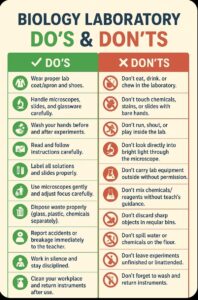
Biology Lab Etiquette: The biology laboratory is more than just a room filled with microscopes, reagents, and glassware—it is a space where curiosity meets discipline, and where discovery depends on responsibility. Every experiment, whether simple or complex, is shaped not only by scientific method but also by the way we conduct ourselves in the lab. This is where Biology Lab Etiquette comes in: a set of practices that safeguard both people and science.
A well‑run lab is not defined solely by results. It is defined by respect—for safety, for precision, for the tools we use, and for the people who share the workspace. Etiquette in the lab is not about rigid rules; it is about cultivating habits that make science sustainable, trustworthy, and inspiring.
Why Biology Lab Etiquette Matters
Imagine a classroom where students rush around, glass slides are left unlabelled, and chemicals are mixed without supervision. The outcome is not discovery—it is chaos. On the other hand, picture a lab where students dress properly, follow instructions, and clean up after themselves. That environment becomes a place of confidence, where mistakes are minimized and learning flourishes.
Biology Lab Etiquette matters because:
- It protects students and teachers from accidents.
- It ensures experiments yield reliable results.
- It builds a culture of accountability and respect.
- It transforms the lab into a professional space, preparing learners for future scientific work.
In short, etiquette is the invisible framework that holds science together.
DO’s: Smart Habits for Every Biologist
The “DOs” of Biology Lab Etiquette are not just safety rules—they are rituals that build trust and precision. Great scientists know that discipline is the foundation of discovery.
- Dress the Part: Always wear a lab coat or apron and closed shoes. Protective clothing is not a fashion statement; it is your Armor against spills, splashes, and accidents.
- Handle with Care: Microscopes, slides, and glassware are fragile and expensive. Treat them as if they were surgical instruments—delicate, precise, and irreplaceable.
- Wash Your Hands: Before and after experiments, handwashing prevents contamination and protects you from harmful substances.
- Follow Instructions: Protocols exist for a reason. Curiosity is welcome, but recklessness is dangerous. Read carefully, and respect the process.
- Label Everything: A slide without a label is a mystery waiting to become a mistake. Clear labelling prevents confusion and ensures accountability.
- Focus Gently: Adjust microscopes slowly and precisely. Rushing can damage specimens or strain your eyes.
- Prepare Separately: Acids, plastics, and chemicals should be handled in isolation. Mixing without care can lead to unwanted reactions.
- Report Accidents Immediately: Breakage or spills must be reported to your teacher or supervisor. Silence only makes problems worse.
- Stay Disciplined: Silence in the lab is not about strictness—it is about safety. Focused minds make fewer mistakes.
- Clean Up Thoroughly: Leave your station cleaner than you found it. Respect the next explorer by ensuring they inherit a safe workspace.
These habits are the backbone of a safe and smart laboratory. They transform the lab from a room of potential hazards into a sanctuary of learning.
DON’Ts: Hazards to Avoid at All Costs
Just as important as the DO’s are the DON’Ts—the pitfalls that can turn a promising experiment into a dangerous mess. Biology Lab Etiquette is about knowing what not to do as much as it is about knowing what to do.
- No Eating or Drinking: The lab is not a café. Food and chemicals do not mix.
- No Bare-Handed Contact: Gloves or tools must be used when handling chemicals and slides. Bare hands invite contamination and injury.
- No Horseplay: Running, shouting, or playing in the lab is reckless. Science demands discipline, not chaos.
- Don’t Stare into Bright Light: Especially through a microscope. Protect your vision—it is one of your greatest scientific tools.
- Don’t Remove Equipment: Lab tools stay in the lab unless explicit permission is given. Equipment theft disrupts learning and damages trust.
- Don’t Mix Freestyle: Reagents and chemicals should only be combined under supervision. Improvisation in science is dangerous.
- Don’t Be Careless: Mishandling slides or chemicals can ruin results and cause injury. Precision is non‑negotiable.
- Don’t Leave Experiments Unattended: Science requires supervision. Abandoning experiments risks accidents and invalid results.
- Don’t Skip Cleanup: Washing and returning instruments is part of the process. Skipping cleanup is disrespectful and unsafe.
- Don’t Forget What You’ve Used: Keep track of tools and materials. Accountability is a cornerstone of scientific integrity.
Avoiding these hazards is not about fear—it is about respect. Respect for science, respect for safety, and respect for each other.
The Balance of Discipline and Discovery
Some students worry that etiquette stifles creativity. In reality, Biology Lab Etiquette creates the conditions for creativity to thrive. When safety and discipline are in place, students can focus on discovery without distraction.
Think of etiquette as the scaffolding of a building. Without scaffolding, construction collapses. With scaffolding, builders can create something extraordinary. Similarly, etiquette provides the structure that allows scientific imagination to flourish.
Etiquette as a Mindset
The most important lesson is that etiquette is not just about following rules—it is about cultivating a mindset. A mindset of:
- Respect: For tools, for protocols, for people.
- Curiosity: Asking questions within the boundaries of safety.
- Care: Treating every experiment as valuable.
- Accountability: Owning your actions and their consequences.
When students embrace this mindset, they are not just learning biology—they are learning how to be scientists.
Practical Classroom Applications
Teachers can reinforce Biology Lab Etiquette by:
- Displaying posters that list DO’s and DON’Ts.
- Modelling proper behaviour during demonstrations.
- Encouraging students to reflect on why etiquette matters.
- Rewarding discipline and responsibility, not just correct results.
Students, in turn, can practice etiquette by:
- Preparing lab journals that include notes on safety.
- Helping peers remember to label and clean up.
- Treating the lab as a shared community space.
These practices make etiquette part of everyday learning, not just a checklist.
A Culture of Respect
Ultimately, Biology Lab Etiquette is about culture. A culture where safety is valued, curiosity is encouraged, and respect is non‑negotiable. In such a culture, accidents are rare, experiments are reliable, and students feel empowered to explore.
This culture does not emerge overnight. It is built through consistent practice, through teachers modelling discipline, and through students embracing responsibility. Over time, etiquette becomes second nature—an instinct that guides every action in the lab.
Conclusion: Science with Responsibility
The biology lab is where theory meets reality. It is where students move from textbooks to microscopes, from diagrams to discoveries. But without etiquette, the lab becomes a place of risk rather than reward.
By following the DO’s and avoiding the DON’Ts, students and teachers alike create a safe, smart, and inspiring workspace. Biology Lab Etiquette is not about avoiding trouble—it is about cultivating respect, curiosity, and care. It is about shaping not only how we learn but also how we lead.
Whether you are a student peering through a microscope for the first time, a teacher guiding young scientists, or a budding researcher preparing for a career in science, remember: etiquette is the foundation of discovery. Dress properly, handle tools with care, follow instructions, and clean up responsibly. Avoid chaos, carelessness, and shortcuts.
In the end, science is not just about results—it is about responsibility. And responsibility begins with Biology Lab Etiquette.
Comparison Chart: on Biology Lab Etiquette Do’s vs Don’ts
| BIOLOGY LABORATORY DO’S & DON’TS | |
| DO’s: What Great Scientists Always Do | DON’Ts: What to Avoid at All Costs |
| Suit Up: Lab coat, closed shoes—your safety armor | No Snacks: Food and science don’t mix |
| Handle Gently: Treat microscopes and glassware like precision tools | No Bare Hands: Gloves on. Safety first |
| Stay Clean: Wash hands before and after every experiment | No Chaos: No running, shouting, or playing |
| Follow Protocols: Read instructions. Respect the process | No Staring: Bright light + microscope = eye strain |
| Label Clearly: Every slide, every solution—no mysteries allowed | No Equipment Theft: Lab tools stay in the lab |
| Focus Softly: Adjust microscopes with care | No Freestyle Mixing: Always follow guidance |
| Separate Prep: Mix acids, plastics, and chemicals responsibly | No Carelessness: Handle slides and chemicals with precision |
| Report Fast: Accidents? Speak up immediately | No Abandonment: Never leave experiments unattended. |
| Stay Sharp: Silence = safety. Discipline = discovery | No Skipped Cleanup: Wash and return instruments |
| Clean Up: Leave no trace. Respect the next explorer | No Forgetting: Track what you use. Own your process |
Click here for any Help, Click here for any Suggestions.
Clear DO’s & DON’Ts make biology labs safe, smart, and professional—students learn discipline while avoiding risks in scientific exploration.
Biology Lab Etiquette ensures safety and discipline—clear DO’s build professionalism, while DON’Ts prevent risks, creating a smart, respectful workspace.
Biology Lab Etiquette: DO’s & DON’Ts—Stay safe, smart, and professional; follow rules, avoid risks, and build a culture of respect in science spaces.