
Table of Contents
DNA fingerprinting and its applications
1. Cover Page, Certificate, and Acknowledgement
the CBSE Class 12 biology project (DNA fingerprinting and its applications) assets — Cover Page, Certificate, and Acknowledgement — in print‑ready format for your investigatory file. (Click to download)
2. Objective
The primary objectives of this investigatory project (DNA fingerprinting and its applications) are:
- To understand the fundamental principles and the underlying molecular biology of DNA fingerprinting technology.
- To study the detailed step-by-step methodology involved in creating a DNA fingerprint.
- To analyse and explore the multifaceted applications of DNA fingerprinting in various fields such as forensic science, paternity disputes, biodiversity conservation, and medical diagnostics.
- To appreciate the ethical and legal considerations associated with the use of this powerful biological tool.
DNA fingerprinting and its applications
3. Introduction
In humans and most organisms, DNA is the hereditary material found in virtually every cell. Comprising about 3 billion base pairs and 20,000 genes, the human genome is organized into 23 pairs of chromosomes. While over 99.9% of the human DNA sequence is the same across all individuals, a small fraction (approximately 0.1%) is unique to every individual (except identical twins). This polymorphism forms the bedrock of DNA fingerprinting.
DNA fingerprinting, also known as DNA profiling or genetic fingerprinting, is a revolutionary technique developed in 1984 by British geneticist Sir Alec Jeffreys at the University of Leicester. It is a laboratory method used to determine the probable identity of a person based on the nucleotide sequences of certain regions of human DNA that are unique to individuals.
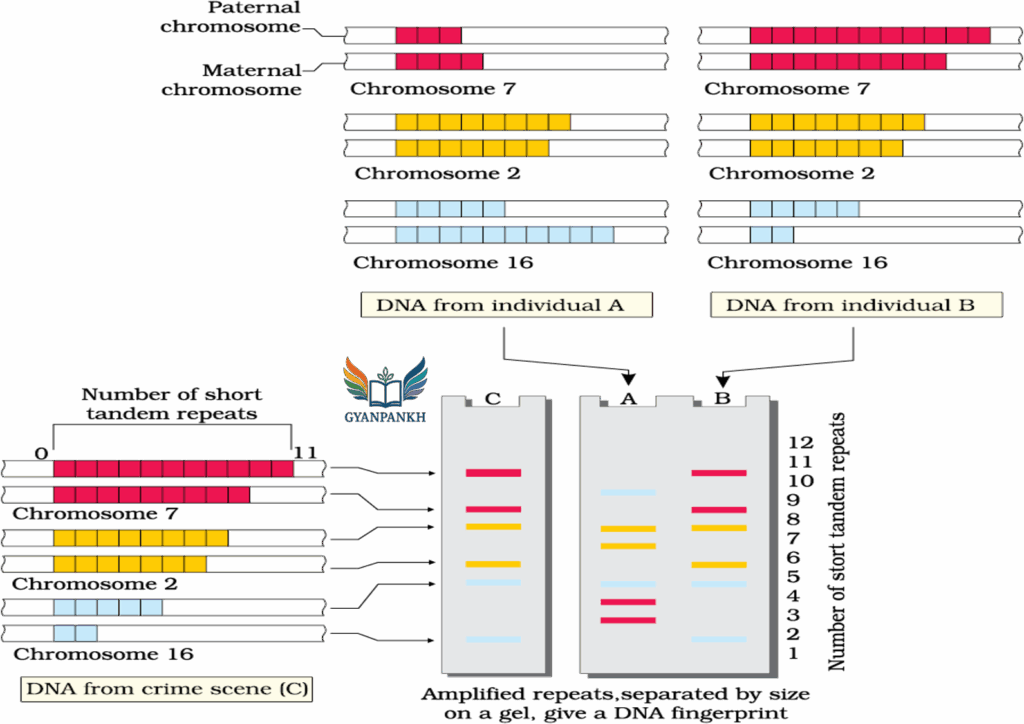
The technique exploits the presence of highly variable, non-coding regions of DNA known as Variable Number Tandem Repeats (VNTRs) or Short Tandem Repeats (STRs). These are sequences where a short core DNA sequence (e.g., GACT) is repeated in tandem numerous times. Length polymorphism arises from highly variable repeat numbers at a given chromosomal position. By analyzing several such loci, a pattern—a “fingerprint”—is generated that is statistically unique for that individual.
This project (DNA fingerprinting and its applications)delves into the science behind this technique, its procedural aspects, and its wide-ranging impact on society and science.
DNA fingerprinting and its applications
4. Theory
4.1 Molecular Basis: Polymorphism in DNA
The effectiveness of DNA fingerprinting hinges on DNA polymorphism. Polymorphism (literally “many forms”) refers to the natural variations in DNA sequences among individuals. While most of our genes are identical, the non-coding regions, which do not produce proteins, accumulate mutations over generations without affecting the individual’s survival. These regions become highly polymorphic.
4.2 Key Elements: VNTRs and STRs
- Variable Number Tandem Repeats (VNTRs): These are sequences with a longer core repeat unit (10-60 base pairs) repeated multiple times. The number of repeats can range from a few to several hundred, creating significant variation in the length of DNA fragments between individuals when cut with specific restriction enzymes.
- Short Tandem Repeats (STRs): Modern DNA profiling primarily uses STRs. These involve much shorter repeat units (2-6 base pairs, e.g., CTG). STR analysis is more robust, can be automated, and requires smaller DNA samples, making it the gold standard for forensic work today.
4.3 Principle of the Technique
The core principle involves:
- Extraction: Isolating DNA from a biological sample (blood, saliva, hair root, etc.).
- Amplification: Using the Polymerase Chain Reaction (PCR) to make billions of copies of specific STR regions. This step is crucial for analyzing minute or degraded samples.
- Separation: The amplified DNA fragments are separated based on their size using Capillary Electrophoresis.
- Visualization: The separated fragments are detected using fluorescent dyes attached during PCR. The result is an electropherogram—a series of peaks where each peak represents a DNA fragment of a specific length (number of repeats) at a specific locus.
- Comparison: The pattern of peaks (alleles at each locus) from the unknown sample is compared with a reference sample. A match indicates a high probability that the samples originated from the same individual.
DNA fingerprinting and its applications
5. Procedure for DNA fingerprinting (modern str-based method)
The following is a schematic representation of the standard protocol used in forensic and diagnostic laboratories:
Step 1: Sample Collection
Any biological material containing nucleated cells can be used:
- Forensic Samples: Blood stains, semen, hair with roots, saliva on cigarette butts, skin cells, bones, teeth.
- Reference Samples: Buccal swab (from cheek), blood sample in EDTA.
Step 2: DNA Extraction
The cellular and nuclear membranes are broken down using detergents and enzymes (e.g., Proteinase K) to release DNA. Proteins and other contaminants are removed, and pure DNA is precipitated using cold ethanol or isopropyl alcohol.
Step 3: Quantification and Quality Assessment
The extracted DNA is quantified to ensure there is a sufficient amount for PCR and its quality (degree of degradation) is assessed.
Step 4: Polymerase Chain Reaction (PCR) Amplification
Specific STR loci (commonly 13-20 core loci, as defined by agencies like the FBI in the CODIS system) are amplified.
- Primers: Short, synthetic DNA sequences complementary to the regions flanking the STR are used.
- Cycling: The DNA is subjected to repeated cycles of denaturation (separating strands), annealing (primers binding), and extension (Taq polymerase building new strands). This exponentially amplifies the target STR regions.
- Fluorescent Tagging: The primers are labelled with fluorescent dyes of different colors, allowing for later detection.
DNA fingerprinting and its applications
Step 5: Capillary Electrophoresis
- The amplified PCR products are injected into a thin glass capillary filled with a polymer.
- An electric field is applied. The negative charge of DNA causes it to migrate toward the anode (positive electrode).
- Smaller DNA fragments move faster through the polymer matrix, while larger fragments move slower. This separates the fragments precisely based on their size (number of base pairs).
Step 6: Detection and Analysis
- As the fluorescently-tagged DNA fragments pass a laser detector at the end of the capillary, the laser excites the dyes, and a camera records the emitted light.
- This data generates an electropherogram. Each colored peak corresponds to an allele at a specific STR locus. The position of the peak indicates its size, which correlates with the number of repeats.
Step 7: Interpretation and Profile Generation
The software interprets the electropherogram and generates a DNA profile—a list of numbers representing the alleles (the count of repeats) found at each analyzed locus. For example, a profile may show “D8S1179: 13, 15,” meaning at the D8S1179 locus, the individual has one allele with 13 repeats and one with 15 repeats.
DNA fingerprinting and its applications
6. Results and discussion
6.1 Interpreting a DNA Profile
A human is diploid, inheriting one set of chromosomes from each parent. Therefore, at each STR locus, an individual will have two alleles (which can be the same—homozygous, or different—heterozygous). The DNA profile is a combination of these alleles across multiple loci.
6.2 Statistical Significance and Match Probability
The power of DNA fingerprinting lies in statistics. The probability that two unrelated individuals will share the same allele at a single locus is relatively high. However, when multiple independent loci are combined, the probability becomes astronomically low.
- Calculation: The Combined Probability of Match (CPM) or Random Match Probability (RMP) is calculated by multiplying the individual genotype frequencies at all loci analysed. For example, if 13 loci are used, and the combined frequency is 1 in 10 billion, it provides near-certainty in identification within the human population.
6.3 Example Scenario
In a paternity test, the child’s profile is compared to the alleged father’s profile. For each locus, one of the child’s alleles must match the mothers, and the other must match the alleged fathers. If this holds true across all tested loci, paternity is established with a very high probability (typically >99.99%). A mismatch at two or more loci excludes paternity.
6.4 Limitations and Challenges
- Degraded Samples: Environmental factors can break DNA into small pieces, making amplification of longer STRs difficult.
- Mixtures: Samples containing DNA from two or more individuals (common in forensic cases) complicate interpretation.
- Human Error and Contamination: Strict laboratory protocols are essential to prevent sample mix-up or contamination with extraneous DNA.
- Ethical Concerns: Issues of genetic privacy, discrimination, and the establishment of DNA databases require careful legal and ethical frameworks.
DNA fingerprinting and its applications
7. APPLICATIONS
The applications of DNA fingerprinting are diverse and profound.
7.1 Forensic Science
- Criminal Investigations: Linking suspects to crime scene evidence (blood, hair, semen). It serves to convict the guilty and exonerate the innocent.
- Identifying Victims: Used in mass disasters (plane crashes, natural disasters) and in identifying unknown human remains by comparing with relatives’ DNA.
- Wildlife Forensics: Tracking the illegal trade of endangered species and their products (ivory, rhino horn, tiger bones).
7.2 Establishing Family Relationships
- Paternity and Maternity Disputes: Provides definitive proof in legal cases of child support, inheritance, and immigration.
- Missing Persons and Kinship Analysis: Establishing biological relationships in cases of adoption, child swapping, or historical/archaeological identification.
7.3 Medical Applications
- Personalized Medicine: Identifying genetic predispositions to certain diseases.
- HLA Typing for Organ Transplantation: Matching donor and recipient tissue types to reduce organ rejection.
- Diagnosis of Inherited Disorders: Detecting mutations associated with diseases like Huntington’s, cystic fibrosis, etc.
7.4 Conservation Biology and Agriculture
- Biodiversity Studies: Assessing genetic variation within and between populations of endangered species to inform conservation strategies.
- Phylogenetics: Determining evolutionary relationships between different species.
- Seed Purity and Authenticity: In agriculture, verifying the genetic purity of high-yield or patented plant varieties.
7.5 Anthropology and Evolution
- Studying genetic diversity and migration patterns of ancient and modern human populations.
DNA fingerprinting and its applications
8. Conclusion
DNA fingerprinting stands as one of the most significant scientific breakthroughs of the 20th century, seamlessly merging principles of genetics, molecular biology, and statistics. From its inception with VNTR analysis to the current high-precision, automated STR profiling, the technique has evolved into an indispensable tool. Its applications transcend the boundaries of forensic laboratories, extending into the realms of medicine, conservation, and our understanding of human history.
While its power to identify individuals with near-perfect accuracy is unparalleled, it also brings forth substantial ethical responsibilities regarding privacy and data protection. The future of DNA technology, including next-generation sequencing and rapid DNA analyzers, promises even greater capabilities. Therefore, it is imperative for society to foster a robust understanding of this technology, ensuring its application is guided by sound science, stringent ethics, and the unwavering principle of justice.
DNA fingerprinting and its applications
9. Bibliography
- NCERT Textbook: “Biology – Class XII,” Chapters 5: Principles of Inheritance and Variation, and Chapter 6: Molecular Basis of Inheritance. National Council of Educational Research and Training, India.
- Online Resource: National Institute of Standards and Technology (NIST) – DNA Profiling: https://www.nist.gov/topics/dna-profiling
- Online Resources (for conceptual understanding only):
- Gyan Pankh. https://gyanpankh.com/
- Wikipedia. https://www.wikipedia.org/
Click here for any Help, Click here for any Suggestions.