
Science Class 8 CBQ of Light Mirrors and Lenses
Science Class 8 CBQ of Light Mirrors and Lenses
Category 1: Conceptual Understanding
Section A: Multiple Choice Questions (MCQs)
- A beam of light striking a reflecting surface at an angle of 900 to the surface itself will experience an angle of reflection equal to:
- 900
- 450
- 00
- 1800
- In contrast to spherical mirrors, lenses enable us to see objects by looking through them, not by looking into them, due to the following reason:
- Lenses reflect all the light that falls onto them.
- Lenses are made of transparent materials that permit the transmission of light.
- Lenses cause lateral inversion while mirrors do not.
- Lenses possess only flat bounding surfaces.
- An object is placed extremely close (3–4 cm) to an unknown spherical mirror. The image observed is erect and magnified. When the object is slowly pulled away, the image flips upside down. This mirror is structurally:
- Curved outwards like the rear side of a spoon.
- Perfectly flat like a standard dressing mirror.
- Curved inwards like a dental inspecting mirror.
- A combination of an outward and inward bulge.
- A spherical mirror is described as having a reflecting surface that curves inwards. Which of the following is true about its schematic representation?
- The reflecting surface is shown with shading.
- The non-reflecting surface is shown as shaded.
- It is consistently depicted as an entirely hollow sphere.
- It represents a convex mirror.
- What does the normal represent in a reflection diagram?
- The incident ray itself
- A line at 90° to the mirror at the point of incidence
- the reflected ray
- The surface of the mirror
- A lens thicker at the middle than at the edges is called:
- Concave lens
- Plane glass
- Convex lens
- Diverging lens
Science Class 8 CBQ of Light Mirrors and Lenses
Section B: Assertion-Reasoning Questions
Instructions: Choose the correct option:
- Both A and R are factually correct, and R provides the precise logical explanation for A.
- A is true and R is also true, but R does not logically justify or clarify A.
- Assertion A holds true; however, the reason given in R is factually incorrect.
- Assertion A is not valid, but the statement in Reason R is accurate.
Assertion (A): When multiple parallel beams of light hit a convex mirror, the reflected rays cross each other at a single real point in front of it.
Reason (R): A convex mirror acts as a diverging system due to the outward bulge of its reflecting surface.
Assertion (A): A plane mirror, a concave mirror, and a convex mirror all exhibit the phenomenon of lateral inversion.
Reason (R): The fundamental laws of reflection are universally valid for all plane and spherical polished surfaces.
Assertion (A): A convex mirror always forms an erect and diminished image.
Reason (R): A convex mirror has a reflective surface that curves outward, which makes the reflected rays spread apart.
Assertion (A): The angle of incidence is always equal to the angle of reflection, regardless of the type of mirror used.
Reason (R): This principle is confirmed by directing a thin ray of light onto a flat mirror and then measuring the angles formed by the rays and the normal line.
Science Class 8 CBQ of Light Mirrors and Lenses
Section C: Short Answer Questions
- Explain how spherical mirrors are fundamentally manufactured. Correct the common misconception that they are physically sliced out of a hollow glass sphere.
- Contrast a convex lens with a concave lens based purely on their structural thickness profiles from the centre to the margins.
- A ray of light is incident on a highly polished flat boundary. If the total angle measured between the incoming incident ray and the outgoing reflected ray is 800, deduce the precise angle of incidence.
- State the two laws of reflection. Are they valid for spherical mirrors? Justify.
- Why does a concave mirror sometimes produce an inverted image and sometimes an erect image?
- What is lateral inversion? Is it seen in spherical mirrors?
Science Class 8 CBQ of Light Mirrors and Lenses
Section D: Long Answer Question
- Describe step-by-step how the image characteristics—whether it is real or virtual, upright or inverted, and its size—vary in a concave mirror when the object moves from very close to the mirror to far away.
- Describe the reason a small amount of water on an oiled or waxed surface behaves similarly to a magnifying lens. Discuss the roles of surface geometry and transparency in this phenomenon.
- Compare the image formed by a plane mirror, concave mirror, and convex mirror when an object is placed very close to them.
- Explain the difference between a concave lens and a convex lens in terms of shape and behaviour of light.
Science Class 8 CBQ of Light Mirrors and Lenses
Section E: Case Based Question
- Meena is trying to explain to her younger brother how the angle of reflection changes when a light ray hits a plane mirror at different angles. She carefully arranges the setup and takes measurements of the angles. However, her brother accidentally tilts the mirror slightly, but the incident ray still comes in along the normal to the new tilted surface. Meena records her observations in a table.
Table: Measured angles in three cases
| Case | Incident ray direction relative to mirror surface | Angle of incidence (i) | Angle of reflection (r) |
| I | Along the normal to the mirror | ? | ? |
| II | Mirror tilted; ray still along new normal | ? | ? |
| III | Mirror tilted; ray at 20° from new normal | ? | ? |
Which option correctly fills the? in the table?
A) I: i=0°, r=0°; II: i=0°, r=0°; III: i=20°, r=20°
B) I: i=90°, r=90°; II: i=0°, r=0°; III: i=20°, r=40°
C) I: i=0°, r=0°; II: i=90°, r=0°; III: i=20°, r=20°
D) I: i=0°, r=90°; II: i=0°, r=0°; III: i=20°, r=10°
- An optics lab technician needs to identify four unlabeled optical components (W, X, Y, and Z) found in a storage cabinet. She places a standard test object exactly 5 cm away from each component and records the orientation and relative size of the resulting image in the table below.
| Component | Orientation of Image | Relative Size of Image | Light Interaction Type |
| W | Erect | Magnified | Reflects light from its front surface |
| X | Erect | Diminished | Reflects light from its front surface |
| Y | Erect | Diminished | Transmits light through its body |
| Z | Erect | Same Size | Reflects light from its front surface |
Question: Based on the image characteristics established in the chapter, which option correctly identifies components W and Y?
(A) Convex lens: W; convex mirror: Y.
(B) Concave mirror: W; concave lens: Y.
(C) W is a concave lens, whereas Y is a convex mirror.
(D) W stands for a convex lens, and Y stands for a convex mirror.
Science Class 8 CBQ of Light Mirrors and Lenses
Category 2: Application
Section A: Multiple Choice Questions (MCQs)
- Why do dentists use a small concave mirror instead of a convex one to inspect a patient’s tooth?
- It provides a smaller, wider view of the entire mouth.
- Placed up close, it provides a virtual, magnified, and erect view of the tooth.
- It turns the image of the tooth upside down to check roots properly.
- It acts as a transparent window to see inside the gums.
- Security personnel at a large apparel department store want to install a single mirror that allows them to scan a vast area of the floor to deter shoplifting. They must choose a:
- Concave mirror, because it converges light to a single point.
- Plane mirror, because it forms an identical true-to-size image.
- Convex mirror, because its outward curve offers a much wider field of view.
- Convex lens, because light passes through it to show objects behind.
- The metal casing that surrounds a scooter headlight is intentionally made with an inner concave curve. The primary purpose behind this design is to:
- Converge diverging light from the bulb into a powerful, focused parallel beam forward.
- Scatter light in all directions to illuminate the sky.
- Turn the light beam upside down to avoid blinding oncoming traffic.
- Diminish the size of the bulb so it consumes less battery power.
- Why are side-view mirrors on vehicles convex?
- To make objects appear larger
- To provide a wider area of the road behind
- To invert the image
- To reduce glare
- A solar concentrator uses mirrors to:
- Spread sunlight
- Store electricity
- Converge sunlight to a small area
- Reflect sunlight away
- A surveillance mirror in a big store is likely to be:
- Concave
- Plane
- Convex
- Opaque
Science Class 8 CBQ of Light Mirrors and Lenses
Section B: Assertion-Reasoning Questions
Instructions: Choose the correct option:
- Both A and R are factually correct, and R provides the precise logical explanation for A.
- A is true and R is also true, but R does not logically justify or clarify A.
- Assertion A holds true; however, the reason given in R is factually incorrect.
- Assertion A is not valid, but the statement in Reason R is accurate.
Assertion (A): Side-view mirrors on passenger cars are inscribed with the warning statement: “Objects in mirror are closer than they appear”.
Reason (R): Convex mirrors form diminished images, which tricks the driver’s brain into perceiving the trailing vehicles as being farther away than they actually are.
Assertion (A): High-end astronomical reflecting telescopes use a massive convex mirror as their primary light-gathering component.
Reason (R): Gathering light from distant stars requires a system that converges incoming parallel stellar light beams into a concentrated region.
Assertion (A): Dentists use concave mirrors to examine teeth.
Reason (R): Concave mirrors create an upright and magnified image when placed near the object.
Assertion (A): A magnifying glass is a convex lens.
Reason (R): Water drops on an oily surface act as convex lenses.
Science Class 8 CBQ of Light Mirrors and Lenses
Section C: Short Answer Questions
- A person wearing reading glasses notices a distinct, small curved line near the bottom region of their lenses. Speculate on the practical function of this specific design modification.
- Imagine three unmarked flat circular discs—one is a plane mirror, one is a concave mirror, and one is a convex mirror. Without touching any of the surfaces, how can you tell which is which?
- Explain why convex mirrors are strategically mounted on tall posts at blind, sharp hair-pin bends in mountainous corridors.
- Why is the warning “Objects in mirror are closer than they appear” written on vehicle side-view mirrors?
- Why are reflectors in torches and car headlights concave?
- How does the human eye use a convex lens to see both near and far objects?
Science Class 8 CBQ of Light Mirrors and Lenses
Section D: Long Answer Question
- Analyse the technological transition from simple glass windows to specialized optical lenses in modern handheld smartphones. Explain how multiple camera lenses on the back of a phone utilize the properties of light to capture high-clarity photographs.
- A modern solar thermal plant utilizes thousands of massive curved reflective arrays to boil a fluid and drive turbines for clean electricity production. Identify the specific type of optical mirror configuration used, explain the physics behind its selection, and map out the energy transformations taking place.
- Explain how convex mirrors are used in road safety and surveillance. Give two examples.
- Describe the role of lenses in eyeglasses, cameras, and telescopes.
Science Class 8 CBQ of Light Mirrors and Lenses
Section E: Case Based Question
- A dentist needs to examine a patient’s molar tooth. She uses a concave mirror to get an enlarged view. She places the mirror very close to the tooth (within 3–4 cm). Then she slowly moves it farther away. She notes the image characteristics in a table.
Table: Image characteristics of concave mirror at different object distances
| Distance from object (relative to mirror) | Image size | Image nature |
| Very close (≈ 2–3 cm) | Enlarged | Erect |
| Slightly farther (≈ 8–10 cm) | Enlarged | Inverted |
| Far (≈ 20 cm) | Diminished | Inverted |
| Very far (≈ 50 cm) | Highly diminished | Inverted |
Which distance should the dentist use?
- Very close (≈ 2–3 cm)
- Slightly farther (≈ 8–10 cm)
- Far (≈ 20 cm)
- Very far (≈ 50 cm)
- An engineering firm is designing an automated tracking track for an electric delivery vehicle. The vehicle requires an onboard camera system fitted with a curved mirror to monitor the widest possible area of the road behind it to prevent collisions at blind intersections. The engineers evaluate four mirror samples featuring distinct internal configurations.
| Prototype | Surface Curvature Facing Traffic | Core Optical Behaviour Observed |
| 1 | Curved inwards (like the inside of a spoon) | Converges incoming parallel beams of light |
| 2 | Flat and uniform | Keeps reflected parallel beams completely parallel |
| 3 | Curved outwards (like the back of a spoon) | Diverges incoming parallel beams of light |
| 4 | Flat transparent pane | Transmits light directly without reflection |
To satisfy safety guidelines and match the design of standard vehicle side-view mirrors that provide a wider viewing area, which prototype must the engineering team select?
- Prototype 1
- Prototype 2
- Prototype 3
- Prototype 4
Science Class 8 CBQ of Light Mirrors and Lenses
Category 3: Problem Solving & Reasoning
Section A: Multiple Choice Questions (MCQs)
- If the angle between an incoming light ray and the surface of a plane mirror is 35°, find the angle at which the ray reflects.
- 350
- 550
- 900
- 700
- A student moves a toy car away from a convex lens at a constant speed. The student tracks the behaviour of the image viewed through the lens. The image will:
- Stay upright and keep growing larger indefinitely.
- Flip upside down immediately at any distance.
- Remain erect but gradually diminish in size as the distance increases.
- Become completely invisible because convex lenses solely reflect light.
- Look at the experimental light rays’ diagram below:
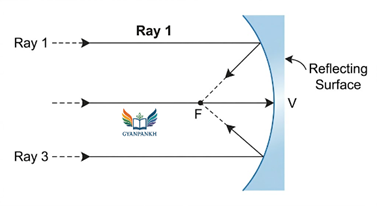
If the reflected rays converge together and intersect at a common point, which specific configuration does this system represent?
- Parallel beams reflecting from a plane mirror.
- Parallel beams diverging from a convex mirror.
- Parallel beams converging from a concave mirror.
- Parallel beams passing through a concave lens.
- A light ray makes an angle of 40° with the normal. What is the angle made by the reflected ray with the mirror surface?
- 40°
- 50°
- 45°
- 60°
- The mirror is tilted but the light ray still falls along the normal to the tilted surface. What is the angle of reflection?
- 0°
- 20°
- 90°
- Cannot be determined
- A convex lens is placed such that an object is very far. The image formed will be:
- Erect and enlarged
- Inverted and diminished
- Inverted and same size
- No image formed
Science Class 8 CBQ of Light Mirrors and Lenses
Section B: Assertion-Reasoning Questions
Instructions: Choose the correct option:
- Both A and R are factually correct, and R provides the precise logical explanation for A.
- A is true and R is also true, but R does not logically justify or clarify A.
- Assertion A holds true; however, the reason given in R is factually incorrect.
- Assertion A is not valid, but the statement in Reason R is accurate.
Assertion (A): If an incident ray strikes a tilted mirror perfectly along its normal vector, the calculated mathematical value for both the angle of incidence i and reflection r is zero.
Reason (R): The normal line by definition forms a 900 angle with the reflecting surface, meaning a ray traveling along the normal has no angular deviation from it.
Assertion (A): A concave lens can be used as a simple burning glass to set a piece of dry scrap paper on fire under bright sunlight.
Reason (R): Concave lenses are diverging lenses that spread light rays over a much larger surface area.
Assertion (A): If the incident ray falls along the normal, the angle of reflection is 0°.
Reason (R): The reflected ray also travels along the normal.
Science Class 8 CBQ of Light Mirrors and Lenses
Section C: Short Answer Questions
- A light ray hits a mirror. The angle of incidence is 400. Calculate the exact mathematical value of the angle made by the reflected ray with the mirror’s actual flat surface.
- A cap of a sketch pen is placed in front of an unknown mirror. The image seen inside the mirror is upright but significantly smaller than the cap itself. Provide a logical explanation identifying the type of mirror and why it cannot be a plane mirror.
- A student views a tall vertical flagpole through a concave lens. Describe what happens to the orientation and size of the flagpole’s image as the student slowly walks backward away from it.
- Parallel beams fall on a concave mirror. What happens to the reflected beams and why?
- Why does the reflected beam disappear when the paper is bent? Link this concept with the second principle of reflection.
- A pencil is placed behind a glass tumbler half-filled with water. Why does it appear bent?
Science Class 8 CBQ of Light Mirrors and Lenses
Section D: Long Answer Question
- A laser pointer is aimed at a flat mirror. The mirror is then tilted by an angle of 200 while keeping the incoming laser beam in the exact same position. Trace the path of the normal line and the new reflected ray. Use the laws of reflection to calculate the total angular shift of the reflected ray.
- A woman walks toward a large concave mirror in an interactive museum display. She notices that her image starts out upside down and small, grows larger as she walks forward, and then suddenly becomes upright and very large. Explain the underlying physics of this visual transition.
- A concave mirror is used by a student to concentrate sunlight onto paper, leading to combustion. Discuss the energy conversion taking place and the reason a convex mirror fails to achieve this.
- In both figures show an object O, mirror M, and image I. Figure (a) shows an erect image same size. Figure (b) shows an erect diminished image. Identify the mirror types and justify.
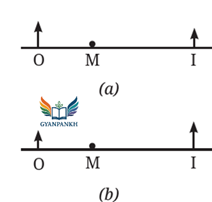
- A student measures three pairs: (i=30°, r=29°), (i=45°, r=46°), (i=60°, r=60°). Which pair is most accurate? Explain experimental errors.
Science Class 8 CBQ of Light Mirrors and Lenses
Section E: Case Based Question
- A student performs Activity with multiple parallel beams falling on three mirrors: plane, concave, and convex. She records whether reflected beams are parallel, converge, or diverge. Then she calculates the angle between extreme reflected rays for each mirror if the incident beam width is 5 cm and mirror width is 5 cm, assuming focal length of concave mirror = 10 cm and convex mirror = -10 cm.
Table: Behaviour of reflected beams
| Mirror type | Reflected beam behaviour | Approximate angle between extreme reflected rays (calculated) |
| Plane | Parallel | 0° |
| Concave | Converge | 2 × arctan (2.5/10) ≈ 28° |
| Convex | Diverge | 2 × arctan (2.5/10) ≈ 28° (but negative divergence) |
Options:
- Plane mirror, because reflected rays are perfectly parallel.
- Concave mirror, because convergence reduces angle between rays.
- Convex mirror, because divergence increases angle.
- both concave and convex give the same angle, but plane gives zero.
- During a physics practical, a student uses a laser pointer and an adjustable plane mirror platform to verify the laws of reflection. He records his measurements across four experimental runs in the logbook below.
| Run | Angle of Incidence (i) | Angle Between Incident Ray and Tilted Mirror Surface | Total Angle Separating Incident and Reflected Rays |
| A | 300 | 600 | 600 |
| B | 450 | 450 | 900 |
| C | 00 | 900 | 00 |
| D | 500 | 400 | 800 |
Question: One of the data entries compiled by the student contains a fundamental error because it directly violates the laws of reflection described in the textbook. Which run contains the invalid dataset?
- Run A
- Run B
- Run C
- Run D
Science Class 8 CBQ of Light Mirrors and Lenses
Category 4: Experimentation & Investigation
Section A: Multiple Choice Questions (MCQs)
- In a lab activity investigating the laws of reflection, a student uses a black paper strip to mask out all the teeth of a hair comb except for one single slit in the middle. The key purpose behind this step is to:
- Block out ambient room light to make the room pitch black.
- Isolate a thin, sharp beam of light that can be easily traced on paper.
- Remove specific-coloured wavelengths from the torch’s beam.
- Increase the total brightness of the light hitting the mirror.
- During an outdoor experiment with a concave mirror, a student successfully focuses sunlight onto a piece of newspaper until it begins to smoke and burn. The clear, concentrated bright area appearing on the paper stands for:
- A magnified, upright virtual image of the Sun.
- A sharply focused, real image of the Sun that is also inverted.
- A shadow created by the mirror’s outer frame.
- Scattered light reflecting off the grass.
- A student places a stiff sheet of chart paper flat on a desk with one section protruding past the table’s boundary. They shine a beam of light across the paper onto a vertical mirror. If they bend the hanging part of the chart paper downward, the reflected light beam traveling across that bent section vanishes. This happens because:
- Bending the paper physically blocks the incoming light beam from hitting the mirror.
- The reflected ray now travels in a different plane than the bent paper surface.
- The mirror’s reflective property is lost once the paper is curved.
- Bending the paper changes the chemical properties of the light.
- What is the way to differentiate between a concave and a convex mirror by looking at their side profile?
- By touching the reflecting surface
- By checking if it curves toward the inside or the outside.
- By looking at the image size
- By measuring weight
- Describe the effect of directing parallel beams onto a convex lens.
- They pass through unchanged
- They converge
- They diverge
- They are absorbed
- Parallel rays of light are directed toward a convex mirror. The reflected beams will:
- Remain parallel
- Converge
- Diverge
- Form a real image
Science Class 8 CBQ of Light Mirrors and Lenses
Section B: Assertion-Reasoning Questions
Instructions: Choose the correct option:
- Both A and R are factually correct, and R provides the precise logical explanation for A.
- A is true and R is also true, but R does not logically justify or clarify A.
- Assertion A holds true; however, the reason given in R is factually incorrect.
- Assertion A is not valid, but the statement in Reason R is accurate.
Assertion (A): During a lab activity in class where a comb with several slits is used, the rays reflected off a plane mirror stay exactly parallel to one another.
Reason (R): The normal vectors at every single point of incidence on a flat plane mirror point in the exact same direction.
Assertion (A): When a concave lens is used in place of a convex lens in an experiment focusing solar rays, the paper catches fire considerably sooner.
Reason (R): Concave lenses converge all parallel solar rays into a small, hot focal spot.
Assertion (A): When a concave mirror reflects sunlight onto paper, the paper ignites.
Reason (R): Concave mirrors cause parallel light rays to converge at a single focal point.
Science Class 8 CBQ of Light Mirrors and Lenses
Section C: Short Answer Questions
- List the safety steps a middle school student should take before working with curved optical devices to focus direct sunlight.
- With a drinking glass, a pencil, and water, design a simple experiment that shows light changing direction at the interface between different materials.
- A student logs data in a lab table while trying to confirm the first law of reflection, noticing small discrepancies—for example, i = 30° and r = 31.5°. Identify two potential sources of experimental error in a typical classroom setup that could cause these discrepancies.
- A student applies a small water drop to a clean glass slide in an attempt to magnify written words, but the drop collapses into a thin, even layer. After rubbing a thin layer of oil or wax on the slide, the same water drop remains rounded and magnifies the text better. What is the reason that oil or wax coating helps maintain the spherical shape of a water drop?
- Why should you never look directly at the Sun or at its reflection through a mirror or lens?
- If a plane mirror is used instead of the concave mirror, what would the result be? Explain.
Science Class 8 CBQ of Light Mirrors and Lenses
Section D: Long Answer Question
- The equipment supplied consists of a flashlight, a comb, a paper clip, black paper, a white sheet of paper, a protractor, a ruler, and a plane mirror. Write a comprehensive laboratory report detailing how to experimentally prove that the angle of incidence equals the angle of reflection. Explain how to set up the experiment, record the data, and take accurate angle readings using a protractor.
- Design an investigative experiment to determine which type of lens (convex or concave) is used in a standard magnifying glass. Your plan should list the materials needed, the step-by-step procedure, the observations to look for at different distances, and the criteria for your final conclusion.
- Design an experiment using a comb, torch, and three mirrors to demonstrate that concave mirrors converge parallel light. Include steps and expected observation.
- A student performs two experiments:
Experiment 1: Observing a toy as it moves from a near position to a far one, first in front of a concave mirror and then in front of a convex mirror.
Experiment 2: Moving the same toy from close to far behind a convex lens and then a concave lens.
Answer the following briefly:
- Which mirror and which lens show similar image behaviour (both can give enlarged erect images up close, then inverted images farther away)?
- Identify the mirror and the lens that always form erect and diminished images, no matter how far or close the object is placed.
- How does the way a concave mirror produces images differ significantly from the way a convex lens does?
- Propose an investigation to check if the laws of reflection hold for a concave mirror using a torch, comb, and protractor. Write the steps.
Science Class 8 CBQ of Light Mirrors and Lenses
Section E: Case Based Question
- A student replaces the concave mirror with a convex lens to burn paper using sunlight. She holds the lens at different distances from the paper and notes the brightness and size of the spot. She records her findings.
Table: Spot characteristics vs. distance between lens and paper
| Distance (cm) | Spot size | Brightness | Paper smoking? |
| 5 | Large | Dim | No |
| 10 | Smallest | Very bright | Yes, within 30 sec |
| 15 | Medium | Medium | No |
| 20 | Large | Dim | No |
Which distance should she use for fastest burning?
- 5 cm
- 10 cm
- 15 cm
- 20 cm
- Students hide three different transmitting optical elements (lenses or glass plates) inside three separate boxes with slit openings. They project a set of parallel light beams separated by an initial distance of 4 cm into each box and measure the beam spacing as it exits the other side.
| Box | Separation of Light Beams Upon Exiting the Box | Spatial Behaviour of Exiting Light Beams |
| Box 1 | Expanded outward to a distance of 8 cm | The beams spread apart (Diverge) |
| Box 2 | Remained spaced exactly at 4 cm | The beams stay completely parallel |
| Box 3 | Narrowed down to 0 cm at a specific point | The beams come together (Converge) |
Question: By tracking the changing beam width metrics against the standard lens investigations in the textbook, what can the students definitively conclude about the contents of Box 1 and Box 3?
- Box 1 contains a convex lens; Box 3 contains a concave lens.
- Inside Box 1 is a thin glass plate, and Box 3 holds a concave lens.
- Box 1 contains a concave lens; Box 3 contains a convex lens.
- Box 1 contains a concave lens; Box 3 contains a thin glass plate.
Category 5: Creativity
Section A: Multiple Choice Questions (MCQs)
- Imagine you are designing a stealth spy gadget that lets you look over high walls while remaining completely hidden. Your design uses a long hollow tube. The proper setup requires you to place:
- Two concave mirrors at opposite ends facing away from each other.
- Two plane mirrors are installed parallel to each other and positioned at 45° angles at the turns.
- A concave lens at the bottom and a convex mirror at the top.
- A flat piece of window glass at both corners.
- You are writing a science fiction story where characters live on an icy planet with no factories. To build a survival tool that can start fires using sunlight, a character should shape a block of clear glacial ice into a:
- Thin, flat rectangular sheet.
- A lens that is thicker at its center and thinner toward its edges.
- Lens that is thin in the middle and thick at the edges.
- hollow cylinder open at both ends.
- An artist wants to build a “Funhouse Mirror Maze” where visitors look at themselves and see their faces appear giant and stretched out, but their legs look tiny and short. The artist can create this effect by building a single mirror sheet that is:
- Perfectly flat from top to bottom.
- Concave on the upper half and convex on the lower half.
- Convex shape on the upper portion and concave on the lower portion.
- Composed of clear window glass treated with an oil layer.
- If you had to design a periscope using only spherical mirrors, which combination would give an erect image?
- Two concave mirrors
- Two convex mirrors
- One concave and one convex
- Two plane mirrors
- Which of the following could be used to create a giant magnifying device without electricity?
- Convex mirror
- Concave lens
- Water-filled large plastic bottle (convex shape)
- Plane mirror
- To monitor a 360° area in a store with one mirror, you would design a:
- Large concave mirror
- Dome-shaped convex mirror
- Plane mirror system
- Parabolic mirror
Section B: Assertion-Reasoning Questions
Instructions: Choose the correct option:
- Both A and R are factually correct, and R provides the precise logical explanation for A.
- A is true and R is also true, but R does not logically justify or clarify A.
- Assertion A holds true; however, the reason given in R is factually incorrect.
- Assertion A is not valid, but the statement in Reason R is accurate.
Assertion (A): To design an efficient solar cooker for a school competition, a student should line the cooking box with a highly polished convex mirror.
Reason (R): Convex mirrors scatter light rays outward, spreading solar energy over a very wide area.
Assertion (A): A creative designer can use online simulation tools to model how light rays behave around complex combinations of spherical mirrors and lenses before building a physical prototype.
Reason (R): Virtual simulations accurately use the mathematical laws of reflection and refraction to predict ray paths.
Assertion (A): A solar cooker for a village should use a large concave mirror.
Reason (R): More sunlight concentration means higher temperature.
Section C: Short Answer Questions
- Invent a concept for a smart compact makeup or shaving mirror that helps people see fine details on their skin without using any electronic zoom. Explain how the optical components in your product are arranged.
- Imagine a world where light travels in curved spiral lines instead of straight lines. Predict how this would change our daily life and how we use standard plane mirrors.
- Create a concept for an eco-friendly water droplet microscope using items found around the house. Explain how you would control the shape of the water droplet to change its magnification.
- Imagine a mirror that is half concave and half convex. Sketch what an object might look like.
- Suggest how convex mirrors could be creatively used on a walking stick to assist someone who is blind.
- If you could make a lens from ice, what shape would you use to start a fire? Why?
Section D: Long Answer Question
- Write a detailed outline for building a solar cooker at home, designed to heat food using the power of the sun. Your proposal must include:
- A labelled design sketch.
- The choice of materials (including the type of mirror or reflective surface used).
- A detailed explanation of how it uses the properties of light to generate heat.
- A simple budget and materials list.
- Create a script or a detailed storyboard for a 2-minute educational animated video titled “The Great Optical Showdown: Concave vs. Convex”. The characters are a concave mirror/lens and a convex mirror/lens arguing about who is more useful to humans. Write dialogue that highlights their unique characteristics and practical uses.
- Design a “solar furnace” for melting small pieces of metal using only concave mirrors and lenses. Draw a labelled diagram and explain the placement.
- Your task is to construct a basic projector using a convex lens and a mobile phone. Write the steps and explain how the image will be formed.
- Write a short story from the perspective of a light ray entering a concave mirror, then a convex lens, and finally forming a rainbow on a wall.
Section E: Case Based Question
- You are designing a solar cooker for your school using the concept from the “Discover, design, and debate” section. You have three reflective surfaces available. Your task is to pick the best option to direct sunlight onto a compact cooking vessel.
Table: Mirror properties
| Mirror type | Reflectivity | Shape | Effect on parallel sun rays | Focal point temperature estimate |
| Plane | 90% | Flat | Reflects without converging | Low |
| Concave | 85% | Inward | Converges to a point | High |
| Convex | 88% | Outward | Diverges | Very low |
| Shiny spoon (concave inner) | 70% | Curved inward | Converges but less precisely | Medium |
Which mirror should you choose for fastest cooking?
- Plane mirror
- Concave mirror
- Convex mirror
- Shiny spoon (concave inner)
- An amateur filmmaker wants to construct a simple DIY projector attachment for his phone to display small typography onto a nearby wall. The text must look upright (erect) and enlarged when placed close to the lens module. He writes down four different substances and shape designs as possible options for building the lens frame of his prototype.
| Concept Design | Base Material Choice | Geometry profile | Light Transmission Class |
| Concept K | Opaque Polished Metal | Curved neatly inward like a small dish | Reflective |
| Concept L | Transparent Clear Glass | Thicker at the middle than at the edges | Transmissive |
| Concept M | Transparent Clear Plastic | Thicker at the edges than at the middle | Transmissive |
| Concept N | Semi-opaque Frosted Glass | Flat, texturized uniform pane | Diffusive |
Question: The filmmaker needs a working prototype that functions like an ordinary magnifying glass—magnifying text sharply and transmitting light straight from the phone screen. Which design route should be selected?
- Concept K
- Concept L
- Concept M
- Concept N
Category 6: Values & Awareness
Section A: Multiple Choice Questions (MCQs)
- Promoting the use of solar concentrators and solar cookers in rural communities is an excellent way to support environmental sustainability because it:
- Increases our reliance on imported fossil fuels.
- Reduces wood cutting, lowers carbon emissions, and saves electricity.
- Changes the global path of sunlight.
- Eliminates the need for clean drinking water.
- Why is it crucial to learn about the correct types of lenses used in eyeglasses?
- It helps us choose stylish frames for fashion trends.
- It helps us understand how optical technology corrects vision issues, improving our quality of life.
- It allows us to see through solid walls.
- It shows us how to block all light from entering our eyes.
- Which safety rule is most important to follow when working with optical devices like magnifying glasses or concave mirrors outdoors?
- Always wear heavy insulated gloves.
- Never look directly at the Sun or point concentrated sunlight at anyone’s eyes.
- Clean the mirror surface with oil before going outside.
- Keep the mirror moving quickly so it stays cool.
- Why should you never look directly at the Sun through a convex lens?
- It will hurt your eyes due to concentrated light
- The lens will melt
- You will see an inverted image
- it is illegal
- Using solar concentrators for melting steel is:
- Dangerous and should be banned
- An eco-friendly method
- Impossible
- Only for small-scale cooking
- What safety awareness does the warning ‘Objects in mirror are closer than they appear’ help to foster?
- Fear of mirrors
- Driver awareness and safety
- Mirror manufacturing standards
- None of the above
Section B: Assertion-Reasoning Questions
Instructions: Choose the correct option:
- Both A and R are factually correct, and R provides the precise logical explanation for A.
- A is true and R is also true, but R does not logically justify or clarify A.
- Assertion A holds true; however, the reason given in R is factually incorrect.
- Assertion A is not valid, but the statement in Reason R is accurate.
Assertion (A): Studying past scientific milestones—such as the way astronomers employed water reflections to observe planets eight centuries ago—deepens our respect for our scientific legacy.
Reason (R): Historical optical tools show that ancient cultures understood and applied the practical principles of light long before modern textbooks were written.
Assertion (A): Public vehicles must maintain clean, undamaged side-view convex mirrors to ensure road safety.
Reason (R): By offering a wider field of vision to the rear, side mirrors assist drivers in avoiding accidents when shifting lanes
- Assertion (A): Solar cookers help save electricity and reduce fossil fuel use.
Reason (R): Mirrors serve to direct and intensify sunlight.
Section C: Short Answer Questions
- Explain how assistive optical technologies, like specialized lenses and eyeglasses, help create an inclusive environment for individuals with vision challenges.
- Provide a concrete example of how virtual lab simulations can enhance science learning for students attending schools that lack costly physical apparatus.
- Discuss how ancient Indian astronomers, during the time of Bhāskara II, used shallow bowls of water and tubes to measure the positions of stars. What insight does this provide into their real-world understanding of light?
- A student focuses sunlight onto a sheet of paper using a concave mirror. What two important safety measures should the student follow during this activity?
- Explain the importance of supervising children when they work with concave mirrors and sunlight in experiments.
- What role can understand spherical mirrors play in enhancing road safety and reducing crashes?
Section D: Long Answer Question
- Talk about how scaling up solar furnace technology (using huge concave mirror systems to melt steel) might affect communities and the environment, compared to traditional blast furnaces that run on coal. Consider energy savings, minimizing pollution, and the difficulties posed by depending on weather patterns.
- Think about what it means to ‘stay curious.’ Write an essay explaining how asking questions about ordinary things—such as labels on car mirrors or the curved design of eyeglasses—fuels scientific discovery and progress in technology for communities.
- The PDF notes that astronomers during the time of Bhaskara II used shallow water-filled bowls to observe stars. What does this reveal about India’s historical contributions to science? What values does it teach?
- Write a dialogue between two students: one arguing for using convex mirrors on all school bus mirrors, the other arguing for plane mirrors. Which one wins and why?
- Prepare an itemized budget for implementing a solar cooker project at school, utilizing concave mirrors as the primary component. Include details on materials, safety measures, and community benefits, referencing the ‘Discover, Design, and Debate’ segment.
Section E: Case Based Question
- A village in Rajasthan uses a solar furnace based on a large concave mirror to melt steel for making small tools. The mirror concentrates sunlight to generate extreme heat. However, some villagers suggest replacing it with a convex mirror because it’s cheaper and gives a wider view.
Table: Comparison of mirrors for solar furnace
| Mirror type | Heat concentration | Use in solar furnace | Wider view for traffic? | Cost |
| Concave | Yes (high) | Suitable | No | High |
| Convex | No (diverges) | Unsuitable | Yes | Low |
| Plane | No | Unsuitable | No | Low |
| Shiny metal sheet (flat) | No | Unsuitable | No | Low |
Which statement is correct?
- Use convex mirror — it gives wider view and is cheaper, good for safety.
- Use concave mirror — only it can concentrate sunlight enough to melt steel.
- Use plane mirror — it’s simplest and reflects all light.
- Use convex mirror — it can also converge light if made larger.
- A rural cooperative is looking to set up an off-grid solar-powered community kitchen. They are testing three styles of large mirror configurations to determine which system can safely and effectively bundle raw sunlight onto a cookpot to generate enough localized thermal energy to boil water.
| Solar Rig | Reflective Assembly Shape | Observable Heat Concentration Potential |
| Rig Alpha | Formed entirely of flat plane mirror panels | Spreads solar rays over an area equal to the mirror size; no focal point. |
| Rig Beta | Formed of a uniform spherical surface curved inward | Collects a wide area of sunbeams and concentrates them into a single sharp spot. |
| Rig Gamma | Formed of a spherical surface bulging outward | Bounces incoming sunbeams widely away in all directions away from the pot. |
Question: Based on environmental awareness and the textbook’s details regarding solar concentrators, which rig setup should the community deploy to successfully ignite fuel or heat liquid?
- Rig Alpha is preferable because flat plane arrays are easier to maintain and clean.
- Rig Beta, because it concentrates light after reflection onto a single point, generating sufficient heat.
- Rig Gamma, because diverging solar rays provides uniform heating across the entire bottom of the kitchen floor.
- Any of the three rigs, as long as they are placed directly under open sunlight.
Click here for any Help, Click here for any Suggestions.