
Science Class 6 SECOND TERM END EXAMINATION 2025-26
Science Class 6 SECOND TERM END EXAMINATION 2025-26
Section A
- Select the material that light can pass through completely.
- Wood
- Glass
- paper
- Iron
- Air is all around us but does not hinder us from seeing each other. In contrast, a wooden door blocks visibility between people.This proves that
- Air is transparent and wooden door is opaque.
- Air is translucent and wooden door is transparent.
- Air is opaque and wooden door is translucent.
- Air is transparent and wooden door is translucent
- Which liquid is commonly used in a laboratory thermometer?
- Vinegar
- Mercury
- Glycerin
- Milk
- The diagram shows four students measuring water temperature with a lab thermometer.
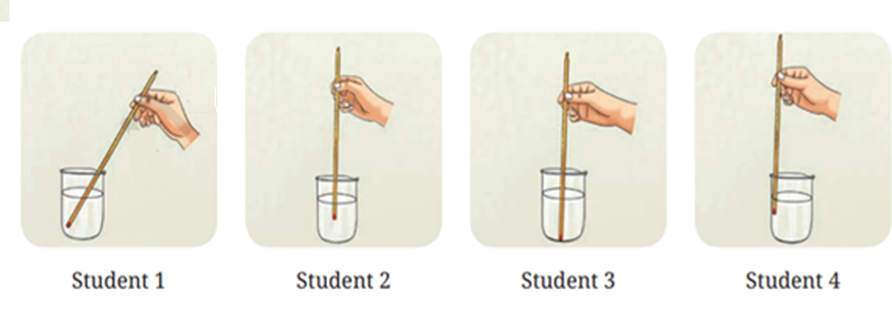
Who do you think followed the correct way for measuring temperature?
- 1
- 2
- 3
- 4
- Which form of matter maintains a fixed shape?
- Solid
- Gas
- Liquid
- Vapour
- What change occurs in water when heated?
- It freezes
- It boils and turns into steam
- It changes color
- It becomes thicker
Assertion (A): When we wash pulses in water before using it for cooking , the process of sedimentation and decantation is used .
Reason (R): Pulses being lighter than water , is being decanted off .
- Both A and R are factually correct, and R provides the precise logical explanation for A.
- A is true and R is also true, but R does not logically justify or clarify A.
- Assertion A holds true; however, the reason given in R is factually incorrect.
- Assertion A is not valid, but the statement in Reason R is accurate.
- Which of the following is true about non-living things?
- They grow and reproduce
- They respond to stimuli
- They do not grow or reproduce
- They require oxygen for survival
- Which of the following is an example of a renewable resource?
- Coal
- Water
- Natural gas
- Petrol
- The Earth gets light from –
- Moon
- Stars
- Sun
- Planets
Science Class 6 SECOND TERM END EXAMINATION 2025-26
Section B
- Who am I? Recognize me from the given characteristics.
- I have lustre.
- I can be easily compressed.
- I am hard and soluble in water.
- I have mass and volume but you cannot see me
- Why do we see water droplets on the outside of a cold glass?
- Riya leaves the tap running while brushing her teeth. Which resource is being wasted? Suggest one way to save it.
- List four activities for which we need Sun’s heat.
Science Class 6 SECOND TERM END EXAMINATION 2025-26
Section C
- Name the following-
- Which is the closest star to the Earth?
- Which star appears brightest in the night sky?
- What is a constellation?
- Write three precautions to be taken while using a clinical thermometer.
- Sana mixed sand and water in a beaker. After some time, she noticed sand particles settling down.
- Why do sand particles settle down at the bottom?
- Name the method used to separate the clear water.
- Describe how sedimentation and decantation help in separation of sand and water.
- Differentiate between living and non-living things. (Any three points)?
- In a village, people use solar panels to produce electricity instead of diesel generators.
- Which type of resource is solar energy?
- Write two advantages of using it.
Or
Explain two ways in which human activities pollute the air. Propose one action which can help in reducing air pollution.
Science Class 6 SECOND TERM END EXAMINATION 2025-26
Section D
- Riya has a fever. Her mother uses a clinical thermometer to check her body temperature. The thermometer shows 39°C. Riya’s normal body temperature is usually 37°C.
(i) Does Riya have a fever?
(ii) What is the normal human body temperature?
(iii) Which thermometer is used here?
(iv) Why is this thermometer suitable for this purpose?
- Observe the activities in your house for a day. Identify the activities that involve evaporation. How can knowledge of evaporation be applied to everyday tasks?
- When preparing dosa, water is sprinkled onto the heated pan. Soon it disappears. Where does it go?
- Give another example of condensation similar to water droplets formed on the outside of tumbler containing cold water.
- Read the passage and answer the following questions:
Reena and her father went camping in a remote village. At night, they lay under the sky and spotted a group of seven bright stars forming a pattern. Her father explained how ancient sailors used these stars to find direction. He then pointed out a faint star that always seemed to stay in the north.
Answer the following:
- What is the name of the group of seven stars Reena saw?
- What is the name of the stationary star in the north direction?
- Which constellation contains the Big Dipper?
- How does the Pole Star help travelers?
Science Class 6 SECOND TERM END EXAMINATION 2025-26
Section E
- Give reasons :
- Metal articles lose their shine after some time.
- Paper-materials can not be used for making cooking utensils.
- Tumbler made of cloth can not be used for storing water.
- We can easily see through a glass window.
- Write two gases which are soluble in water.
- Use the diagram to respond to the questions below.
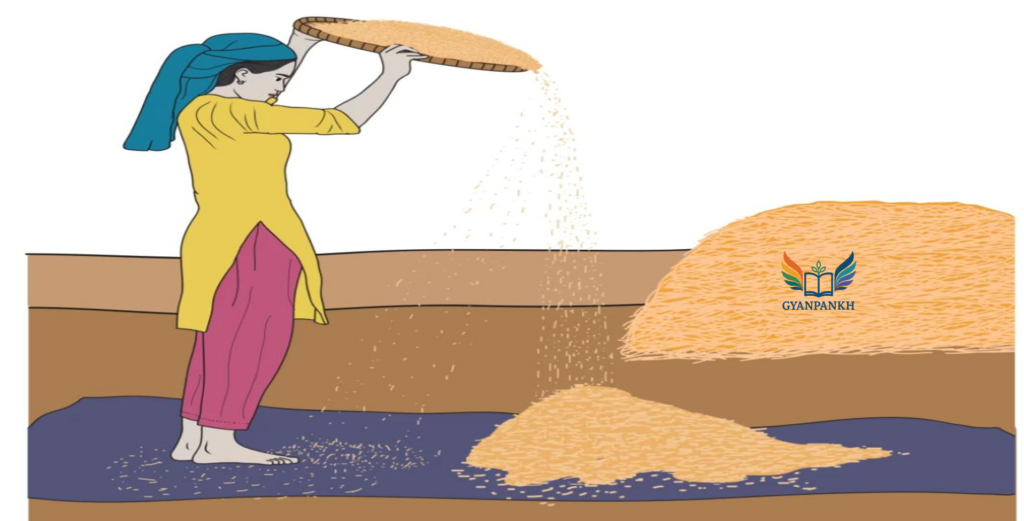
- Which method of separation is shown in the diagram?
- What is the main difference in the behavior of wheat grains and husk in the diagram?
- Why is the farmer standing on a raised platform in the diagram?
- How does wind contribute to the separation process shown in the diagram?
- Why does winnowing fail in a closed room?
- Ravi and Neeta set up the experiment shown in the picture .
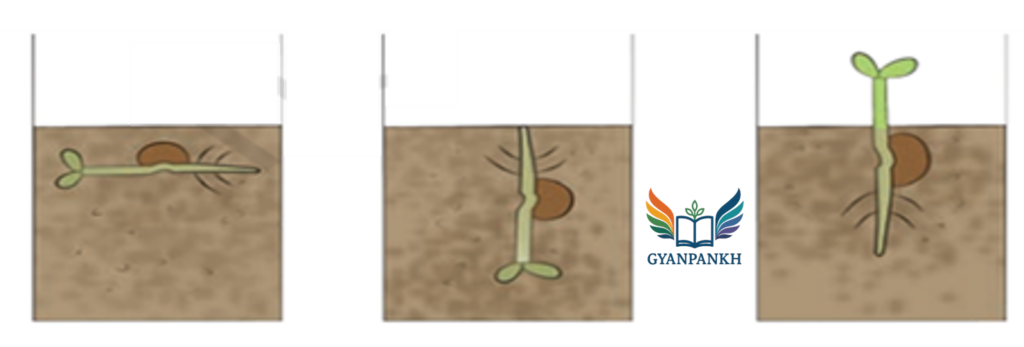
- What is the purpose of the experimental setup?
- Why is sunlight exposure critical for the plant in the Figure ?
- Why is the plant in the Figure expected to show specific growth patterns?
- How does the presence of water in the Figure affect the plant?
OR
Write 2 similarities and 3 distinguishing features between the life cycles of a mosquito and a frog?
Science Class 6 SECOND TERM END EXAMINATION 2025-26
Answer Key
Section A
- Glass
- Air is transparent and wooden door is opaque
- Mercury
- 2
- Solid
- It boils and turns into steam
- A is true, R is false
- They do not grow or reproduce
- Water
- sun
Science Class 6 SECOND TERM END EXAMINATION 2025-26
Section B
- (a) Metal (b) Gas (c) Salt (solid) (d) Air
- A cold glass gets water droplets on its outside from condensation.
When water vapor in the air meets the cold glass surface, it cools and turns into small droplets.
- The resource being used inefficiently is water.
One way to save it: Turn off the tap while brushing and use a mug of water instead.
- Four activities for which we need sun’s heat:
- drying of clothes
- cooking food
- Mopping
- Photosynthesis
Science Class 6 SECOND TERM END EXAMINATION 2025-26
Section C
a)
(i) The Sun
(ii) Sirius
(b) A constellation is a group of stars that forms a recognizable pattern in the night sky.
- Three precautions while using a clinical thermometer:
- Wash the thermometer before and after use.
- Ensure the mercury level is below 35°C before taking the reading.
- Read the thermometer at eye level without touching the mercury bulb.
a) Sand particles are heavier and insoluble in water, so they settle down due to gravity.
b) Decantation.
c) In sand and water mixture, sand settles at the bottom (sedimentation), and the clear water is poured off (decantation).
Living things grow; non-living things do not.
Living things reproduce; non-living things cannot.
Living organisms react to stimuli, whereas non-living things do not.
Solar energy is a type of renewable resource.
Two advantages:
It does not cause pollution.
It is available in unlimited supply from the Sun.
OR
Two ways human activities pollute the air:
Burning of fuels in vehicles releases smoke and harmful gases into the air.
Smoke from factories and burning of garbage pollute the air.
One action to reduce air pollution:
Use public transport, cycle, or walk instead of using private vehicles.
Science Class 6 SECOND TERM END EXAMINATION 2025-26
SECTION D
(i) Yes, Riya has a fever because her temperature (39°C) is higher than normal.
(ii) A healthy person’s body temperature is typically 37°C.
(iii) A clinical thermometer is used.
(iv) It is suitable because it is specially designed to measure human body temperature accurately.
(i) Activities involving evaporation: drying of clothes, cooling of water in an earthen pot, drying of wet floor.
Usefulness: Understanding evaporation helps us dry clothes faster and keeps us cool through sweating.
(ii) Heat turns water into vapour, which then rises into the air.
(iii) Water droplets forming on the outside of a cold bottle kept in the refrigerator is another example of condensation.
(i) The seven-star formation is referred to as the Big Dipper or Saptarishi.
(ii) The star that remains fixed in the northern sky is the Pole Star (Polaris).
(iii) The Big Dipper is part of the Ursa Major constellation.
(iv) The Pole Star helps travellers by showing the north direction, which helps them find their way.
Science Class 6 SECOND TERM END EXAMINATION 2025-26
SECTION E
a) (i) Metals lose their shine due to the effect of air and moisture on them.
(ii) Paper catches fire on heating.
(iii) Clothes cannot hold water because of pores present in it.
(iv) Glass of window is transparent and light can pass through it completely.
b) Oxygen and carbon dioxide.
(i) The separation method shown is winnowing.
(ii) Wheat grains are heavier and fall down, while husk is lighter and is carried away by the wind.
(iii) The farmer stands on a raised platform so that the grains and husk get more exposure to wind for better separation.
(iv) The wind blows away the lighter husk, while the heavier grains fall straight down.
(v) Winnowing fails in a closed room because there is no wind to carry away the husk.
(i) The purpose of the experimental setup is to show the conditions needed for plant growth.
(ii) Sunlight is critical because plants use it to prepare their food through photosynthesis.
(iii) The plant is expected to show specific growth patterns because it grows towards light and needs proper conditions to grow well.
(iv) The presence of water helps the plant absorb nutrients and stay healthy, which supports its growth.
OR
Similarities (any two):
Both start their life cycle from eggs.
Both have an aquatic larval stage in their development.
Distinguishing features (any three):
A mosquito undergoes complete metamorphosis (egg–larva–pupa–adult), while a frog has egg–tadpole–adult stages without a pupa.
Adult mosquitoes are insects that fly, while adult frogs are amphibians that hop and swim.
The mosquito larva is very different from the adult, whereas the tadpole gradually changes into a frog during growth.
Click here for any Help, Click here for any Suggestions.