
Table of Contents
Attitudes toward renewable energy
1. Cover Page, Certificate, and Acknowledgement
the CBSE Class 12 Biology project (Attitudes toward renewable energy and sustainable living) assets — Cover Page, Certificate, and Acknowledgement — in print‑ready format for your investigatory file. (Click to download)
2. Objective
This investigatory project aims:
- To assess the attitudes and level of awareness among Class XI and XII students regarding renewable energy sources and sustainable living practices.
- To investigate the correlation between a student’s socio-academic background (stream of study, parental education, urban/rural residence) and their environmental consciousness.
- To analyze the primary sources of environmental information for adolescents.
- To understand the perceived barriers preventing the adoption of sustainable practices in daily life.
Attitudes toward renewable energy
3. Introduction
The escalating crisis of environmental degradation, driven by anthropogenic activities such as the combustion of fossil fuels, deforestation, and unsustainable consumption, poses an existential threat to global ecosystems. As outlined in the NCERT Biology textbook (Chapter 16, Environmental Issues), the shift towards renewable energy (solar, wind, hydro, biomass) and sustainable living is no longer a choice but an imperative for maintaining ecological balance and ensuring human survival.
Renewable energy, derived from replenishable natural sources, offers a clean alternative to fossil fuels, mitigating air pollution and greenhouse gas emissions. Sustainable living encompasses a lifestyle that minimizes an individual’s or society’s use of Earth’s natural resources. It involves conscious decisions regarding energy consumption, waste management, transportation, and dietary habits.
Adolescents, as the future decision-makers and stakeholders, play a pivotal role in this transition. Their attitudes, awareness, and willingness to adopt sustainable practices will significantly influence future policies and societal norms. Educational background, particularly the science stream which includes ecology and environmental biology, along with familial and societal influences, can shape these attitudes.
This project, rooted in the principles of environmental biology and human ecology, seeks to bridge the gap between textbook knowledge and real-world application by empirically studying the awareness levels and attitudes of the youth. It aligns with the NCERT’s emphasis on applying biological principles to contemporary issues, fostering scientific temper, and encouraging proactive environmental stewardship.
4. Theory
4.1. Renewable Energy: A Biological Imperative
The burning of fossil fuels releases pollutants like sulphur dioxide, nitrogen oxides, and particulate matter, leading to acid rain, smog, and respiratory ailments (NCERT Class XII, Biology). More critically, carbon dioxide is a major greenhouse gas causing global warming and climate change, disrupting biodiversity, causing sea-level rise, and altering weather patterns. Renewable energy sources are low-carbon. For instance, photosynthesis (a core biological process) is the basis of biomass energy. Understanding these interconnections is fundamental to biology.
4.2. Sustainable Living and Ecology
Sustainable living practices are direct applications of ecological concepts:
- Resource Management: Mirrors the concept of carrying capacity and sustainable development.
- Waste Reduction and Recycling: Relates to the biogeochemical cycles (Carbon, Nitrogen) taught in ecology. Reducing waste minimizes the disruption of these natural cycles.
- Conservation of Resources: Directly linked to the conservation of biodiversity and natural resources discussed in Chapters 15 (Biodiversity and Conservation) and 16.
4.3. Attitude Formation: A Bio-Social Perspective
Attitude formation is influenced by a combination of factors:
- Knowledge and Education: Formal education, especially in biology, provides scientific grounding.
- Socio-Cultural Factors: Family values, community practices, and media exposure shape perceptions.
- Perceived Behavioral Control: The individual’s belief in their ability to perform a behavior (e.g., installing a solar panel, composting).
This project hypothesizes that students from the Science stream and those with higher parental education will demonstrate more positive attitudes and higher awareness due to greater exposure to scientific concepts and informed domestic discourse.
5. Materials and Methodology
5.1. Type of Study: Descriptive and Analytical Cross-sectional Study.
5.2. Materials:
- Self-Administered Questionnaire: A structured, anonymized questionnaire with four sections:
- Section A: Demographic and Socio-academic data (Stream, Parental Education, Residence).
- Section B: Awareness Assessment (10 MCQ-based questions on renewable energy types, benefits, and sustainable practices).
- Section C: Attitude Assessment (15 statements using a 5-point Likert Scale from Strongly Agree to Strongly Disagree). Topics included willingness to pay extra for green energy, support for policies, and personal adoption of habits.
- Section D: Open-ended questions on sources of information and perceived barriers.
- Stationery: Pens, papers, folders for data compilation.
- Digital Tools: Google Forms (for wider online dissemination), MS Excel and Google Sheets for data tabulation and preliminary analysis.
5.3. Methodology:
- Questionnaire Design: The questionnaire was designed based on a review of key concepts from NCERT and simplified research papers. It was pilot-tested on 10 students for clarity and revised.
- Sample Selection: A sample of 150 students from Classes XI and XII was targeted using a stratified random sampling method. Strata were created based on Science and Non-Science (Commerce/Humanities) streams. Schools in both urban and semi-urban locales were approached.
- Data Collection: The questionnaire was distributed in physical form during school breaks and also circulated as a Google Form link through school networks over two weeks, ensuring voluntary participation.
- Data Analysis:
- Awareness Score: 1 point for each correct answer in Section B (Total=10).
- Attitude Score: Positive statements scored 5 to 1 (Strongly Agree to Strongly Disagree); negative statements were reverse-scored. Total score calculated for each respondent.
- Quantitative data (scores vs. demographic factors) were analyzed using comparative tables and bar graphs. Mean scores were calculated for different groups.
- Qualitative data from open-ended questions were categorized into major themes.
Ethical Considerations: Participation was voluntary and anonymous. Completing the questionnaire implied informed consent.
6. Observations and Data Collection
Data was successfully collected from 142 students (Response rate ~95%). The demographic distribution was as follows:
- Stream: Science (n=78), Commerce (n=42), Humanities (n=22).
- Parental Education (Highest Degree): Postgraduate+ (n=51), Graduate (n=62), ≤School level (n=29)
- Residence: Urban (n=98), Semi-Urban/Rural (n=44).
Sample Observations from Raw Data:
- High awareness (>7/10) was commonly seen among science students.
- Many Commerce/Humanities students showed keen interest but had factual inaccuracies (e.g., confusing nuclear energy with renewable energy).
- Common sources of information cited: School textbooks (Biology), Internet/social media, Documentaries, Family.
- Frequently mentioned barriers: “High cost of sustainable products,” “Lack of infrastructure (e.g., segregated waste bins),” “Inconvenience,” and “Lack of complete knowledge.”
7. Results and Analysis
7.1. Awareness Levels:
Table 1: Mean Awareness Score Across Different Streams
| Stream | No. of Students (n) | Mean Awareness Score (/10) |
| Science | 78 | 8.2 |
| Commerce | 42 | 6.1 |
| Humanities | 22 | 5.9 |
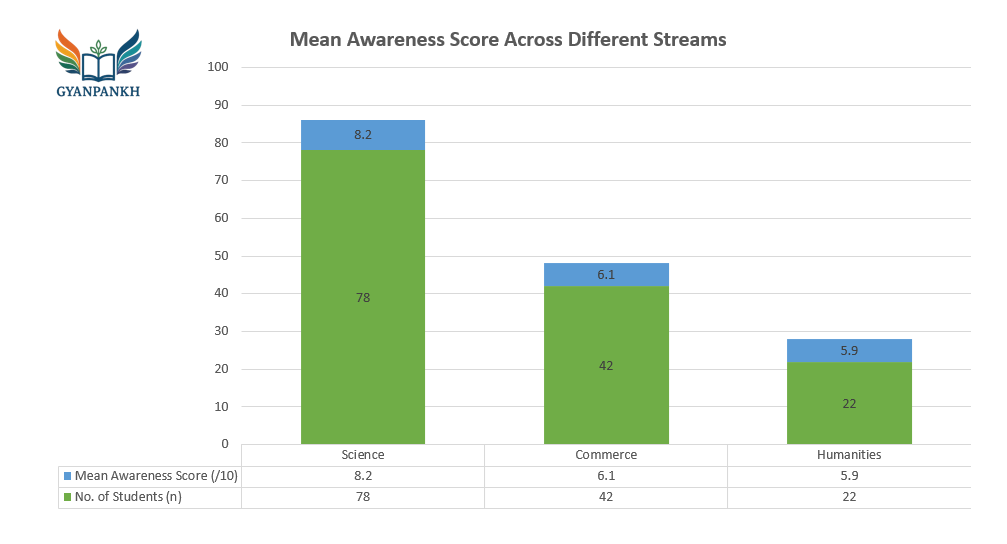
Analysis: Science students exhibited significantly higher awareness, likely due to the direct inclusion of environmental science in their biology and chemistry curriculum.
Table 2: Mean Awareness Score Based on Parental Education
| Parental Education Level | Mean Awareness Score (/10) |
| Postgraduate & above | 7.8 |
| Graduate | 7.1 |
| School Level or Below | 6.0 |
Analysis: A positive correlation is observed between parental education level and student awareness, suggesting the role of an educated home environment in fostering environmental knowledge.
7.2. Attitude Scores:
Table 3: Mean Attitude Score (Range 15-75) Across Groups
| Grouping Variable | Category | Mean Attitude Score |
| Stream | Science | 62.4 |
| Non-Science | 58.1 | |
| Residence | Urban | 61.0 |
| Semi-Urban/Rural | 59.5 |
Analysis: While Science students showed more positive attitudes, the difference with Non-Science peers was less stark than in awareness. This indicates a generally positive disposition towards sustainability across streams. Urban students showed a marginally more positive attitude, possibly due to greater exposure to campaigns and alternatives.
7.3. Qualitative Analysis:
- Primary Source of Information: 65% of students cited “School Textbooks (Especially Biology)” as their most trusted source, followed by “Digital Media” (25%).
- Key Perceived Barriers: (In order of frequency)
- Economic Constraints (60%)
- Lack of Access/Facilities (45%)
- Insufficient Practical Knowledge (35%)
- Social Pressure/Indifference (20%)
8. Discussion
The results validate the primary hypothesis that academic background, specifically enrolment in the Science stream, is strongly correlated with higher awareness of renewable energy and sustainable concepts. This underscores the critical role of formal science education, as per the NCERT syllabus, in building a foundational understanding of ecological principles.
However, the attitude scores, while positively correlated with awareness, showed a smaller gap between Science and Non-Science students. This suggests that a pro-environmental attitude is influenced by a broader spectrum of factors beyond the classroom, including media, family values, and peer influence, as theorized. The significant mention of school textbooks as a trusted source highlights the project’s relevance to the academic context.
The correlation between parental education and awareness levels points to the “educational environment at home” as a significant multiplier. Educated parents might engage in more informed discussions or model sustainable behaviors.
The identified barriers offer crucial insights. The predominance of “Economic Constraints” and “Lack of Access” indicates that while awareness and intent may be present, the translation into action is hindered by systemic and infrastructural challenges. This aligns with the “Perceived Behavioral Control” component of behavioral theories.
Limitations of the Study:
- The sample size, though adequate, was confined to a few schools, limiting generalizability.
- Self-reported data can be subject to bias (social desirability bias).
- The study captures a snapshot in time; attitudes can evolve.
Implications:
- Curriculum Integration: Environmental education should be further integrated across all streams, not just sciences, focusing on practical applications.
- Beyond Awareness: Educational initiatives must move beyond knowledge dissemination to address perceived barriers by showcasing affordable, feasible sustainable practices.
- School-Community Link: Schools can act as hubs for demonstrating sustainable technologies (e.g., solar panels, composting pits), providing students with tangible examples.
9. Conclusion
This investigatory project successfully demonstrates a measurable link between academic study (particularly Biology in the Science stream) and awareness of renewable energy and sustainable living among Class XII students. While awareness is higher in science-educated groups, a generally positive attitude towards sustainability cuts across academic streams, indicating a receptive youth populace. The major hurdles to action are perceived as economic and infrastructural, not necessarily a lack of will.
Therefore, the path forward, in line with biological principles of adaptation and survival, requires a dual approach: strengthening foundational environmental education as per NCERT guidelines and concurrently creating enabling environments that empower students to convert their positive attitudes into sustainable daily practices. The youth are not just future leaders but present-day change agents, provided they are equipped with both knowledge and accessible means.
10. Bibliography
- National Council of Educational Research and Training (NCERT). (2023). Biology, Textbook for Class XII. New Delhi: NCERT. (Chapters 13 – Organisms and Populations, 14 – Ecosystem, 15 – Biodiversity and Conservation, 16 – Environmental Issues).
- Ministry of New and Renewable Energy (MNRE), Government of India. (2023). *Annual Report 2022-23*. [Online Resource for latest schemes and data].
- CBSE. (2023). Project Work Guidelines in Biology for Class XII. Central Board of Secondary Education. (For methodological framework).
- Online Resources (for conceptual understanding only):
- Gyan Pankh. https://gyanpankh.com/
- Wikipedia. https://www.wikipedia.org/
11. Appendix
Section A: Demographic & Socio-Academic Information
(Please tick [✓] the appropriate option)
- Your Current Class:
- XI
- XII
- Your Stream of Study:
- Science (PCB/PCM)
- Commerce
- Humanities/Arts
- Highest Educational Qualification of Your Father/Mother/Guardian:(Please consider the higher of the two)
- Postgraduate Degree or Above (M.Sc., MA, M.Tech, PhD, etc.)
- Graduate Degree (B.Sc., BA, B.Com, B.Tech, etc.)
- School Level (Up to Class XII) or Below
- Type of Locality You Reside In:
- Urban (City/Town with municipal corporation)
- Semi-Urban/Rural
Section B: Awareness Assessment
(Please select ONE correct answer for each question)
- Select the non-renewable energy source?
- Solar Energy
- Wind Energy
- Natural Gas
- Biomass Energy
- The primary environmental advantage of using renewable energy is:
- Lower initial cost
- Reduction in greenhouse gas emissions
- They are available everywhere at all times
- They require less maintenance
- Which of these is a direct application of the biological process of ‘anaerobic digestion’?
- Solar Panel
- Biogas Plant
- Wind Turbine
- Hydroelectric Dam
- According to ecological principles, sustainable living primarily aims to:
- Increase economic growth at any cost
- Minimize use of Earth’s finite resources for present and future generations
- Use technology to dominate natural processes
- Promote urbanization
- Which sustainable practice directly helps in ‘nutrient cycling’ as taught in ecology?
- Using incandescent bulbs
- Composting kitchen waste
- Driving a personal car for short distances
- Using plastic bags
- The ‘Chipko Movement’ in India is historically associated with:
- Water conservation
- Forest conservation
- Air pollution protest
- Wildlife protection
- Which item is typically NOT suitable for home composting?
- Fruit and vegetable peels
- Eggshells
- Plastic wrappers
- Dry leaves
- E-Waste is a growing environmental concern because it contains:
- Only biodegradable material
- Harmful heavy metals like lead and mercury
- Useful nutrients for plants
- Only recyclable plastic
- A ‘carbon footprint’ is a measure of:
- The size of your house
- Total greenhouse gases emitted due to your activities
- The amount of oxygen you consume
- Your physical fitness level
- The concept of ‘Reduce, Reuse, Recycle’ is primarily aimed at:
- Increasing industrial production
- Managing solid waste effectively
- Promoting tourism
- Generating more energy
Section C: Attitude Assessment
(Indicate how much you agree or disagree. Circle one number.)
Scale: 1 (Strongly Disagree) to 5 (Strongly Agree)
| No. | Statement | 5 | 4 | 3 | 2 | 1 |
| 11 | I believe switching to renewable energy (solar, wind) is crucial for India’s future. | |||||
| 12 | I am willing to pay a slightly higher electricity bill if it comes from a renewable source. | |||||
| 13 | I make a conscious effort to turn off lights and fans when leaving a room. | |||||
| 14 | I believe my individual actions (e.g., saving water, recycling) can make a difference to the environment. | |||||
| 15 | I prefer to use public transport, cycle, or walk for short distances when possible. | |||||
| 16 | I actively avoid using single-use plastic (bags, bottles, straws). | |||||
| 17 | I feel schools should have mandatory practical projects on sustainability. | |||||
| 18 | The government should provide substantial subsidies for rooftop solar panels. | |||||
| 19 | I am interested in learning more about how to start composting at home. | |||||
| 20 | Environmental protection is important, but it can slow down economic development. (R) | |||||
| 21 | I feel confused about what can and cannot be recycled. | |||||
| 22 | I would participate in a tree-plantation or clean-up drive in my locality. | |||||
| 23 | Sustainable products (e.g., cloth bags, bamboo toothbrushes) are too expensive for me. (R) | |||||
| 24 | I discuss environmental issues with my family or friends. | |||||
| 25 | I am optimistic that humans can solve the current environmental crisis through technology and behaviour change. |
Note: (R) indicates a negatively worded statement. Scoring is reversed during analysis (5 becomes 1, 4 becomes 2, etc.).
Section D: Qualitative Insights
- What is your PRIMARY source of information about environmental issues and sustainable living? (e.g., School textbooks, social media, News, Family, Documentaries, Other – please specify)
- In your opinion, what is the BIGGEST BARRIER preventing you/people your age from adopting more sustainable practices in daily life? (e.g., Cost, Lack of knowledge, Inconvenience, Lack of facilities, Belief that it won’t matter, Other – please specify)
Thank you for your time and valuable input!
Click here for any Help, Click here for any Suggestions.